
Free Safe Operating Procedure (Port Waste Handling) Template
Formalise your port waste management processes with our structured Safe Operating Procedure. Download your free Port Waste Handling SOP template today.
Free Safe Operating Procedure (Port Waste Handling) Template
DOCX • 126 KB + PDF
Updated Oct 2026
No signup required
Purpose of the Free Safe Operating Procedure (Port Waste Handling) Template
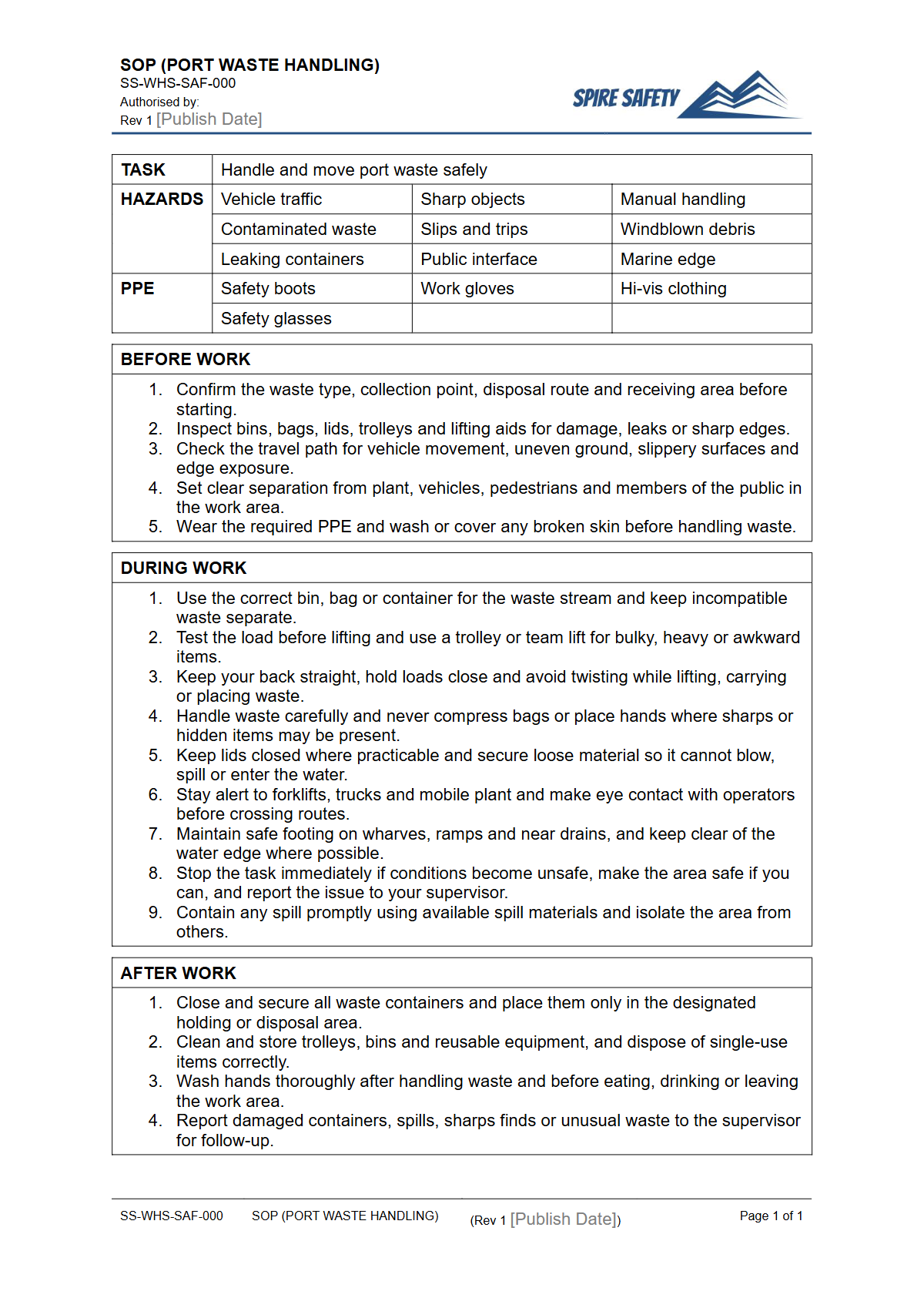
Managing waste in a port environment involves unique risks, from hazardous materials and biosecurity threats to heavy vehicle interaction. This Free Safe Operating Procedure (Port Waste Handling) Template provides a structured framework to help your organisation document the required steps for safely collecting, segregating, storing, and disposing of various waste streams.
A documented SOP is a critical tool for providing clear instructions to workers, standardising safe work practices, and demonstrating due diligence in managing workplace health and safety risks.
This SOP is designed to address the common hazards associated with port-based waste management, including manual handling, exposure to biological or chemical substances, and the operation of associated machinery. It serves as a foundation for your risk management process, helping you implement effective control measures.
For tasks involving specific machinery, it's essential to have dedicated procedures, such as our FREE Conveyer System SOP, which can be integrated into your overall waste handling plan.
Video walkthrough
How to use the Free Safe Operating Procedure (Port Waste Handling) Template
To use this template, simply download the DOCX or PDF file and integrate it into your safety management system. The document is structured logically, covering prerequisites, personal protective equipment (PPE), step-by-step procedures, and emergency responses.
You should methodically work through each section, adding or removing information to align with your specific operational context.
Important: This template is a starting point. We strongly recommend you customise this document to reflect the specific equipment, waste types (e.g., quarantine, recyclables, general, hazardous), site layout, and control measures unique to your port or terminal.
An effective SOP should be a practical and living document within your broader WHS management systems, not a generic placeholder.
Ensure that the final procedure accurately reflects the tasks performed on your site. This may include referencing procedures for specific plant used in the process, such as moving bulk waste containers with a telehandler.
You can adapt our FREE Telehandler SOP Template for this purpose. Once customised, the SOP should be used to train all relevant personnel, and a record of this training should be maintained.
When to use it
A Safe Operating Procedure for port waste handling should be developed and implemented before any workers undertake the task. It forms a key part of worker induction and ongoing competency training.
The SOP should be readily available at the point of work for reference and supervision.
It is also crucial to review and update the SOP:
- Following any incident, near miss, or identified hazard associated with waste handling.
- When new equipment, substances, or waste streams are introduced.
- If legislation, codes of practice, or industry standards change.
- As part of a scheduled review process, typically annually, or as determined by your WHS compliance auditing schedule.
Who should use it
This SOP is intended for use by any Person Conducting a Business or Undertaking (PCBU) involved in maritime, port, or terminal operations. It should be used by:
- WHS Managers and Advisors: To develop and implement formalised safety procedures as part of the overall safety system.
- Port and Terminal Operators: To ensure consistent and safe management of waste generated on their sites.
- Supervisors and Team Leaders: To train, instruct, and supervise workers performing waste handling duties.
- Workers and Contractors: As a clear guide to performing their tasks safely and in accordance with company and regulatory requirements.
By ensuring all personnel understand and follow the established procedures, you help foster a strong safety culture and minimise the risk of injury or environmental harm. For more templates and safety resources, browse our complete free WHS resources library.
Common mistakes
Common mistakes to avoid
- Incorrect segregation of waste streams, leading to cross-contamination and improper disposal.
- Using poor manual handling techniques when lifting or moving bins, causing musculoskeletal injuries.
- Failing to wear appropriate Personal Protective Equipment (PPE) for the specific waste being handled.
- Inadequate documentation of waste transfers, particularly for regulated, hazardous, or quarantine waste.
Legal references
Legal considerations
The following legal requirements may be relevant to this type of work.
- Work Health and Safety Act (Harmonised) — Provides the primary duties for protecting workers and other people from work health and safety risks.
- Work Health and Safety Regulations (Harmonised) — Sets out requirements supporting the management of workplace hazards and risks.
The following codes may be relevant to this type of work.
- Managing WHS Risks Code of Practice — Provides practical guidance on identifying hazards, assessing risks and applying effective controls.
- Work Health and Safety Consultation, Cooperation and Coordination Code of Practice — Provides practical guidance on consulting workers and coordinating with other duty holders.
- Managing the Work Environment and Facilities Code of Practice — Provides practical guidance on safe work environments, workplace facilities and related controls.
Did you know
MARPOL Regulations
The International Convention for the Prevention of Pollution from Ships (MARPOL) Annex V specifically regulates the disposal of garbage from ships, making proper port waste reception facilities a critical part of global maritime environmental protection.
Biosecurity Risk
Waste from international vessels can carry foreign pests and diseases that pose a significant threat to Australia's agriculture and unique environment. This is why 'quarantine waste' is subject to strict handling and disposal protocols.
FAQ
Frequently asked questions
01What are the key hazards in port waste handling?
02Who is responsible for implementing a Port Waste Handling SOP?
03How often should a Port Waste Handling SOP be reviewed?
04Does this SOP cover biosecurity and quarantine waste?
Share this resource
Free Safe Operating Procedure (Port Waste Handling) Template
Browse Categories
How To Use It
- 1Download and open in Word or PDF.
- 2Replace the placeholders with your business details.
- 3Get it reviewed by a WHS specialist before rollout.
Need it customised?
Our WHS consultants can adapt this template to your site, run a gap analysis, or audit what you already have in place.
Book a Free Consultation WHS consulting servicesor call 1300 156 382
Related templates
- Free Safe Operating Procedure (Portable Appliance Test) Template
- Free Safe Operating Procedure (Portable Bandsaw) Template
- Free Safe Operating Procedure (Portable Heater) Template
- Free Safe Operating Procedure (Portable Hoist Check) Template
- Free Safe Operating Procedure (Portable Ramp Setup) Template
- Free Safe Operating Procedure (Portable Sawmill) Template