
Free Safe Operating Procedure (Portable Sawmill) Template
Effectively manage risks associated with portable sawmills with our structured template. Download this free Safe Operating Procedure to get started.
Free Safe Operating Procedure (Portable Sawmill) Template
DOCX • 126 KB + PDF
Updated Oct 2026
No signup required
Purpose of the Free Safe Operating Procedure (Portable Sawmill) Template
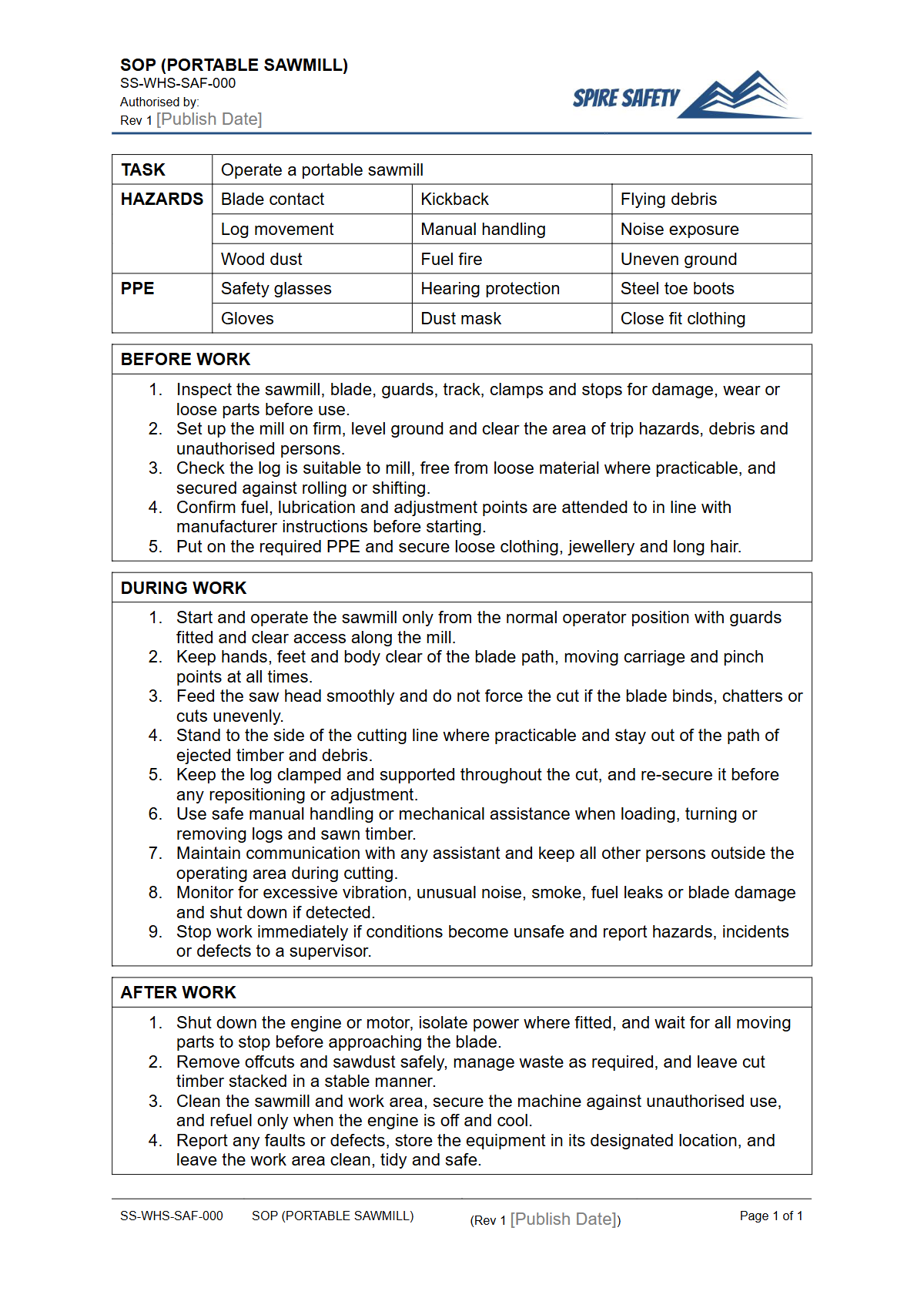
Operating a portable sawmill involves significant risks, including cuts, amputations, kickback, and noise exposure. This Free Safe Operating Procedure (Portable Sawmill) Template provides a structured framework for documenting the safest way to perform this task.
An SOP is a fundamental component of all effective WHS management systems, acting as a practical tool to control identified hazards. It formalises a step-by-step process that helps organisations meet their duty of care to provide a safe working environment.
The template guides you through outlining essential health and safety information, from required personal protective equipment (PPE) and pre-operational checks to the specific steps for safe operation and shutdown. By systematically addressing these elements, you create a clear, actionable guide for workers, minimising guesswork and promoting consistent, safe work practices.
Video walkthrough
How to use the Free Safe Operating Procedure (Portable Sawmill) Template
This document is provided in both DOCX and PDF formats for your convenience. The DOCX file is fully editable, allowing for comprehensive customisation. To effectively implement this Safe Operating Procedure, follow these steps:
- Download the template and review it against your specific portable sawmill model and typical operating conditions.
- Consult with the workers who will be using the equipment. Their firsthand experience is invaluable for identifying practical risks and effective control measures.
- Adapt and add details specific to your workplace, including emergency contacts, site-specific hazards, and required authorisations.
- Have the finalised SOP reviewed and approved by a supervisor or manager.
- Train all operators on the content of the SOP, ensuring they understand every step and the reasons behind it. Keep records of this training.
Please note: This document is a template and not a complete Safe Operating Procedure. We have created it as a starting point, but it must be customised to reflect the unique requirements of your workplace, machinery, and operational tasks.
A similar approach is needed when using our FREE Circular Saw SOP Template or any other equipment-specific guide.
What's covered in the template?
Our portable sawmill SOP template is structured to align with the model WHS framework. It includes sections for:
- Identifying the plant and its specific operational risks.
- Listing required Personal Protective Equipment (PPE) such as safety glasses, hearing protection, steel-capped boots, and high-visibility clothing.
- Detailing pre-operational safety checks, covering blade condition, guards, emergency stops, and the work area.
- Providing a step-by-step sequence for safe operation, from setting up the log to making the final cut.
- Outlining post-operational procedures, including cleaning, maintenance, and storage.
- Documenting emergency procedures in case of malfunction, injury, or fire.
This comprehensive structure ensures all key aspects of the task are considered. For associated equipment, you may also need separate procedures, such as our Free Air Compressor SOP (Safe Operating Procedure) Template if pneumatic tools are used for cleaning or maintenance.
When to use it
A Safe Operating Procedure is not a document to be filed away and forgotten. It should be a living document integrated into daily work routines.
Use this SOP when inducting and training new operators to ensure they learn the correct, safe method from the start. It should also be used as a reference for pre-start meetings or toolbox talks, reinforcing key safety messages before work begins.
Furthermore, the SOP is an essential tool for supervisors conducting work observations and for teams investigating an incident or near miss. Regularly reviewing the SOP against actual work practices helps identify any gaps or procedural drift.
If your organisation needs assistance with implementing or reviewing your safety documents, our specialist WHS consulting services can provide expert guidance.
Who should use it
This Safe Operating Procedure is intended for anyone involved with the use of portable sawmills. This includes:
- Operators: To understand and follow the safe steps for completing their tasks.
- Supervisors and Managers: To train staff, monitor compliance, and enforce safe work practices.
- WHS Personnel: To use as part of the risk management process and for developing training programs.
- Persons Conducting a Business or Undertaking (PCBUs): To help fulfil their primary duty of care to ensure the health and safety of workers.
Properly documented procedures are a key piece of evidence that a PCBU has taken reasonably practicable steps to manage risks. For tasks often performed in conjunction with sawmilling, such as moving logs and materials, other specific procedures like the FREE Telehandler SOP Template will also be required. The existence and quality of such documents are often scrutinised during WHS compliance audits.
Common mistakes
Common mistakes to avoid
- Using a generic template without site-specific customisation.
- Failing to train operators on the finalised SOP content and verifying their understanding.
- Neglecting to include procedures for blade changes, fuelling, and routine maintenance.
- Not reviewing the SOP after an incident, near miss, or change in equipment or process.
Legal references
Legal considerations
The following legal requirements may be relevant to this type of work.
- Work Health and Safety Act (Harmonised) — Provides the primary duties for protecting workers and other people from work health and safety risks.
- Work Health and Safety Regulations (Harmonised) — Sets out requirements supporting the management of workplace hazards and risks.
The following codes may be relevant to this type of work.
- Managing WHS Risks Code of Practice — Provides practical guidance on identifying hazards, assessing risks and applying effective controls.
- Work Health and Safety Consultation, Cooperation and Coordination Code of Practice — Provides practical guidance on consulting workers and coordinating with other duty holders.
- Managing the Work Environment and Facilities Code of Practice — Provides practical guidance on safe work environments, workplace facilities and related controls.
Did you know
Kickback Risk
Kickback is one of the most serious hazards of any saw. It occurs when the blade binds in the cut, violently thrusting the workpiece or the saw itself back towards the operator.
Hearing Protection
Portable sawmills can generate noise levels well above 85 dB(A), the exposure standard over an 8-hour period. Consistent use of appropriate hearing protection is essential to prevent permanent hearing loss.
FAQ
Frequently asked questions
01What should be included in a Safe Operating Procedure for a portable sawmill?
02Who is responsible for writing and implementing a portable sawmill SOP?
03How often should a portable sawmill SOP be reviewed?
04Is an SOP enough to manage all risks for portable sawmills?
Share this resource
Free Safe Operating Procedure (Portable Sawmill) Template
Browse Categories
How To Use It
- 1Download and open in Word or PDF.
- 2Replace the placeholders with your business details.
- 3Get it reviewed by a WHS specialist before rollout.
Need it customised?
Our WHS consultants can adapt this template to your site, run a gap analysis, or audit what you already have in place.
Book a Free Consultation WHS consulting servicesor call 1300 156 382
Related templates
- Free Safe Operating Procedure (Portal Crane) Template
- Free Safe Operating Procedure (Post Driver) Template
- Free Safe Operating Procedure (Post Hole Digger) Template
- Free Safe Operating Procedure (Potable Water Cart) Template
- Free Safe Operating Procedure (Potato Peeler) Template
- Free Safe Operating Procedure (Potting Bench Cleaning) Template