
Free Safe Operating Procedure (Post Hole Digger) Template
Download our free Safe Operating Procedure template for post hole diggers. This customisable document helps you outline key safety controls. Get your copy now.
Free Safe Operating Procedure (Post Hole Digger) Template
DOCX • 126 KB + PDF
Updated Oct 2026
No signup required
Purpose of the Free Safe Operating Procedure (Post Hole Digger) Template
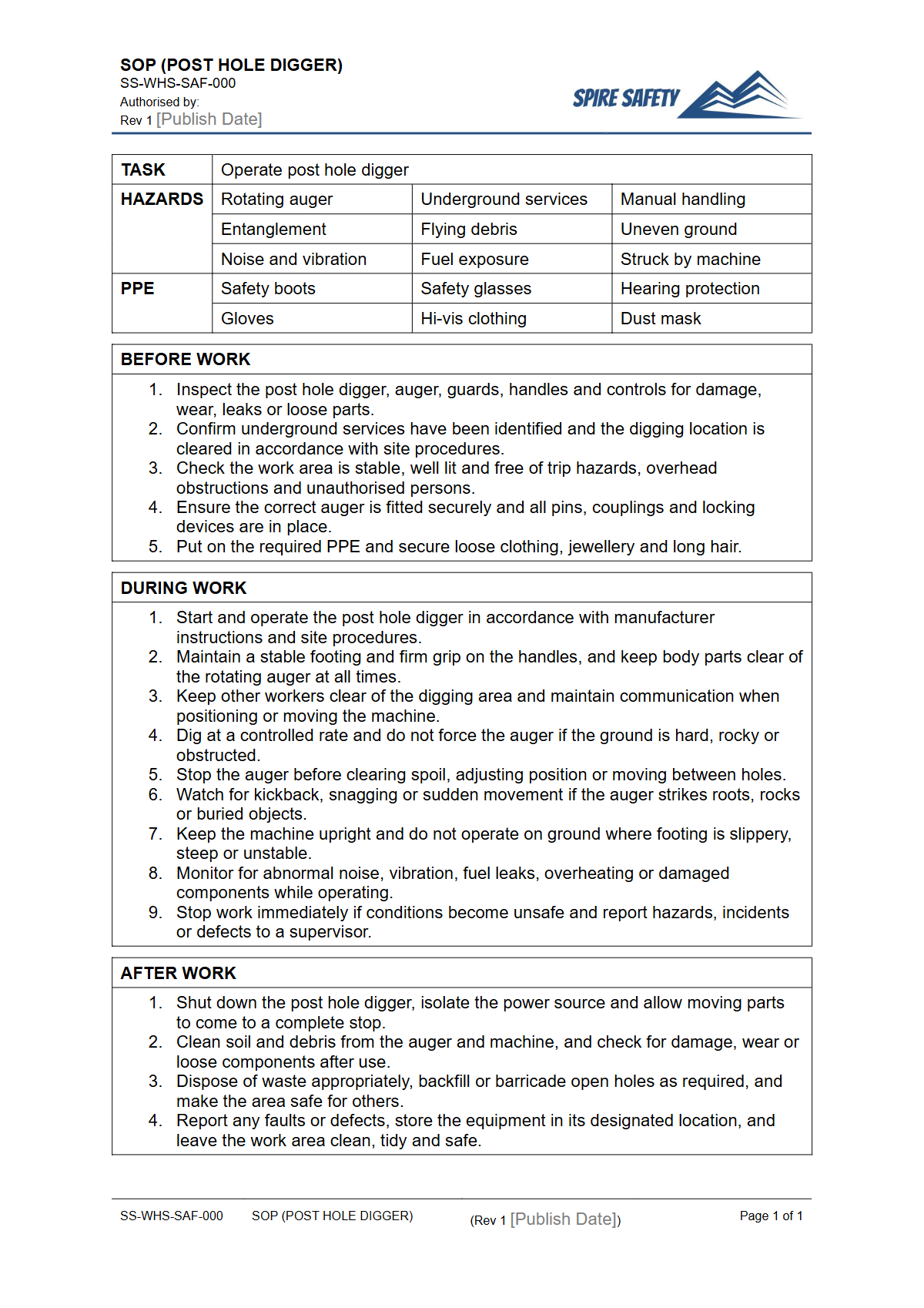
A post hole digger, whether a one-person or two-person model, introduces significant workplace hazards if not operated correctly. This free Safe Operating Procedure (Post Hole Digger) template provides a structured framework for documenting the safest way to perform this task.
Its primary purpose is to standardise procedures, minimise risk, and provide a clear training tool for workers. By formally outlining steps for pre-operational checks, operation, and shutdown, an SOP helps prevent common incidents such as striking underground utilities, auger entanglement, and musculoskeletal injuries from improper manual handling.
Implementing robust SOPs is a fundamental component of proactive safety management. They serve as practical, on-the-ground instructions that support your broader safety objectives.
Integrating specific procedures like this one is a key step in building comprehensive WHS management systems that protect your workers and your business.
Key Hazards Addressed
Using a post hole digger can expose operators and others to numerous hazards. This SOP template prompts you to consider and control risks including:
- Striking underground services: Contact with electrical cables, gas lines, water pipes, or communication cables.
- Entanglement: The rotating auger catching loose clothing, hair, or jewellery.
- Manual handling: Strains and sprains from lifting the equipment or managing reactive forces (kickback).
- Noise and vibration: Prolonged exposure leading to hearing loss or hand-arm vibration syndrome (HAVS).
- Unstable ground: Slips, trips, and falls while operating on uneven, wet, or sloped surfaces.
- Flying debris: Rocks, soil, or other objects being ejected by the auger.
- Fuel handling: Risks of fire, explosion, or chemical exposure when refuelling petrol-powered models.
Video walkthrough
How to use the Free Safe Operating Procedure (Post Hole Digger) Template
This document is a starting point, not a finished product. To make it effective, you must customise it to reflect the specific circumstances of your workplace.
Download the DOCX file and adapt it with details relevant to your post hole digger's make and model, the site conditions where it will be used, and your organisation’s specific safety protocols. For tasks involving similar excavation equipment, you might also find our free Trencher SOP template useful as a reference.
Important: We have provided this template as a guide. It is the responsibility of the PCBU (Person Conducting a Business or Undertaking) to ensure the final document is tailored to the workplace and is reviewed by a competent person before implementation.
Customisation Checklist
When adapting the template, ensure you include or verify the following information:
- Equipment specifics: Manufacturer, make, and model of the post hole digger.
- Personal Protective Equipment (PPE): Specify mandatory PPE such as steel-capped boots, safety glasses, gloves, and hearing protection.
- Pre-start checks: Detail the exact inspection points for your model (e.g., fuel/oil levels, condition of the auger, throttle controls, emergency clutch/stop function).
- Site-specific hazards: Add controls for risks unique to your work areas, such as working near traffic, on steep gradients, or in confined spaces.
- Emergency procedures: Outline steps for equipment failure, first aid response, and emergency shutdown.
If you are unsure how to conduct the risk assessments needed to properly customise this document, seeking expert WHS consulting can provide clarity and ensure your procedures are robust and fit for purpose.
When to use it
A Safe Operating Procedure for a post hole digger should be a central part of your safety documentation. It is used during worker inductions to familiarise new staff with the equipment and associated risks.
It serves as a key document for task-specific training and competency assessments. Supervisors and workers should also use it as a reference for pre-start meetings or toolbox talks before commencing work.
The SOP is a living document that should be reviewed and updated after any incident, or when changes to equipment or processes occur. For other small plant, a resource like the Dingo Digger SOP (Safe Operating Procedure) follows a similar lifecycle of use.
Who should use it
This SOP is intended for use by multiple roles within an organisation. A PCBU or manager is responsible for ensuring the SOP is developed, customised, and implemented.
Supervisors use the SOP to train, instruct, and monitor workers, ensuring the documented procedures are followed correctly. Operators are the primary end-users, relying on the SOP to understand how to perform their work safely and consistently.
Having clear, well-communicated SOPs is also a key piece of evidence during regular WHS compliance audits, demonstrating a commitment to systematic risk management.
By standardising procedures for all equipment on site, from post hole diggers to other common machinery, you create a more predictable and safer work environment. For example, you can apply the same principles of documentation to develop an Air Compressor SOP (Safe Operating Procedure). You can find more templates and checklists in our free WHS resources library to help build out your safety system.
Common mistakes
Common mistakes to avoid
- Failing to check for underground services before digging.
- Using the wrong auger size or type for the ground conditions and equipment capacity.
- Attempting to operate a two-person digger with only one person, leading to loss of control.
- Neglecting to inspect the equipment's safety features, such as the emergency stop or clutch, before use.
Legal references
Legal considerations
The following legal requirements may be relevant to this type of work.
- Work Health and Safety Act (Harmonised) — Provides the primary duties for protecting workers and other people from work health and safety risks.
- Work Health and Safety Regulations (Harmonised) — Sets out requirements supporting the management of workplace hazards and risks.
The following codes may be relevant to this type of work.
- Managing WHS Risks Code of Practice — Provides practical guidance on identifying hazards, assessing risks and applying effective controls.
- Work Health and Safety Consultation, Cooperation and Coordination Code of Practice — Provides practical guidance on consulting workers and coordinating with other duty holders.
- Managing the Work Environment and Facilities Code of Practice — Provides practical guidance on safe work environments, workplace facilities and related controls.
Did you know
Dial Before You Dig
Striking underground utilities is a major risk. Always contact Dial Before You Dig (or your state's equivalent) to obtain plans of underground services before starting any excavation work.
Auger Entanglement
Loose clothing, long hair, and jewellery are serious entanglement hazards around a rotating auger. Ensure operators wear close-fitting clothing and have secured any potential snagging items.
FAQ
Frequently asked questions
01What is a Safe Operating Procedure (SOP) for a post hole digger?
02Is this template enough to be WHS-aligned?
03Who is responsible for creating a post hole digger SOP?
04How often should a post hole digger SOP be reviewed?
Share this resource
Free Safe Operating Procedure (Post Hole Digger) Template
Browse Categories
How To Use It
- 1Download and open in Word or PDF.
- 2Replace the placeholders with your business details.
- 3Get it reviewed by a WHS specialist before rollout.
Need it customised?
Our WHS consultants can adapt this template to your site, run a gap analysis, or audit what you already have in place.
Book a Free Consultation WHS consulting servicesor call 1300 156 382
Related templates
- Free Safe Operating Procedure (Potable Water Cart) Template
- Free Safe Operating Procedure (Potato Peeler) Template
- Free Safe Operating Procedure (Potting Bench Cleaning) Template
- Free Safe Operating Procedure (Potting Mix Handling) Template
- Free Safe Operating Procedure (Poultry Feeding) Template
- Free Safe Operating Procedure (Poultry Litter Change) Template