
Free Safe Operating Procedure (Potting Mix Handling) Template
Download our free Safe Operating Procedure for Potting Mix Handling to manage risks like Legionella.
Free Safe Operating Procedure (Potting Mix Handling) Template
DOCX • 126 KB + PDF
Updated Oct 2026
No signup required
Purpose of the Free Safe Operating Procedure (Potting Mix Handling) Template
Handling potting mix, compost, and other soil conditioners introduces significant workplace hazards, including biological, respiratory, and musculoskeletal risks. This Free Safe Operating Procedure (Potting Mix Handling) Template provides a structured framework for documenting and standardising the safety measures required to control these risks.
Its primary purpose is to help Persons Conducting a Business or Undertaking (PCBUs) fulfil their duty of care by establishing a clear, step-by-step guide for workers to follow, minimising exposure to harmful bacteria like Legionella longbeachae, airborne dusts, and strains from manual handling.
A well-defined SOP is a critical control measure that formalises safe work practices. By outlining required PPE, pre-operational checks, safe handling techniques, and emergency procedures, the document serves as a vital tool for worker training, supervision, and incident prevention.
It ensures that everyone performing the task understands the hazards and the agreed-upon methods for working safely. For tasks involving mechanical distribution of materials, this procedure can be used alongside equipment-specific documents like a free Spreader SOP template to ensure comprehensive coverage.
Video walkthrough
How to use the Free Safe Operating Procedure (Potting Mix Handling) Template
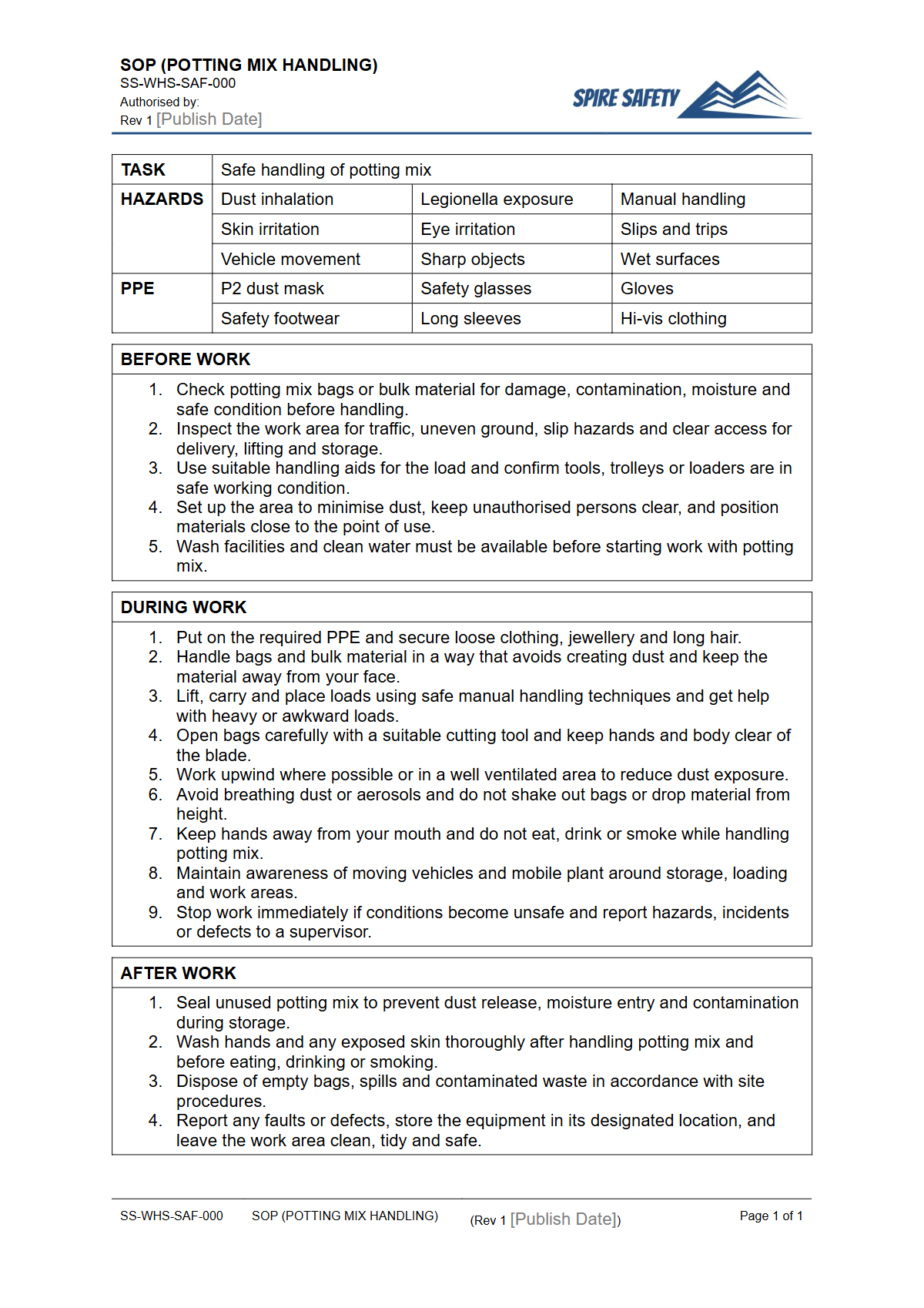
This template is provided in both DOCX and PDF formats to suit your organisation's needs. The DOCX version is fully editable, allowing you to tailor the content directly to the specific circumstances of your workplace, including the types of potting mix used, the equipment available, and your unique site layout.
It forms a strong foundation for developing robust WHS management systems by embedding practical risk controls into daily operations.
Note: This document is a template and must be customised to your specific workplace. We have provided a structured starting point based on common industry practices and the model WHS framework, but you must conduct your own risk assessment and consult with your workers to identify all relevant hazards and implement suitable control measures.
Your final SOP should reflect the reality of your operations.
Pre-Operational Checks
Before beginning work, the operator must verify several key points. This includes inspecting the work area to ensure it is well-ventilated and free from trip hazards.
All tools, such as shovels, scoops, or wheelbarrows, should be checked for damage. Crucially, the worker must confirm that the correct Personal Protective Equipment (PPE) is available and in good condition.
This typically includes waterproof gloves, safety eyewear, and a P2-rated disposable respirator.
Step-by-Step Operating Instructions
The core of the SOP outlines the safe execution of the task. It should begin with instructions for putting on the required PPE.
The procedure then details how to safely open bags of potting mix—directing the opening away from the face to avoid inhaling dust—and the importance of dampening the material with a light spray of water before use to minimise airborne particles. It should specify the use of tools for transferring mix rather than hands where possible. For large-scale operations, procedures may involve equipment guided by a Conveyer System SOP.
Post-Operational Tasks
Once the primary task is complete, the procedure must guide the worker through safe clean-up and shutdown. This includes cleaning all tools used, storing leftover potting mix in a sealed container, and properly disposing of used bags and PPE.
The most critical step is personal hygiene: workers must wash their hands and face thoroughly with soap and water after removing gloves and other PPE, especially before eating, drinking, or smoking. This step is essential for preventing ingestion of harmful microorganisms.
When to use a Potting Mix Handling SOP
A Safe Operating Procedure for handling potting mix should be developed and implemented before any worker undertakes the task. It is a proactive document used in nurseries, garden centres, landscaping businesses, horticultural operations, and any other workplace where soil conditioners are handled.
It should be used as the basis for initial worker training, for refresher training, and as a reference guide for supervisors monitoring work practices. If your operations require specialised advice, you may benefit from general WHS consulting to ensure all risks are addressed.
Who should use this Safe Operating Procedure
This SOP is intended for use by multiple roles within an organisation. PCBUs and managers use it to establish and document safe systems of work as part of their legislative duties.
Supervisors rely on it to induct and train new employees, conduct toolbox talks, and verify that correct procedures are being followed on-site. Workers who perform the task use it as a practical guide to remember and apply the correct safety steps.
Workers performing tasks like filling pots or garden beds, often as part of larger jobs detailed in documents like a free Planter SOP, should be trained in and have access to this procedure.
Common mistakes
Common mistakes to avoid
- Forgetting to dampen the potting mix before use, leading to high levels of airborne dust.
- Using the template without customising it for specific workplace tasks, equipment, and materials.
- Inadequate provision or inconsistent use of appropriate PPE, especially respiratory and hand protection.
- Failing to wash hands thoroughly after handling materials, increasing the risk of infection.
Legal references
Legal considerations
The following legal requirements may be relevant to this type of work.
- Work Health and Safety Act (Harmonised) — Provides the primary duties for protecting workers and other people from work health and safety risks.
- Work Health and Safety Regulations (Harmonised) — Sets out requirements supporting the management of workplace hazards and risks.
The following codes may be relevant to this type of work.
- Managing WHS Risks Code of Practice — Provides practical guidance on identifying hazards, assessing risks and applying effective controls.
- Work Health and Safety Consultation, Cooperation and Coordination Code of Practice — Provides practical guidance on consulting workers and coordinating with other duty holders.
- Managing the Work Environment and Facilities Code of Practice — Provides practical guidance on safe work environments, workplace facilities and related controls.
Did you know
A Different Strain
The type of Legionella found in potting mix and compost, Legionella longbeachae, is different from Legionella pneumophila, which is typically found in contaminated water systems like air conditioning towers.
Just Add Water
Gently wetting the potting mix with a light spray of water before scooping or pouring it can significantly reduce the amount of airborne dust, lowering the risk of inhaling harmful particles and microorganisms.
FAQ
Frequently asked questions
01What are the main hazards of handling potting mix?
02Is a Safe Operating Procedure for potting mix legally required in Australia?
03What PPE should be worn when handling potting mix?
04How often should I review my Potting Mix Handling SOP?
Share this resource
Free Safe Operating Procedure (Potting Mix Handling) Template
Browse Categories
How To Use It
- 1Download and open in Word or PDF.
- 2Replace the placeholders with your business details.
- 3Get it reviewed by a WHS specialist before rollout.
Need it customised?
Our WHS consultants can adapt this template to your site, run a gap analysis, or audit what you already have in place.
Book a Free Consultation WHS consulting servicesor call 1300 156 382
Related templates
- Free Safe Operating Procedure (Poultry Feeding) Template
- Free Safe Operating Procedure (Poultry Litter Change) Template
- Free Safe Operating Procedure (Powder Coating) Template
- Free Safe Operating Procedure (Power File) Template
- Free Safe Operating Procedure (Power Scraper) Template
- Free Safe Operating Procedure (Power Shears) Template