
Free Safe Operating Procedure (Power Scraper) Template
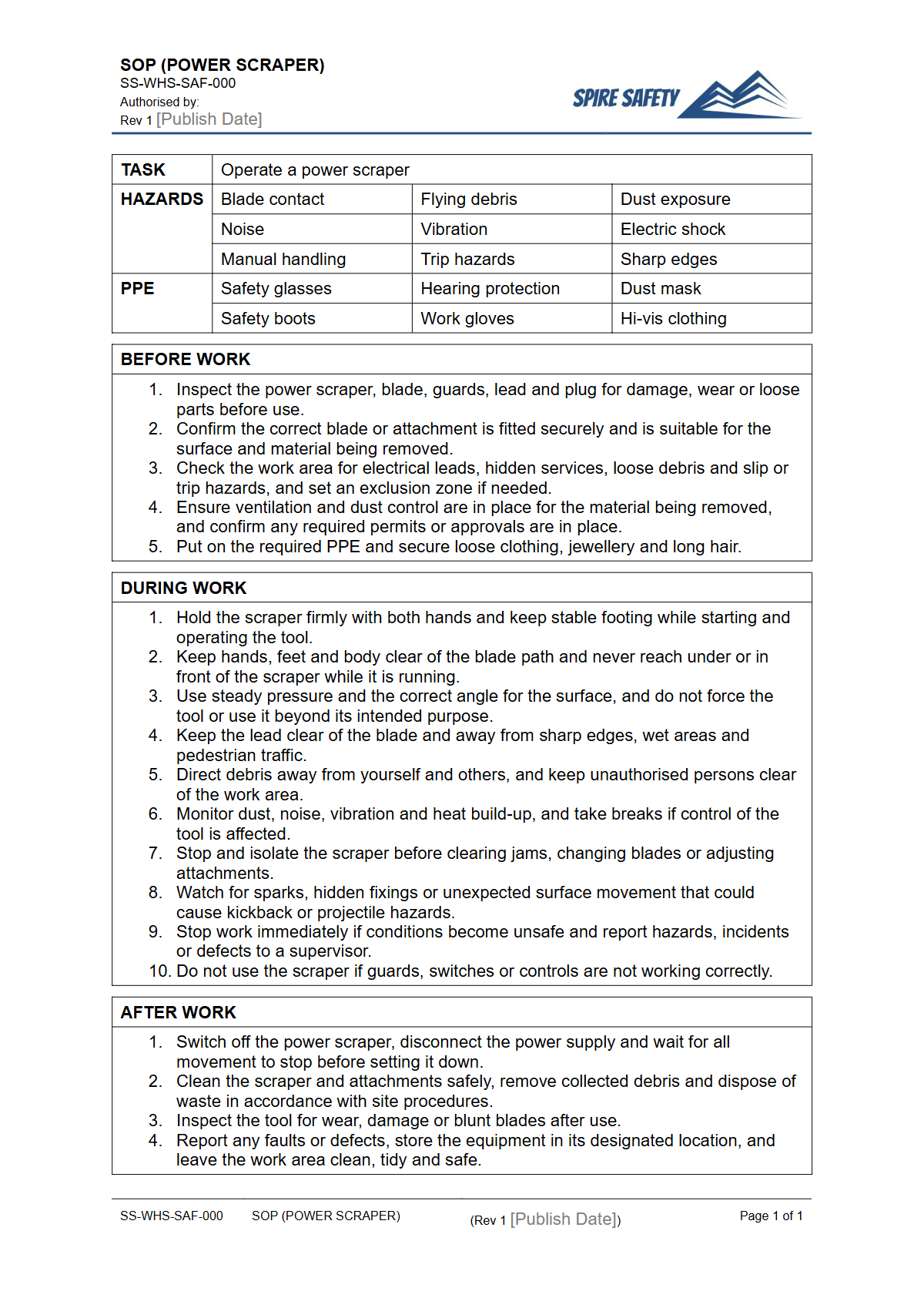
Download our free Safe Operating Procedure (Power Scraper) template to formalise safe work methods. This customisable DOCX and PDF helps manage hazards.
Free Safe Operating Procedure (Power Scraper) Template
DOCX • 126 KB + PDF
Updated Oct 2026
No signup required
Purpose of the Free Safe Operating Procedure (Power Scraper) Template
A Safe Operating Procedure (SOP) is a critical tool for ensuring tasks are performed safely and consistently. This Safe Operating Procedure (Power Scraper) Template provides a structured framework for documenting the step-by-step process for safely operating powered scraping equipment on-site.
It helps persons conducting a business or undertaking (PCBUs) fulfil their duty of care by clearly outlining safety requirements, potential hazards, and the control measures needed to mitigate them.
Using a power scraper involves significant risks, including exposure to hazardous dust (like silica or asbestos), high noise levels, hand-arm vibration, electrical shock, and risks of musculoskeletal injury. This template guides you through documenting essential safety elements such as pre-start checks, operational steps, required Personal Protective Equipment (PPE), and shutdown procedures.
Formalising these steps helps standardise safe work practices, assists in worker training, and provides a clear reference point for supervisors and operators. It is a foundational component of effective WHS management systems.
Video walkthrough
How to use the Free Safe Operating Procedure (Power Scraper) Template
This template is provided in both DOCX and PDF formats for your convenience. The DOCX file is fully editable, allowing you to tailor the content to your specific operational needs.
To use it effectively, download the document and methodically work through each section, replacing the placeholder text with information relevant to your workplace.
Important: This is a generic template and must be customised. We provide this document as a starting point.
You must review, edit, and adapt it to reflect the specific power scraper model in use (e.g., walk-behind, ride-on), the materials being removed, and the unique hazards present in your work environment. We strongly recommend consulting with the machine operators and supervisors during this process to ensure the final SOP is practical, accurate, and reflects how the work is actually done.
What is a Safe Operating Procedure?
An SOP details the established and safe method for carrying out a specific task. It breaks down the task into a logical sequence of steps and lists the hazards and control measures associated with each step.
Unlike a simple risk assessment, an SOP is an instructional document used for training and operational guidance. While this document covers power scrapers, we also offer specific templates for other plant, such as our grader SOP template for roadwork and earthmoving operations.
When to use it
A power scraper SOP should be developed and implemented before any work involving the equipment begins. It serves several key purposes throughout the project lifecycle:
- Training and Induction: Use the SOP to train new workers on the safe operation of the power scraper and to induct them into site-specific procedures.
- Refresher Training: It can be used for periodic refresher training for experienced operators to reinforce safe behaviours and introduce any procedural updates.
- Pre-Task Planning: The SOP serves as a valuable reference during daily pre-start meetings or toolbox talks to review the day's tasks and associated risks.
- Incident Investigation: In the event of an incident or near-miss, the SOP can be reviewed to determine if procedures were followed and whether they need to be improved.
- Audits and Inspections: A well-developed SOP demonstrates a commitment to safe systems of work during internal or external audits. Regular WHS compliance auditing can verify that documented procedures are being implemented correctly on the ground.
Who should use it
This template is designed for use by anyone responsible for health and safety management in industries like construction, demolition, flooring, and property maintenance. This includes:
- WHS Managers and Advisors: To develop and integrate standardised safety documents into the company's safety management system.
- Site Supervisors and Forepersons: To ensure their teams have clear, written instructions for operating equipment safely and to use as a tool for supervision and training.
- Business Owners (PCBUs): To meet their primary duty of care under WHS legislation by providing and maintaining safe systems of work.
- Project Managers: To ensure safety compliance and consistent procedures are followed across a project site, which may involve various types of machinery, each requiring its own procedure, such as a trencher SOP template for excavation work.
By implementing a robust SOP, your organisation can actively reduce the risk of injury and ensure work is conducted in a planned and controlled manner. You can find more templates for other common plant and equipment in our free WHS resources library.
Common mistakes
Common mistakes to avoid
- Using the generic template without customising it for the specific machine and task.
- Failing to adequately train workers on the finalised SOP's contents.
- Neglecting to inspect for hidden electrical cables or plumbing in the floor before starting.
- Not enforcing the use of required PPE, particularly respiratory, eye, and hearing protection.
Legal references
Legal considerations
The following legal requirements may be relevant to this type of work.
- Work Health and Safety Act (Harmonised) — Provides the primary duties for protecting workers and other people from work health and safety risks.
- Work Health and Safety Regulations (Harmonised) — Sets out requirements supporting the management of workplace hazards and risks.
The following codes may be relevant to this type of work.
- Managing WHS Risks Code of Practice — Provides practical guidance on identifying hazards, assessing risks and applying effective controls.
- Work Health and Safety Consultation, Cooperation and Coordination Code of Practice — Provides practical guidance on consulting workers and coordinating with other duty holders.
- Managing the Work Environment and Facilities Code of Practice — Provides practical guidance on safe work environments, workplace facilities and related controls.
Did you know
Vibration Exposure
Prolonged use of power scrapers can cause Hand-Arm Vibration Syndrome (HAVS), a painful and irreversible condition affecting blood vessels, nerves, and joints. A key control is limiting an operator's 'trigger time' each day.
Silica Dust Hazard
Scraping concrete, tiles, or mortar can release respirable crystalline silica (RCS). This dust is a major health hazard, and workplaces must use controls like on-tool water suppression or dust extraction systems to protect workers.
FAQ
Frequently asked questions
01What are the main hazards of using a power scraper?
02Is a Safe Operating Procedure a legal requirement in Australia?
03How often should an SOP for a power scraper be reviewed?
04Can this template be used for all types of power scrapers?
Share this resource
Free Safe Operating Procedure (Power Scraper) Template
Browse Categories
How To Use It
- 1Download and open in Word or PDF.
- 2Replace the placeholders with your business details.
- 3Get it reviewed by a WHS specialist before rollout.
Need it customised?
Our WHS consultants can adapt this template to your site, run a gap analysis, or audit what you already have in place.
Book a Free Consultation WHS consulting servicesor call 1300 156 382
Related templates
- Free Safe Operating Procedure (Power Shears) Template
- Free Safe Operating Procedure (Power Trowel) Template
- Free Safe Operating Procedure (Powered Pallet Mover) Template
- Free Safe Operating Procedure (Powered Respirator) Template
- Free Safe Operating Procedure (Pressure Calibrator) Template
- Free Safe Operating Procedure (Pressure Cleaning Setup) Template