
Free Safe Operating Procedure (Power Trowel) Template
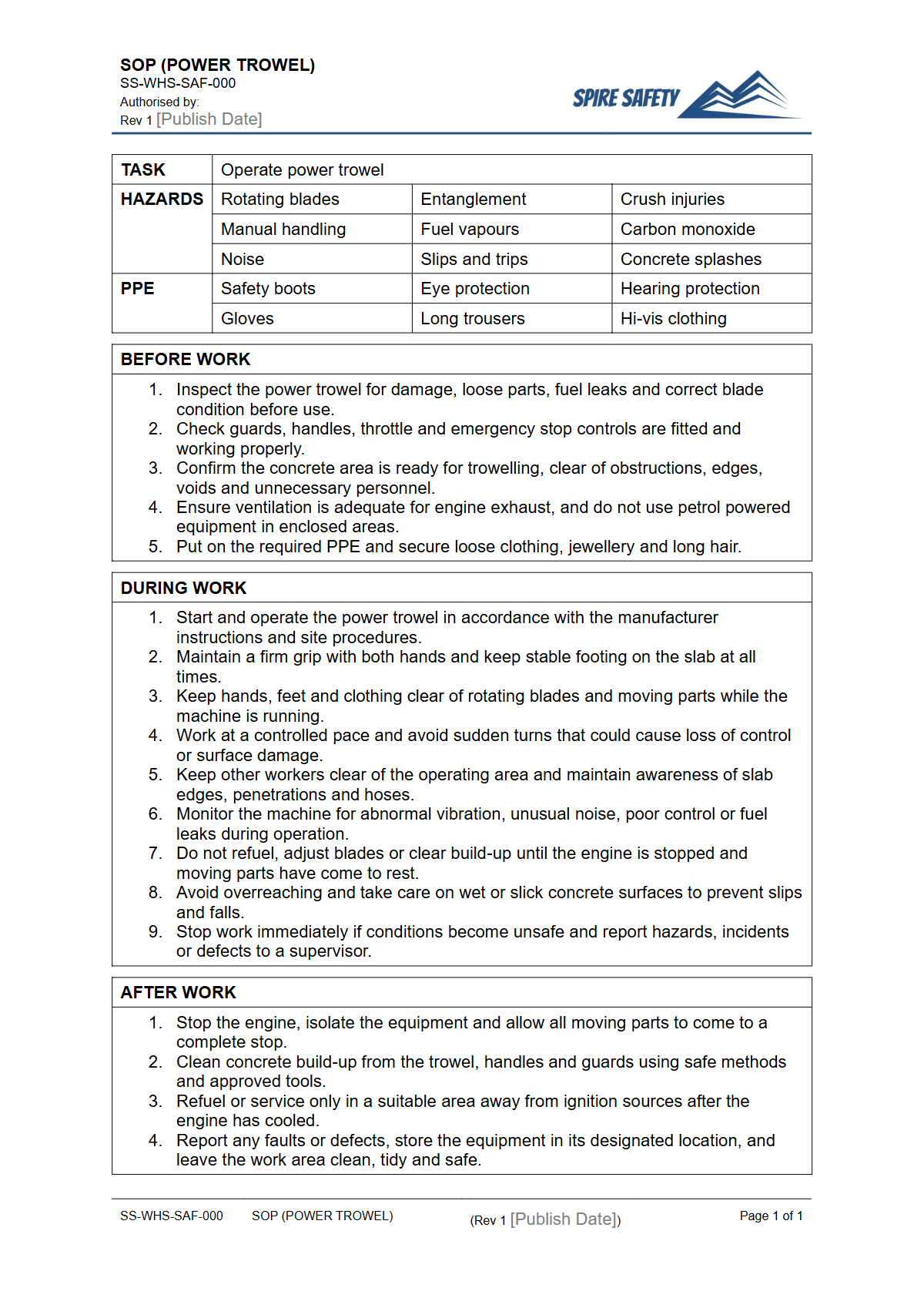
Download our free Safe Operating Procedure (Power Trowel) Template. This document provides a starting point for managing power trowel hazards in your workplace.
Free Safe Operating Procedure (Power Trowel) Template
DOCX • 126 KB + PDF
Updated Oct 2026
No signup required
Purpose of the Free Safe Operating Procedure (Power Trowel) Template
Operating a power trowel, whether a walk-behind or ride-on model, introduces significant workplace hazards. This free Safe Operating Procedure (Power Trowel) Template provides a structured framework for documenting the required steps to operate this equipment safely.
It helps organisations meet their duty of care by outlining key risks and control measures, from pre-start checks to shutdown procedures. A documented SOP is a critical tool for worker training, competency verification, and incident investigation, forming a vital part of a robust safety management system.
The primary goal is to control risks associated with rotating blades, carbon monoxide from petrol engines, manual handling, high noise levels, and working on wet concrete surfaces. Using a standardised procedure ensures that every operator follows the same safe, approved method, reducing the likelihood of injuries and promoting a consistent safety culture on site.
This template is designed as a comprehensive starting point, aligned with Australian WHS principles for managing plant and equipment.
Video walkthrough
How to use the Free Safe Operating Procedure (Power Trowel) Template
This resource is provided in both DOCX and PDF formats for your convenience. The DOCX file is fully editable, allowing you to tailor the content directly to your operational needs.
To use it effectively, download the template and begin customising each section to reflect the specific power trowel models used at your workplace and the unique conditions of your work environment.
- Review and Customise: Go through each section, including Personal Protective Equipment (PPE), pre-operational checks, operating instructions, and emergency procedures. Add or remove steps based on manufacturer guidelines and your site-specific risk assessment.
- Consult Your Team: Involve operators and supervisors in the customisation process. Their practical experience is invaluable for creating a procedure that is both safe and workable.
- Obtain Approval: Once finalised, the SOP should be formally approved by a competent person within your organisation, such as a WHS Manager or Site Supervisor.
Important: This document is a template only. We have provided a structured guide, but you must adapt it to your specific equipment, environment, and legal obligations.
Effective safety documentation is never a one-size-fits-all solution; it requires careful consideration of your unique operational context.
Integrating the SOP into your Safety System
An SOP should not exist in isolation. It forms a key part of your overall WHS management systems. Use this procedure as a foundation for operator training, include it in site induction packs, and reference it in your risk assessments.
Regular reviews and updates are essential to ensure it remains current and effective, especially when new equipment is purchased or work methods change. Consider using it alongside our FREE Circular Saw SOP Template for a consistent approach to managing hazardous tools on site.
Key Hazards of Power Trowel Operation
A thorough understanding of the hazards is the first step in creating a useful SOP. Power trowels present several serious risks that must be controlled.
- Mechanical Hazards: The fast-spinning blades can cause severe lacerations, amputation, or impact injuries. Entanglement of loose clothing is also a major risk. Guards must always be in place and in good condition.
- Carbon Monoxide Poisoning: Petrol-powered engines produce carbon monoxide (CO), a colourless, odourless, and deadly gas. Using petrol models indoors or in poorly ventilated areas like basements can be fatal. Electric models should be used where possible, or extensive ventilation and air monitoring must be implemented.
- Musculoskeletal Injury: Operating walk-behind models involves awkward postures, pushing/pulling forces, and exposure to hand-arm vibration, which can lead to musculoskeletal disorders over time.
- Noise: Power trowels can generate noise levels that cause permanent hearing damage. Hearing protection is almost always required.
- Slips, Trips, and Falls: The work area involves wet, slippery concrete, increasing the risk of falls onto the slab or into the path of the machine.
Documenting controls for these hazards is the core function of this SOP. For equipment that is frequently used alongside power trowels, such as air compressors, consider downloading our Free Air Compressor SOP to ensure all site equipment is covered.
When to Use This Safe Operating Procedure
A power trowel SOP should be a live document used consistently throughout your operations. It is not a document to be filed away and forgotten. It should be used:
- As the primary reference document for training new operators.
- To conduct competency assessments or verifications.
- As a guide for pre-start inspections and post-use cleaning.
- During regular safety talks or toolbox meetings to refresh knowledge.
- As a benchmark document during WHS compliance auditing to verify that prescribed safety controls are being followed in practice.
For more complex plant, procedures become even more critical. If your site uses heavy machinery like telehandlers, our FREE Telehandler SOP Template can provide another valuable resource.
Who Should Use This Template
This template is designed for use by any person responsible for ensuring the health and safety of workers using power trowels. This includes:
- Persons Conducting a Business or Undertaking (PCBUs): To help meet their primary duty of care.
- WHS Managers and Safety Officers: To create, implement, and review safety documentation.
- Site Managers and Supervisors: To train workers and enforce safe work practices on the ground.
- Small Business Owners: To establish a formal safety procedure without starting from scratch.
If you require more hands-on assistance developing bespoke documentation or safety systems for your business, consider engaging professional WHS consulting services. For more downloadable documents, browse our complete free WHS resources library.
Common mistakes
Common mistakes to avoid
- Using petrol-powered models in poorly ventilated areas like basements without adequate air monitoring.
- Failing to inspect blades and safety guards for damage or security before starting the machine.
- Neglecting to wear appropriate PPE, especially steel-capped boots, eye protection, and hearing protection.
- Attempting to refuel the machine while the engine is hot or running.
Legal references
Legal considerations
The following legal requirements may be relevant to this type of work.
- Work Health and Safety Act (Harmonised) — Provides the primary duties for protecting workers and other people from work health and safety risks.
- Work Health and Safety Regulations (Harmonised) — Sets out requirements supporting the management of workplace hazards and risks.
The following codes may be relevant to this type of work.
- Managing WHS Risks Code of Practice — Provides practical guidance on identifying hazards, assessing risks and applying effective controls.
- Work Health and Safety Consultation, Cooperation and Coordination Code of Practice — Provides practical guidance on consulting workers and coordinating with other duty holders.
- Managing the Work Environment and Facilities Code of Practice — Provides practical guidance on safe work environments, workplace facilities and related controls.
Did you know
Carbon Monoxide Risk
A single petrol-powered power trowel can produce lethal concentrations of carbon monoxide in an enclosed space in just minutes. Always prioritise electric models for indoor work or ensure mechanical ventilation and continuous air monitoring are in place.
FAQ
Frequently asked questions
01What is a Safe Operating Procedure for a power trowel?
02Is this power trowel SOP template suitable for both walk-behind and ride-on models?
03How often should a power trowel SOP be reviewed?
04Who is responsible for implementing the SOP on site?
Share this resource
Free Safe Operating Procedure (Power Trowel) Template
Browse Categories
How To Use It
- 1Download and open in Word or PDF.
- 2Replace the placeholders with your business details.
- 3Get it reviewed by a WHS specialist before rollout.
Need it customised?
Our WHS consultants can adapt this template to your site, run a gap analysis, or audit what you already have in place.
Book a Free Consultation WHS consulting servicesor call 1300 156 382
Related templates
- Free Safe Operating Procedure (Powered Pallet Mover) Template
- Free Safe Operating Procedure (Powered Respirator) Template
- Free Safe Operating Procedure (Pressure Calibrator) Template
- Free Safe Operating Procedure (Pressure Cleaning Setup) Template
- Free Safe Operating Procedure (Pressure Cushion Check) Template
- Free Safe Operating Procedure (Pressure Gauge Test) Template