
Free Safe Operating Procedure (Pressure Calibrator) Template
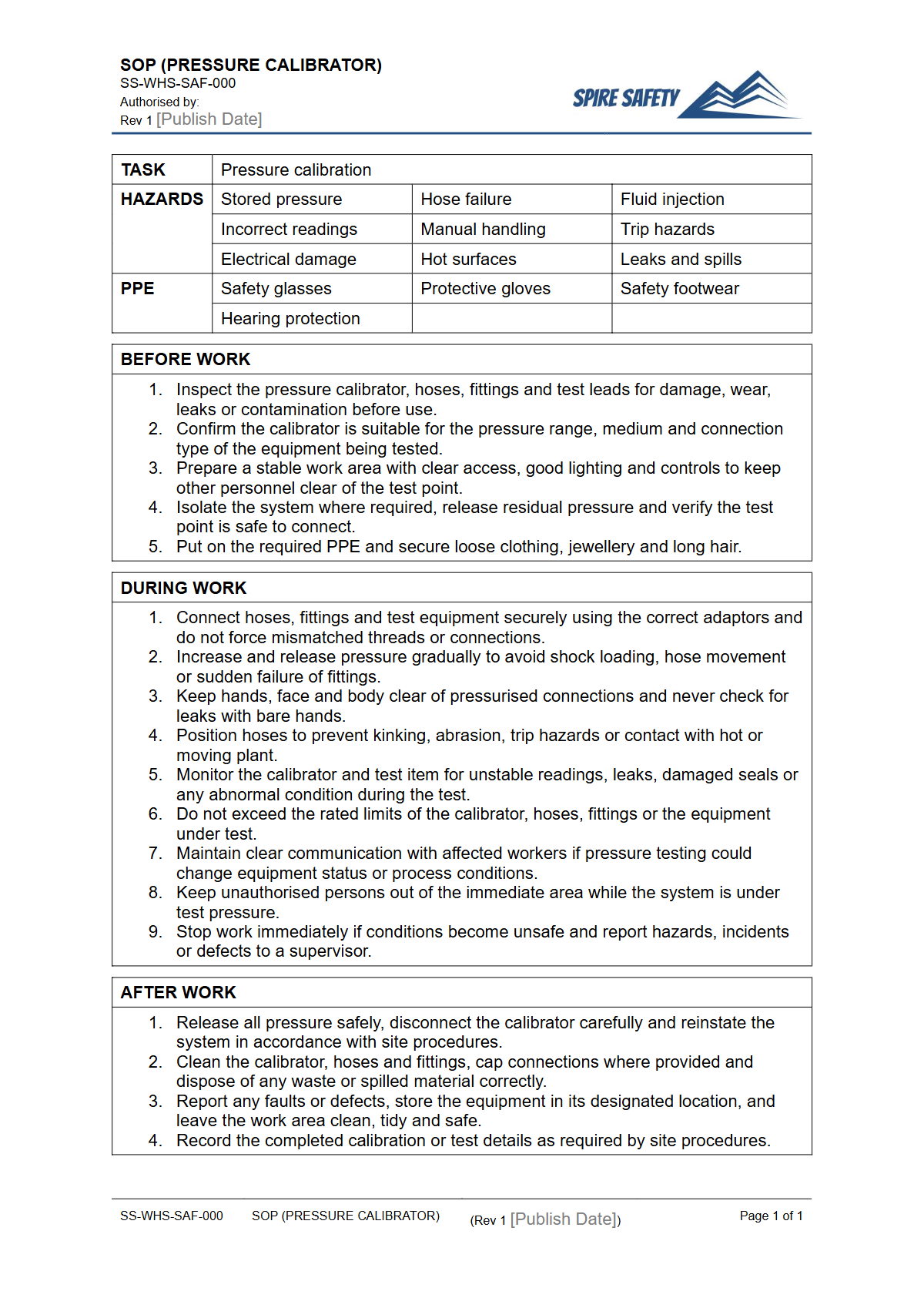
Download our free Safe Operating Procedure (Pressure Calibrator) Template to detail safe work steps for your team. Customise this DOCX or PDF resource today.
Free Safe Operating Procedure (Pressure Calibrator) Template
DOCX • 126 KB + PDF
Updated Oct 2026
No signup required
Purpose of the Free Safe Operating Procedure (Pressure Calibrator) Template
A pressure calibrator is a specialised instrument used to verify the accuracy of pressure measuring devices like gauges, transmitters, and switches. While essential for process control and safety, their operation involves significant risks, including exposure to high-pressure fluids or gases, equipment failure, and stored energy release.
This free Safe Operating Procedure (Pressure Calibrator) Template provides a structured format for documenting the essential health and safety controls required to manage these risks effectively. Using a documented procedure helps ensure tasks are performed consistently and safely by all personnel, forming a critical part of your overall safety management system.
An SOP standardises work methods and provides a clear training tool for new operators. By outlining pre-operational checks, correct setup, and safe depressurisation steps, it helps prevent incidents caused by procedural error. This is similar to the structured approach needed for other equipment involving pressurised systems, as detailed in resources like our Free Air Compressor SOP Template.
Video walkthrough
How to use the Free Safe Operating Procedure (Pressure Calibrator) Template
This template is provided as a starting point in both DOCX and PDF formats. Download the document and adapt it to the specific context of your workplace.
You must detail the exact make and model of your pressure calibrator, the types of systems it will be used on, and the specific personal protective equipment (PPE) required. It is designed to be integrated into your broader WHS management systems, providing tangible evidence of your commitment to safe work practices.
Important: This is a template, not a finished document. We cannot know your specific equipment, workplace hazards, or legal obligations.
You must conduct a site-specific risk assessment and consult with your operators and technicians to customise this SOP. Ensure all sections are reviewed and completed before the procedure is approved for use.
When to use it
A formal SOP for pressure calibration should be used whenever the task is performed. This includes routine scheduled calibrations as part of a preventive maintenance program, commissioning of new plant or instrumentation, and post-maintenance verification to ensure equipment is functioning correctly.
It is also a critical reference document during operator training and competency assessments. Having a robust procedure in place is vital for industries where pressure measurement is critical to safety and quality, such as manufacturing, oil and gas, and processing plants.
Regular reviews of your safety procedures are also crucial to maintain their relevance and effectiveness. A systematic review process can be supported by periodic WHS compliance auditing to verify that documented procedures are being followed correctly in practice.
Who should use it
This Safe Operating Procedure should be used by personnel who are trained, competent, and authorised to perform pressure calibration tasks. This typically includes instrument technicians, maintenance fitters, electricians, and engineers.
Supervisors and managers should also be familiar with the procedure to ensure it is being implemented correctly and to use it as a tool for work planning and safety supervision. Untrained or unauthorised personnel must not operate pressure calibration equipment.
The principles of documenting safe procedures apply to a wide range of equipment, as shown in our FREE Circular Saw SOP Template, which outlines risks for a completely different type of tool.
Documenting procedures for all types of machinery, from complex industrial units to common workshop tools, is a cornerstone of good WHS practice. You can find more examples across our entire free WHS resources library to help build out your internal safety documentation.
Common mistakes
Common mistakes to avoid
- Using a calibrator with an incorrect pressure range for the device under test.
- Failing to properly isolate and depressurise the system before connecting or disconnecting.
- Not accounting for atmospheric pressure (using gauge pressure vs. absolute pressure) where required.
- Treating the template as a finished document without customising it for specific equipment and workplace risks.
Legal references
Legal considerations
The following legal requirements may be relevant to this type of work.
- Work Health and Safety Act (Harmonised) — Provides the primary duties for protecting workers and other people from work health and safety risks.
- Work Health and Safety Regulations (Harmonised) — Sets out requirements supporting the management of workplace hazards and risks.
The following codes may be relevant to this type of work.
- Managing WHS Risks Code of Practice — Provides practical guidance on identifying hazards, assessing risks and applying effective controls.
- Work Health and Safety Consultation, Cooperation and Coordination Code of Practice — Provides practical guidance on consulting workers and coordinating with other duty holders.
- Managing the Work Environment and Facilities Code of Practice — Provides practical guidance on safe work environments, workplace facilities and related controls.
Did you know
Calibration Drift
All measuring instruments, including pressure gauges, can 'drift' over time, giving inaccurate readings. Regular calibration using a verified device is essential to ensure process safety, quality control, and compliance.
The Pascal Principle
Pressure calibrators function based on the Pascal Principle, which states that a pressure change at any point in a confined, incompressible fluid is transmitted equally throughout the entire fluid.
FAQ
Frequently asked questions
01What should be included in a pressure calibrator SOP?
02How often should we review our pressure calibrator procedure?
03Is a Safe Operating Procedure a legal requirement in Australia?
04Can I use this template for any type of pressure calibrator?
Share this resource
Free Safe Operating Procedure (Pressure Calibrator) Template
Browse Categories
How To Use It
- 1Download and open in Word or PDF.
- 2Replace the placeholders with your business details.
- 3Get it reviewed by a WHS specialist before rollout.
Need it customised?
Our WHS consultants can adapt this template to your site, run a gap analysis, or audit what you already have in place.
Book a Free Consultation WHS consulting servicesor call 1300 156 382
Related templates
- Free Safe Operating Procedure (Pressure Cleaning Setup) Template
- Free Safe Operating Procedure (Pressure Cushion Check) Template
- Free Safe Operating Procedure (Pressure Gauge Test) Template
- Free Safe Operating Procedure (Pressure Mattress Check) Template
- Free Safe Operating Procedure (Pressure Transmitter) Template
- Free Safe Operating Procedure (Price Gun Use) Template