
Free Safe Operating Procedure (Price Gun Use) Template
Streamline your retail and warehousing safety protocols with our free Safe Operating Procedure for price gun use. Download your customisable DOCX template now.
Free Safe Operating Procedure (Price Gun Use) Template
DOCX • 126 KB + PDF
Updated Oct 2026
No signup required
Purpose of the Free Safe Operating Procedure (Price Gun Use) Template
A price gun, or pricing labeler, is a common tool in retail, warehousing, and logistics. While it may seem simple, repetitive use can lead to significant health and safety risks, primarily musculoskeletal disorders (MSDs) and repetitive strain injuries (RSI).
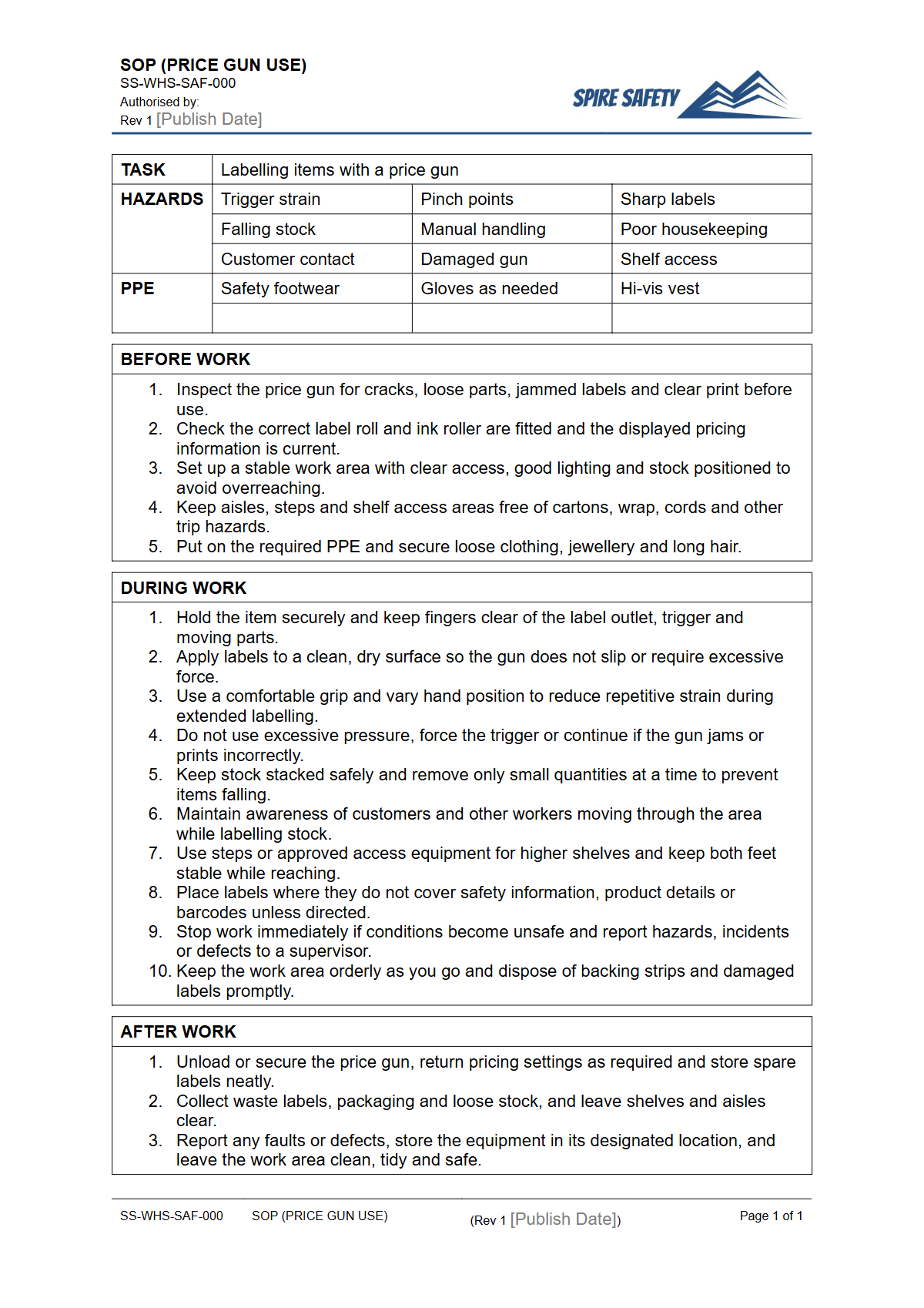
This Free Safe Operating Procedure (Price Gun Use) Template provides a structured framework for documenting the safe and correct method for operating this equipment. The goal is to standardise procedures, minimise ergonomic risks, and ensure all workers are trained to a consistent standard.
By implementing a formal SOP, you can effectively manage hazards associated with incorrect handling, improper loading, and prolonged use. This document serves as a critical component of your safety management system, demonstrating a commitment to identifying and controlling workplace risks. For businesses looking to formalise their safety frameworks, integrating this SOP is a practical step towards building comprehensive WHS management systems.
What is a Safe Operating Procedure?
A Safe Operating Procedure (SOP) is a written document that provides step-by-step instructions on how to safely perform a task or operate a piece of equipment. It details potential hazards and the control measures required to eliminate or minimise the risk of injury or illness.
A well-drafted SOP is a vital training tool and a reference point for workers and supervisors.
Video walkthrough
How to use the Free Safe Operating Procedure (Price Gun Use) Template
This template is designed as a foundational document, aligned with Australian WHS principles, that you can adapt for your specific workplace. It is provided in both DOCX and PDF formats for your convenience. To get the most out of this resource, follow these steps:
- Download the Template: Choose the DOCX version for easy editing.
- Customise Company Details: Add your company name, logo, and other relevant information in the designated fields.
- Consult with Your Team: Involve the workers who actually use the price guns. Their firsthand experience is invaluable for identifying practical challenges and effective control measures.
- Review and Adapt Tasks: The template includes common steps for operating a price gun, from loading labels to application. Review these against the specific models used in your workplace and the environment they are used in. Add, remove, or modify steps to reflect your exact processes.
- Specify Control Measures: Detail the specific controls your business uses. This could include mandatory break times, instructions on proper grip and posture, and procedures for clearing a jammed label. This process is similar to creating procedures for other common workplace equipment, such as that detailed in our FREE Conveyer System SOP.
- Finalise and Train: Once finalised, use the SOP to train all relevant staff. Ensure it is readily accessible in the work area for easy reference.
Important: This is a template only. We have provided a solid foundation based on common practice, but you must customise it to reflect the specific equipment, environment, and risks present in your workplace to ensure it is effective.
When to use a Safe Operating Procedure
An SOP for price gun use should be a living document integrated into your daily operations. It is most critical during key moments in the employment lifecycle and operational workflow.
It should be used for all induction and initial training before a worker is permitted to use the equipment unsupervised. The procedure should also be a central part of any refresher training programs to prevent procedural drift and reinforce safe behaviours.
Furthermore, the SOP should be immediately referenced and reviewed following any incident, injury, or near miss related to price gun use. This ensures that any new or previously unidentified hazards are assessed and that control measures are updated accordingly. Implementing SOPs across all relevant equipment, from a price gun to a deep fryer, helps build a consistent safety culture, as shown in our Free Safe Operating Procedure (Deep Fryer - Standard Operation) template.
Who should use this Safe Operating Procedure
This document is intended for use by multiple roles within an organisation to foster a shared understanding of safety responsibilities. Persons Conducting a Business or Undertaking (PCBUs) and managers can use it to fulfil their primary duty of care by providing a safe system of work.
Supervisors are key users, relying on the SOP to conduct training, monitor performance, and enforce safe work practices on the floor.
Workers themselves should use the SOP as their primary guide for operating the equipment correctly and safely. Finally, WHS officers and safety committees will use this template as a tool for risk assessment, procedure development, and review.
Its implementation and effectiveness can be verified during a WHS compliance auditing process to ensure it is being correctly applied. If you need assistance developing or reviewing your procedures, our WHS consulting team can provide expert guidance.
For more templates and safety documents, you can explore our complete free WHS resources library, which covers a wide range of equipment and tasks.
Common mistakes
Common mistakes to avoid
- Using the wrong size or type of labels or tags, leading to frequent jamming and frustration.
- Failing to conduct regular cleaning and maintenance on the device as per manufacturer instructions.
- Neglecting ergonomic principles, such as taking regular breaks during long pricing sessions and varying tasks.
- Operating the tool without appropriate training on loading, clearing jams, and safe handling.
Legal references
Legal considerations
The following legal requirements may be relevant to this type of work.
- Work Health and Safety Act (Harmonised) — Provides the primary duties for protecting workers and other people from work health and safety risks.
- Work Health and Safety Regulations (Harmonised) — Sets out requirements supporting the management of workplace hazards and risks.
The following codes may be relevant to this type of work.
- Managing WHS Risks Code of Practice — Provides practical guidance on identifying hazards, assessing risks and applying effective controls.
- Work Health and Safety Consultation, Cooperation and Coordination Code of Practice — Provides practical guidance on consulting workers and coordinating with other duty holders.
- Managing the Work Environment and Facilities Code of Practice — Provides practical guidance on safe work environments, workplace facilities and related controls.
Did you know
Ergonomic Impact
Work-related musculoskeletal disorders, including repetitive strain injuries from tasks like pricing, account for a significant portion of serious workers' compensation claims in Australia. Even seemingly simple tools can contribute to these injuries if not used correctly.
FAQ
Frequently asked questions
01What are the main hazards of using a price gun?
02Does a simple tool like a price gun require a formal Safe Operating Procedure?
03Who is responsible for training workers on price gun use?
04How often should a price gun SOP be reviewed?
Share this resource
Free Safe Operating Procedure (Price Gun Use) Template
Browse Categories
How To Use It
- 1Download and open in Word or PDF.
- 2Replace the placeholders with your business details.
- 3Get it reviewed by a WHS specialist before rollout.
Need it customised?
Our WHS consultants can adapt this template to your site, run a gap analysis, or audit what you already have in place.
Book a Free Consultation WHS consulting servicesor call 1300 156 382
Related templates
- Free Safe Operating Procedure (Printing Press) Template
- Free Safe Operating Procedure (Privacy Curtain Change) Template
- Free Safe Operating Procedure (Produce Bin Cleaning) Template
- Free Safe Operating Procedure (Produce Crate Handling) Template
- Free Safe Operating Procedure (Produce Display Clean) Template
- Free Safe Operating Procedure (Produce Hand Sorting) Template