
Free Safe Operating Procedure (Produce Crate Handling) Template
Document the safe handling of produce crates to prevent manual handling injuries. Download our free Safe Operating Procedure template to get started.
Free Safe Operating Procedure (Produce Crate Handling) Template
DOCX • 126 KB + PDF
Updated Oct 2026
No signup required
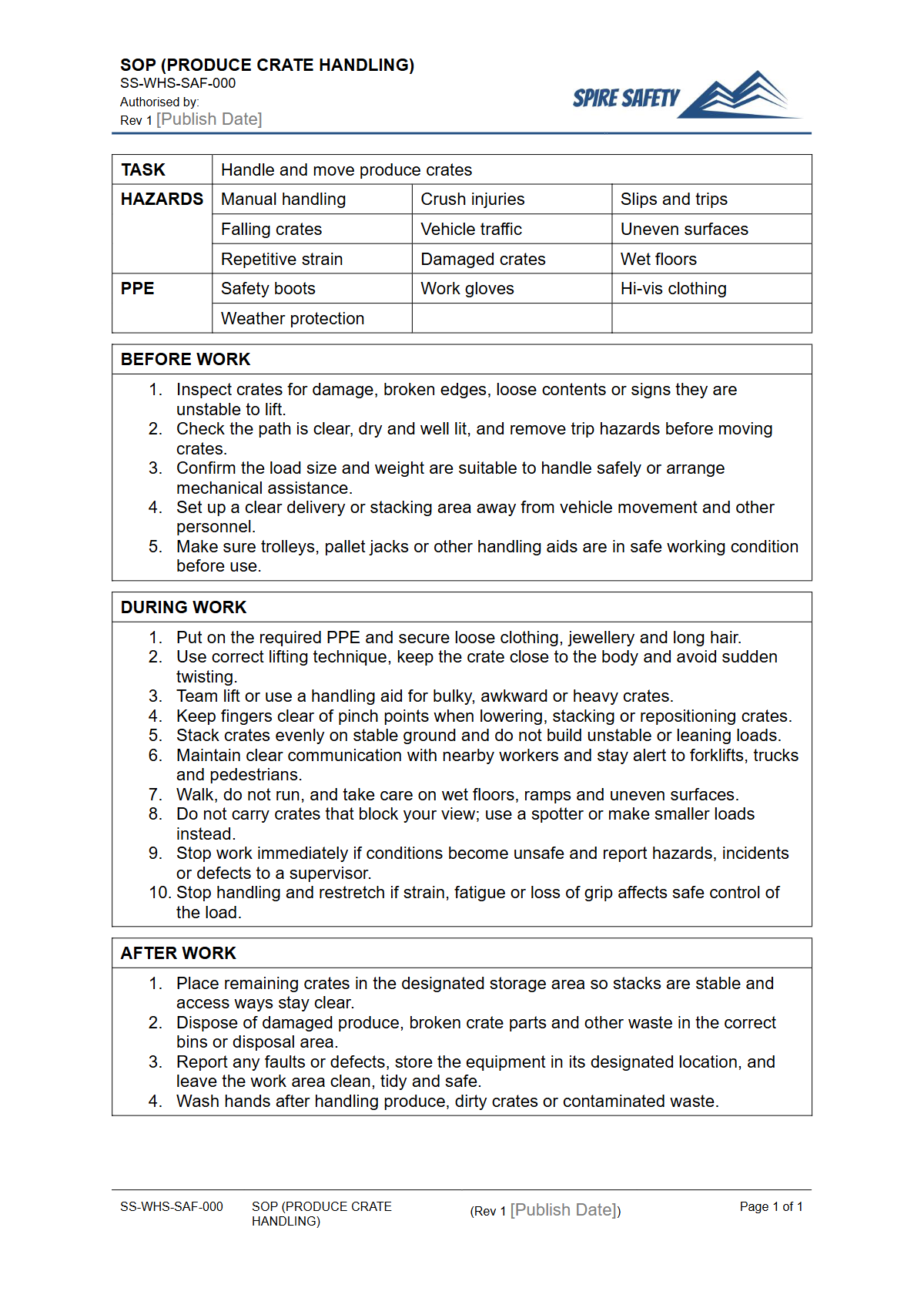
Purpose of the Free Safe Operating Procedure (Produce Crate Handling) Template
Handling produce crates is a frequent task in agriculture, logistics, and retail, but it carries significant risks of musculoskeletal disorders (MSDs) and other injuries. This free Safe Operating Procedure (Produce Crate Handling) template provides a structured starting point for your business to document and standardise the required safety measures for this task.
A clear SOP is a critical tool for managing risks associated with manual handling, such as lifting, carrying, stacking, and moving crates.
By implementing a formal procedure, you can reduce the likelihood of sprains, strains, and back injuries. It ensures all workers, from new starters to experienced staff, follow a consistent, safe method, minimising errors and unsafe practices.
This document helps in meeting your WHS duties by systematically addressing hazards and control measures, forming an essential component of your overall safety management approach.
Key Hazards in Produce Crate Handling
Your procedure should identify and control risks specific to your workplace, which may include:
- Forceful exertion: Lifting heavy or awkward crates.
- Repetitive movement: Repeatedly lifting and moving crates over a shift.
- Awkward postures: Bending, twisting, or reaching while handling crates.
- Environmental factors: Slippery floors from water or produce debris, poor lighting, or congested work areas.
- Equipment use: Incorrect use of pallet jacks, trolleys, or forklifts. In mechanised environments, a specific conveyer system SOP may also be necessary to manage associated risks.
Video walkthrough
How to use the Free Safe Operating Procedure (Produce Crate Handling) Template
Our free Safe Operating Procedure (Produce Crate Handling) template is available in both DOCX and PDF formats for your convenience. The DOCX file is fully editable, allowing you to tailor the content to the specific equipment, environment, and processes at your site.
To effectively use this resource, download the document and methodically work through each section, replacing the placeholder text with details relevant to your operation.
Involve your workers in the customisation process; their direct experience is invaluable for creating a practical and effective procedure. Once finalised, the SOP should be integrated into your broader WHS management systems. This includes using it for training, inductions, and ongoing competency verification.
Important: This is a template only. You must customise it to reflect the specific hazards and control measures applicable to your workplace, equipment, and personnel.
We are not responsible for the outcomes of any documentation you produce using this template.
When to use this Safe Operating Procedure
A Produce Crate Handling SOP is a versatile document that should be used as a constant reference for safe work practices. Its primary applications include:
- Worker Training and Induction: Use the SOP as the foundation for training new employees on the correct, safe methods for handling crates.
- Pre-Task Planning: Supervisors can use it for pre-start meetings or toolbox talks to remind workers of the key risks and controls before they begin work.
- Refresher Training: The SOP should be used for periodic refresher training to ensure standards do not slip over time. If crates are being moved in bulk with machinery, this may be combined with training covered by a Telehandler SOP or similar equipment-specific procedure.
- Incident Investigation: Following a manual handling incident or near miss, the SOP should be reviewed to determine if the procedure was adequate and followed correctly.
Who should use this Safe Operating Procedure
This procedure is designed for use by a range of personnel within any organisation where produce crates are handled. Key users include:
- Workers: Farm hands, warehouse staff, pickers, packers, and retail employees who physically handle the crates must be trained on and follow the procedure.
- Supervisors and Team Leaders: They are responsible for ensuring workers understand and adhere to the SOP, providing supervision, and correcting unsafe behaviour.
- WHS Managers and Advisors: These professionals use the SOP to formalise risk controls, facilitate training, and conduct workplace inspections. It's a key document reviewed during any formal WHS compliance auditing activities.
- Business Owners (PCBUs): For a Person Conducting a Business or Undertaking, having documented procedures like this SOP is a key step in demonstrating due diligence and meeting primary duties of care under WHS law. For expert assistance in developing and implementing your safety systems, consider engaging professional WHS consulting services.
By ensuring all relevant personnel are familiar with and use the document, you create a more consistent and safety-conscious culture. For more templates covering various workplace tasks and equipment, browse our complete free WHS resources library.
Common mistakes
Common mistakes to avoid
- Using a generic template without customising it with site-specific details like crate weights and work area layouts.
- Failing to consult with and train workers on the finalised procedure.
- Not reviewing or updating the SOP after an incident, or when new equipment or processes are introduced.
- Creating a procedure that is too complex or impractical for workers to follow during their daily tasks.
Legal references
Legal considerations
The following legal requirements may be relevant to this type of work.
- Work Health and Safety Act (Harmonised) — Provides the primary duties for protecting workers and other people from work health and safety risks.
- Work Health and Safety Regulations (Harmonised) — Sets out requirements supporting the management of workplace hazards and risks.
The following codes may be relevant to this type of work.
- Managing WHS Risks Code of Practice — Provides practical guidance on identifying hazards, assessing risks and applying effective controls.
- Work Health and Safety Consultation, Cooperation and Coordination Code of Practice — Provides practical guidance on consulting workers and coordinating with other duty holders.
- Managing the Work Environment and Facilities Code of Practice — Provides practical guidance on safe work environments, workplace facilities and related controls.
Did you know
Manual Handling Statistics
According to Safe Work Australia, body stressing, which includes hazardous manual tasks, remains the leading cause of serious workers' compensation claims in the country. These injuries often result from seemingly simple tasks performed incorrectly or repetitively.
FAQ
Frequently asked questions
01What is a Safe Operating Procedure for produce crate handling?
02Why are manual handling procedures so important in the produce industry?
03Who is responsible for creating and implementing a crate handling SOP?
04How often should we review our Produce Crate Handling SOP?
Share this resource
Free Safe Operating Procedure (Produce Crate Handling) Template
Browse Categories
How To Use It
- 1Download and open in Word or PDF.
- 2Replace the placeholders with your business details.
- 3Get it reviewed by a WHS specialist before rollout.
Need it customised?
Our WHS consultants can adapt this template to your site, run a gap analysis, or audit what you already have in place.
Book a Free Consultation WHS consulting servicesor call 1300 156 382
Related templates
- Free Safe Operating Procedure (Produce Display Clean) Template
- Free Safe Operating Procedure (Produce Hand Sorting) Template
- Free Safe Operating Procedure (Produce Packing) Template
- Free Safe Operating Procedure (Produce Pallet Loading) Template
- Free Safe Operating Procedure (Produce Shed Cleaning) Template
- Free Safe Operating Procedure (Produce Washer) Template