
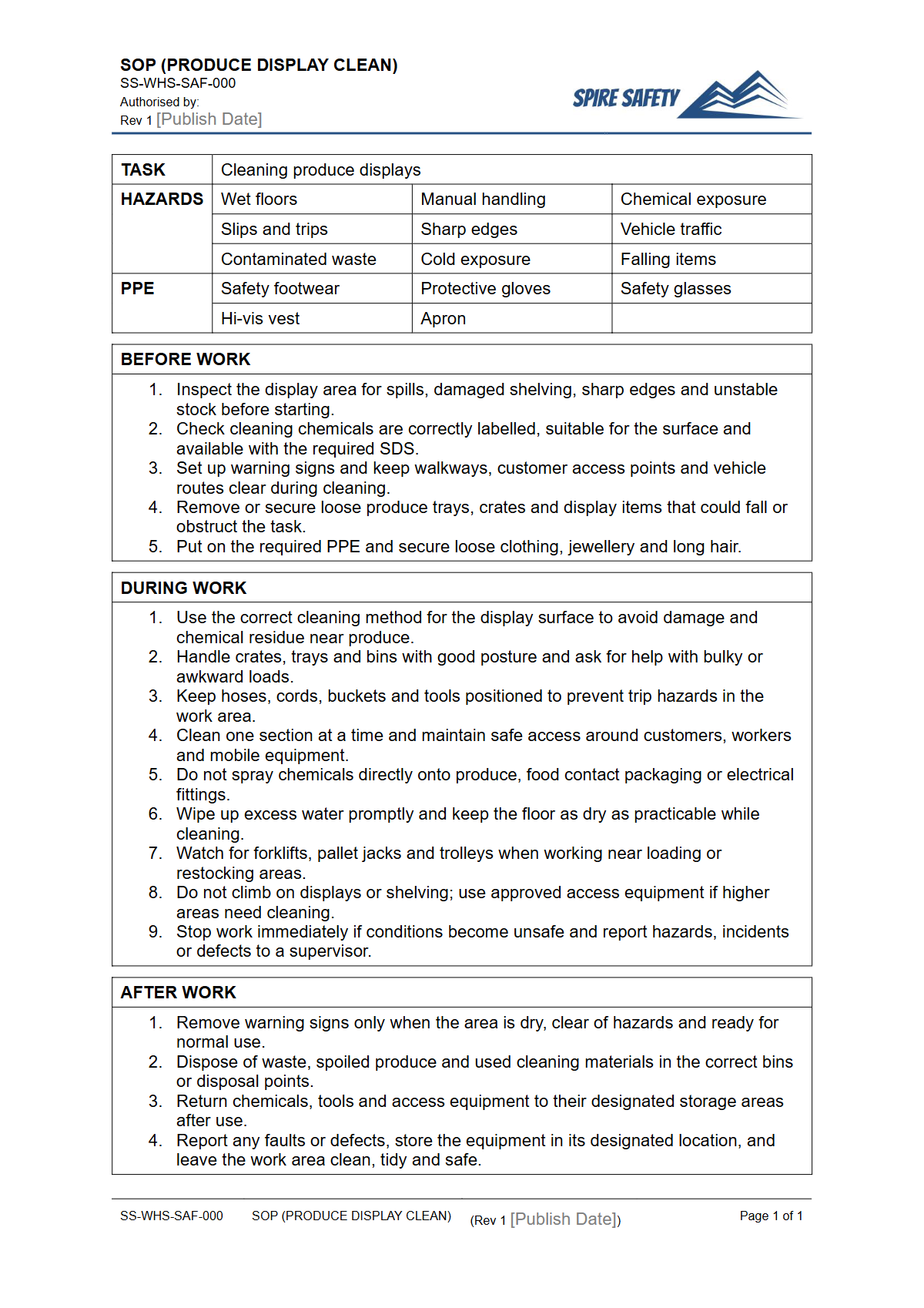
Free Safe Operating Procedure (Produce Display Clean) Template
Maintain hygiene and safety with our free template for cleaning produce displays. Download this customisable Safe Operating Procedure to standardise your process.
Free Safe Operating Procedure (Produce Display Clean) Template
DOCX • 126 KB + PDF
Updated Oct 2026
No signup required
Purpose of the Free Safe Operating Procedure (Produce Display Clean) Template
Maintaining a clean and hygienic environment is critical in any setting where fresh food is sold. This free Safe Operating Procedure (Produce Display Clean) template provides a structured framework for ensuring your produce displays are cleaned safely and effectively.
A documented procedure helps standardise the cleaning process across all staff, reducing the risk of food contamination, managing slip hazards, and demonstrating due to diligence in meeting food safety standards. It formalises the steps required, from preparation to waste disposal, ensuring a consistent and high standard of cleanliness is achieved every time.
This SOP is a foundational document for controlling hazards in a retail food environment.
By implementing a clear SOP, you establish repeatable, safe work methods that protect both your employees and customers. It serves as a vital tool for training and competency assessment, ensuring every team member understands the specific hazards and control measures associated with the task.
This document should form one part of your overall safety management system, working alongside other procedures like a conveyer system SOP if stock is moved mechanically, to create a comprehensive safety framework.
Video walkthrough
How to use the Free Safe Operating Procedure (Produce Display Clean) Template
This template is designed as a starting point, aligned with Australian WHS principles, and must be adapted to your specific workplace. Upon downloading the DOCX or PDF, you should conduct a site-specific risk assessment to identify all relevant hazards and controls.
This involves reviewing your store layout, the types of produce displays you use, the specific cleaning chemicals on-site, and your emergency procedures. This process ensures the final document is a practical and relevant tool for your team.
Customisation is Essential
To make this Safe Operating Procedure effective, you must customise it with your business's details. We've included prompts within the document to guide you. Be sure to add:
- Your company name, ABN, and logo.
- Site-specific details, such as the location of cleaning stations and first aid kits.
- The exact names and dilution ratios of the cleaning chemicals used.
- Specific Personal Protective Equipment (PPE) required, such as gloves and safety glasses.
- Emergency contact information and shutdown procedures.
- Details for waste disposal according to your local council and business requirements.
Integrating this customised SOP into your broader WHS management systems is crucial for its ongoing success and for demonstrating a systematic approach to safety.
When to use it
This SOP should be the go-to document for several routine and non-routine activities. It is intended for daily or weekly scheduled cleaning tasks to maintain presentation and hygiene standards.
It should also be used for periodic deep cleaning of produce sections. Furthermore, it serves as a critical guide when responding to spills of liquids or spoiled produce to ensure the area is cleaned and made safe promptly.
The procedure is also an essential resource during staff onboarding and refresher training sessions, providing a clear, authoritative guide on the expected safe work method. Regular reviews of the SOP, perhaps as part of your internal WHS compliance auditing program, ensure it remains current.
Who should use it
This procedure is primarily for employees directly responsible for cleaning and maintaining produce displays, including retail assistants, department staff, and dedicated cleaning personnel. Supervisors and team leaders should also use the document to oversee work, conduct spot checks, and deliver training.
Store managers and WHS officers have a responsibility to ensure the SOP is properly implemented, reviewed, and updated as necessary. They must ensure that all staff who perform this task are trained on the contents of the procedure and are competent to carry it out safely. You can find more templates for a range of different tasks in our free WHS resources library.
Key Hazards in Produce Display Cleaning
While seemingly straightforward, cleaning produce displays involves several potential hazards that must be managed. These include:
- Slips, Trips, and Falls: Wet floors during and after cleaning are a primary risk. Control measures include using 'wet floor' signs, cleaning during low-traffic periods, and ensuring floors are completely dry before removing signs.
- Chemical Exposure: Contact with cleaning chemicals can cause skin irritation or respiratory issues. Controls include using the correct PPE, ensuring adequate ventilation, and providing training on chemical safety data sheets (SDS).
- Manual Handling: Lifting crates of produce, moving display components, and handling cleaning equipment can lead to musculoskeletal injuries. Staff should be trained in safe lifting techniques.
- Cross-Contamination: Using dirty cloths or the same equipment for different areas can spread bacteria. The SOP should specify procedures for using clean, sanitised equipment for food contact surfaces.
Each workplace has unique equipment and risks; an SOP for another task, such as an air compressor SOP, would outline a completely different set of hazards and controls relevant to that machinery. This highlights the importance of task-specific procedures.
Common mistakes
Common mistakes to avoid
- Using incorrect or improperly diluted cleaning chemicals, which can be ineffective or leave harmful residues.
- Neglecting to clean hard-to-reach areas like drains, seams, and underneath display fixtures.
- Failing to adequately train staff on the procedure, leading to inconsistent or unsafe practices.
- Not allowing surfaces to air dry completely after sanitising, which can render the sanitiser ineffective.
Legal references
Legal considerations
The following legal requirements may be relevant to this type of work.
- Work Health and Safety Act (Harmonised) — Provides the primary duties for protecting workers and other people from work health and safety risks.
- Work Health and Safety Regulations (Harmonised) — Sets out requirements supporting the management of workplace hazards and risks.
The following codes may be relevant to this type of work.
- Managing WHS Risks Code of Practice — Provides practical guidance on identifying hazards, assessing risks and applying effective controls.
- Work Health and Safety Consultation, Cooperation and Coordination Code of Practice — Provides practical guidance on consulting workers and coordinating with other duty holders.
- Managing the Work Environment and Facilities Code of Practice — Provides practical guidance on safe work environments, workplace facilities and related controls.
Did you know
Cross-Contamination Hotspots
Studies have shown that reusable shopping bags and the bottom of shopping carts can be major sources of cross-contamination. This makes the cleanliness of the in-store produce display area, where these items frequently make contact, even more critical for public health.
The Food Standards Code
Food Standards Australia New Zealand (FSANZ) develops the Food Standards Code, which includes Standard 3.2.2. This standard legally requires food businesses to maintain their premises, fittings, and equipment to a high standard of cleanliness to prevent food contamination.
FAQ
Frequently asked questions
01What kind of chemicals are safe for cleaning produce displays?
02How often should produce displays be cleaned?
03Is a Safe Operating Procedure a legal requirement for cleaning?
04What is the difference between an SOP and a Safe Work Method Statement (SWMS)?
Share this resource
Free Safe Operating Procedure (Produce Display Clean) Template
Browse Categories
How To Use It
- 1Download and open in Word or PDF.
- 2Replace the placeholders with your business details.
- 3Get it reviewed by a WHS specialist before rollout.
Need it customised?
Our WHS consultants can adapt this template to your site, run a gap analysis, or audit what you already have in place.
Book a Free Consultation WHS consulting servicesor call 1300 156 382
Related templates
- Free Safe Operating Procedure (Produce Hand Sorting) Template
- Free Safe Operating Procedure (Produce Packing) Template
- Free Safe Operating Procedure (Produce Pallet Loading) Template
- Free Safe Operating Procedure (Produce Shed Cleaning) Template
- Free Safe Operating Procedure (Produce Washer) Template
- Free Safe Operating Procedure (Produce Washing Setup) Template