
Free Safe Operating Procedure (Produce Washer) Template
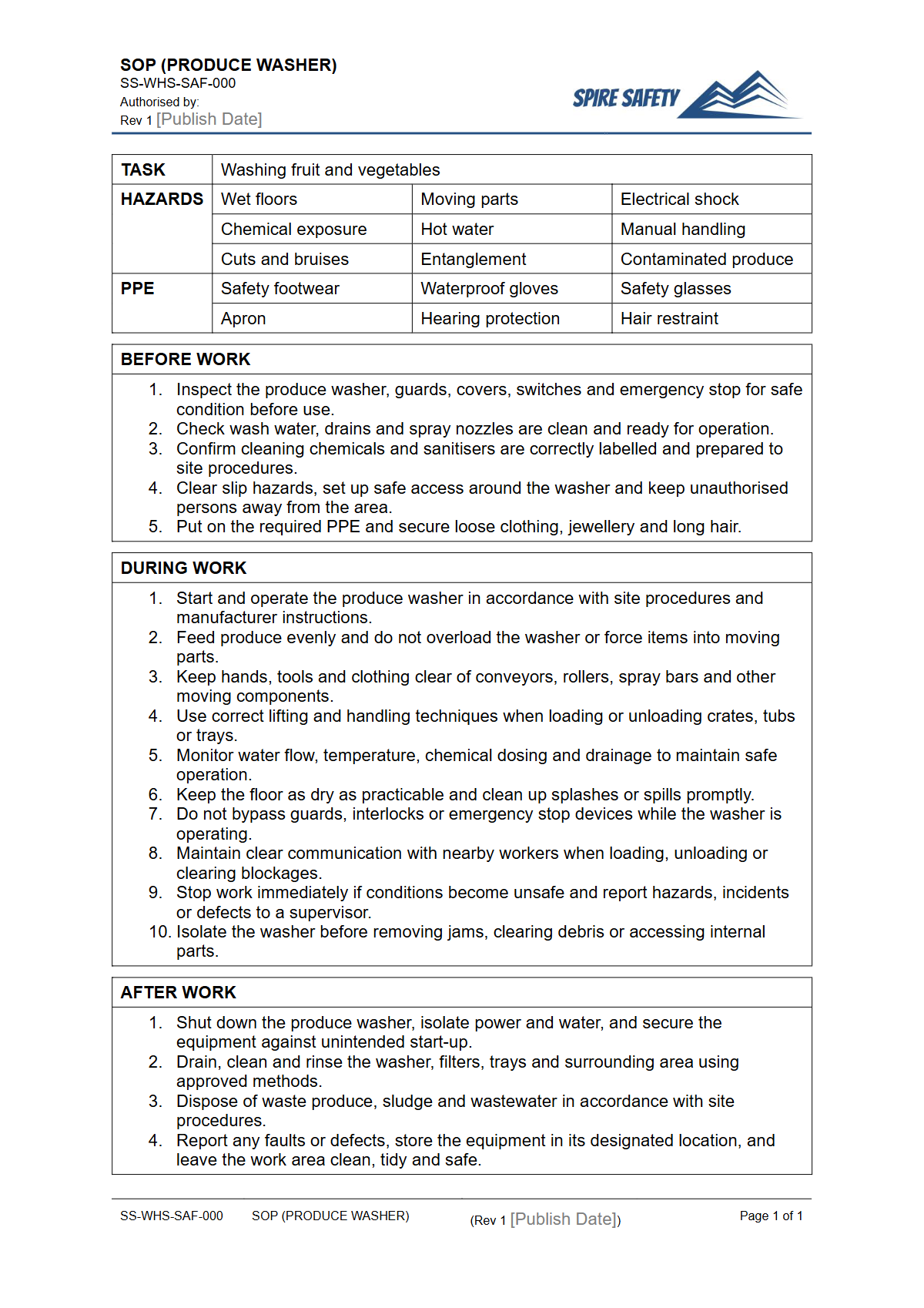
Download our free Safe Operating Procedure for produce washers. This template helps you outline safe work practices for your food handling environment.
Free Safe Operating Procedure (Produce Washer) Template
DOCX • 126 KB + PDF
Updated Oct 2026
No signup required
Purpose of the Free Safe Operating Procedure (Produce Washer) Template
This free Safe Operating Procedure (Produce Washer) Template provides a structured foundation for documenting the risks and controls associated with operating industrial and commercial produce washing equipment. The primary goal is to establish a clear, repeatable process that minimises the risk of injury to operators and ensures food safety standards are maintained.
By formalising procedures, you can effectively manage hazards such as moving parts, electrical systems near water, slip and trip risks, and exposure to cleaning chemicals.
A documented SOP serves as a critical training tool and a reference point for workers, promoting consistent and safe operational behaviour. It forms an essential part of demonstrating due diligence in managing workplace health and safety obligations, particularly in food processing, agricultural, and hospitality settings.
Proper use of this procedure helps prevent equipment damage, reduces the likelihood of incidents, and supports a positive safety culture within your organisation.
Video walkthrough
How to use the Free Safe Operating Procedure (Produce Washer) Template
Our template is provided in both DOCX and PDF formats for your convenience. The DOCX file is fully editable, allowing you to add, remove, and modify sections to align perfectly with your specific workplace.
It is crucial to adapt the document to the make and model of your produce washer, the layout of your facility, the specific cleaning agents used, and your established emergency procedures.
Important: This is a template, not a finished document. We strongly recommend that a competent person, such as a WHS manager or supervisor, customises this procedure in direct consultation with the workers who regularly operate the equipment.
Their hands-on experience is invaluable for identifying specific risks and practical control measures that might otherwise be overlooked. Finalising the SOP without this consultation can lead to ineffective or impractical safety controls.
When to use a Safe Operating Procedure
An SOP for a produce washer should be a core component of your safety management system. It should be used during the induction and training of any new employee tasked with operating the machine.
It also serves as an excellent tool for refresher training to ensure standards are maintained over time. Following any incident, near miss, or significant change to the equipment or work environment, the SOP must be reviewed and updated.
Regular, scheduled reviews—typically annually—are also a key part of maintaining its relevance and effectiveness.
Who should use it
This Safe Operating Procedure is designed for use by Persons Conducting a Business or Undertaking (PCBUs), WHS managers, supervisors, and team leaders in any industry that utilises produce washing equipment. This includes, but is not limited to, commercial kitchens, food manufacturing plants, large-scale farms, and grocery distribution centres.
It provides the framework needed to fulfil their duty of care to provide and maintain a safe system of work. If you require assistance implementing this or other safety documents, our WHS consulting services can provide expert guidance.
Key Hazards and Control Measures
A comprehensive produce washer SOP should address several key hazard categories:
- Mechanical Hazards: Many produce washers contain rollers, brushes, and conveyor belts. The SOP must detail requirements for machine guarding, lockout/tagout procedures for cleaning and maintenance, and the location and testing of emergency stops. For machinery with integrated belts, our Conveyer System SOP provides more specific guidance.
- Electrical Hazards: The combination of electricity and water creates a significant risk. Controls include ensuring the use of correctly installed Residual Current Devices (RCDs), regular inspection of electrical cords and connections, and procedures to prevent water from splashing onto electrical components.
- Slips, Trips, and Falls: Water spillage is a common issue. Control measures should include ensuring adequate drainage, use of non-slip flooring, and procedures for immediately cleaning up spills.
- Chemical Hazards: Document the specific cleaning and sanitising chemicals used, referencing their Safety Data Sheets (SDS). The SOP should mandate the required Personal Protective Equipment (PPE), such as gloves and safety glasses.
- Ergonomic Hazards: Loading and unloading produce can involve repetitive motions and awkward postures. The SOP should encourage job rotation and outline correct manual handling techniques to prevent musculoskeletal injuries.
Integrating the SOP into Your WHS System
A Safe Operating Procedure is most effective when it is part of a holistic safety framework. This document should not exist in isolation.
It needs to be supported by practical training, competency assessments, and regular supervision. Furthermore, it should link to and be informed by your workplace's overall WHS management systems, including your hazard register and risk assessments.
For example, in a commercial kitchen environment, this SOP would work alongside other equipment-specific procedures, like a deep fryer SOP, to create a comprehensive safety portfolio.
After customising this template, ensure it is readily accessible to all relevant workers. Keep records of who has been trained on the procedure and when. You can find more templates and checklists to support your safety framework in our free resources library.
Common mistakes
Common mistakes to avoid
- Using a generic SOP template without customising it for the specific make and model of the washer.
- Failing to include detailed lockout/tagout procedures for cleaning and maintenance tasks.
- Neglecting to train all operators on the finalised SOP and verify their competency.
- Not making the SOP easily accessible to workers at the point of use.
Legal references
Legal considerations
The following legal requirements may be relevant to this type of work.
- Work Health and Safety Act (Harmonised) — Provides the primary duties for protecting workers and other people from work health and safety risks.
- Work Health and Safety Regulations (Harmonised) — Sets out requirements supporting the management of workplace hazards and risks.
The following codes may be relevant to this type of work.
- Managing WHS Risks Code of Practice — Provides practical guidance on identifying hazards, assessing risks and applying effective controls.
- Work Health and Safety Consultation, Cooperation and Coordination Code of Practice — Provides practical guidance on consulting workers and coordinating with other duty holders.
- Managing the Work Environment and Facilities Code of Practice — Provides practical guidance on safe work environments, workplace facilities and related controls.
Did you know
Cross-Contamination Risk
According to Food Standards Australia New Zealand (FSANZ), contaminated fruits and vegetables are a significant source of foodborne illness. A documented washing procedure is a critical control point in preventing cross-contamination from harmful bacteria like E. coli and Salmonella.
FAQ
Frequently asked questions
01What key information must be included in a produce washer SOP?
02How often should a Safe Operating Procedure for a produce washer be reviewed?
03Is an SOP for a produce washer legally required in Australia?
04Who is responsible for training staff on the produce washer SOP?
Share this resource
Free Safe Operating Procedure (Produce Washer) Template
Browse Categories
How To Use It
- 1Download and open in Word or PDF.
- 2Replace the placeholders with your business details.
- 3Get it reviewed by a WHS specialist before rollout.
Need it customised?
Our WHS consultants can adapt this template to your site, run a gap analysis, or audit what you already have in place.
Book a Free Consultation WHS consulting servicesor call 1300 156 382
Related templates
- Free Safe Operating Procedure (Produce Washing Setup) Template
- Free Safe Operating Procedure (Proofing Cabinet) Template
- Free Safe Operating Procedure (Propeller Safety) Template
- Free Safe Operating Procedure (Pruning Shears) Template
- Free Safe Operating Procedure (Pruning Waste Handling) Template
- Free Safe Operating Procedure (Public Bin Collection) Template