
Free Safe Operating Procedure (Pruning Shears) Template
Download our Free Safe Operating Procedure (Pruning Shears) Template. This document provides a structured guide for your workplace safety protocols.
Free Safe Operating Procedure (Pruning Shears) Template
DOCX • 126 KB + PDF
Updated Oct 2026
No signup required
Purpose of the Free Safe Operating Procedure (Pruning Shears) Template
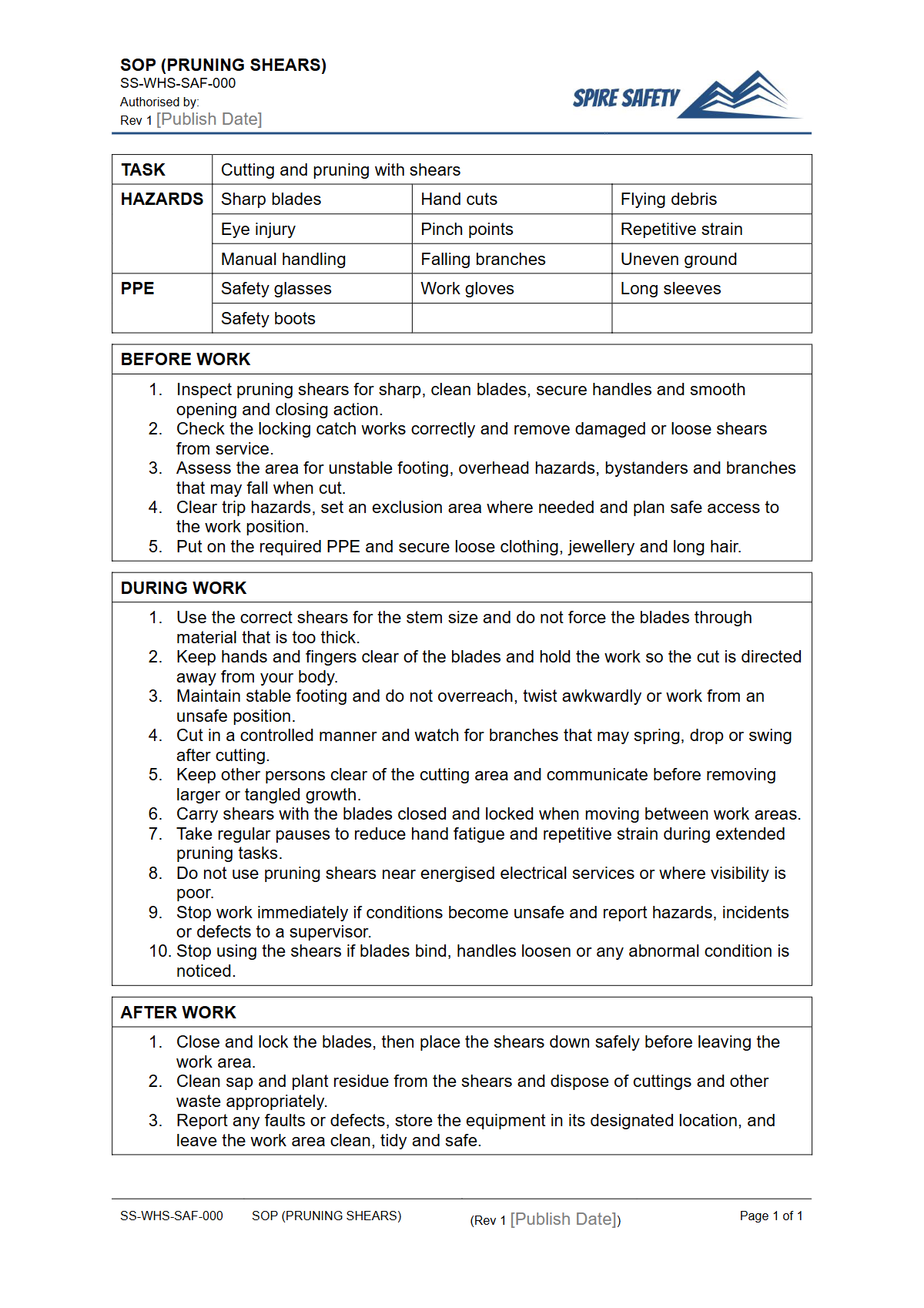
This Free Safe Operating Procedure (Pruning Shears) Template provides a structured framework for documenting the safe use of manual pruning shears in your workplace. Its primary purpose is to identify and control the health and safety risks associated with their operation, helping your organisation meet its duty of care under Australian WHS laws.
By establishing a clear, step-by-step process, this SOP aims to prevent common injuries such as cuts, punctures, and musculoskeletal disorders resulting from repetitive motions or forceful exertion. It serves as a practical tool for standardising safe work practices across all personnel involved in gardening, landscaping, horticultural, and agricultural tasks.
Video walkthrough
How to use the Free Safe Operating Procedure (Pruning Shears) Template
Download the template in your preferred format—DOCX for easy editing or PDF for straightforward distribution. Before implementation, you must customise the document to reflect the specific hazards, equipment, and control measures relevant to your unique work environment.
A comprehensive WHS management system integrates specific procedures like this one into a broader safety framework, ensuring consistency and continuous improvement.
Customising Your Pruning Shears SOP
Consultation is a critical step. Involve workers who regularly use pruning shears to ensure the procedure is practical, effective, and reflects on-the-ground realities.
Your customisation should detail site-specific emergency procedures, the exact make and model of shears used, required Personal Protective Equipment (PPE), and maintenance schedules. For expert assistance in developing and implementing your safety systems, consider engaging with Spire Safety's WHS consulting services.
Training and Implementation
Once finalised, the SOP should be used as the basis for training and competency assessments for all relevant workers. Ensure every operator reads and understands the SOP before they begin work.
Keep records of this training and schedule regular refresher sessions to maintain high safety standards. Effective implementation requires ongoing supervision to verify that the documented procedures are being followed correctly.
When to use it
A Safe Operating Procedure for pruning shears should be referenced before any task involving their use commences. It is an essential document for worker inductions, task-specific training, and regular refresher training sessions.
The SOP also serves as a critical reference tool during incident investigations or when reviewing risk assessments for gardening and landscaping tasks. For similar hand-held power tools, you might also find our FREE Circular Saw SOP Template a useful reference point for structuring your safety documents.
Who should use it
This SOP is designed for use by Persons Conducting a Business or Undertaking (PCBUs), managers, and supervisors in industries such as horticulture, viticulture, landscaping, agriculture, and facilities management. It is also a vital tool for WHS officers and, most importantly, the workers who perform the tasks.
By providing clear instructions, it empowers workers to carry out their duties safely and consistently. Many roles that use pruning shears also operate machinery, making documents like the FREE Trencher SOP Template equally important for managing overall site risks.
Key Hazards and Control Measures
Your SOP should address common hazards associated with using pruning shears, including:
- Mechanical Hazards: Cuts and punctures from sharp blades. Controls include wearing appropriate PPE (e.g., cut-resistant gloves, safety glasses), maintaining a safe distance from body parts, using the correct cutting technique, and ensuring shears have a functional locking mechanism for safe transport and storage.
- Musculoskeletal Hazards: Repetitive strain injuries (RSIs), sprains, and strains from frequent use, awkward postures, or using excessive force with dull blades. Controls include selecting ergonomic tools, ensuring blades are kept sharp, providing training on proper body mechanics, rotating tasks, and scheduling regular breaks.
- Environmental Hazards: Slips, trips, and falls while moving around a site or from discarded plant matter. Controls involve maintaining clear work areas, good housekeeping practices, and wearing appropriate non-slip footwear.
Integrating a specific and well-developed procedure is a proactive step towards creating a safer work environment for everyone. Organisations in the agricultural sector can further enhance their safety documentation with resources like our FREE Spreader SOP Template. For more templates and guides covering a wide range of equipment and tasks, browse our complete free WHS resources library.
Common mistakes
Common mistakes to avoid
- Using shears with dull, dirty, or damaged blades, which requires excessive force and increases the risk of musculoskeletal injury.
- Failing to wear appropriate Personal Protective Equipment (PPE), particularly cut-resistant gloves and safety glasses.
- Applying incorrect cutting techniques, such as twisting the wrist or using an awkward posture, leading to sprains and strains.
- Leaving shears unlocked and unattended in a work area, creating a cut or puncture hazard for others.
Legal references
Legal considerations
The following legal requirements may be relevant to this type of work.
- Work Health and Safety Act (Harmonised) — Provides the primary duties for protecting workers and other people from work health and safety risks.
- Work Health and Safety Regulations (Harmonised) — Sets out requirements supporting the management of workplace hazards and risks.
The following codes may be relevant to this type of work.
- Managing WHS Risks Code of Practice — Provides practical guidance on identifying hazards, assessing risks and applying effective controls.
- Work Health and Safety Consultation, Cooperation and Coordination Code of Practice — Provides practical guidance on consulting workers and coordinating with other duty holders.
- Managing the Work Environment and Facilities Code of Practice — Provides practical guidance on safe work environments, workplace facilities and related controls.
Did you know
Hand Tool Injuries
According to Safe Work Australia, injuries from hand tools are a significant cause of workplace compensation claims. Lacerations and musculoskeletal disorders are among the most common injuries reported from using non-powered hand tools.
FAQ
Frequently asked questions
01What should be included in a Safe Operating Procedure for pruning shears?
02Is training required to use pruning shears safely in a workplace?
03How often should an SOP for hand tools be reviewed?
04Can this template be used for electric or pneumatic pruning shears?
Share this resource
Free Safe Operating Procedure (Pruning Shears) Template
Browse Categories
How To Use It
- 1Download and open in Word or PDF.
- 2Replace the placeholders with your business details.
- 3Get it reviewed by a WHS specialist before rollout.
Need it customised?
Our WHS consultants can adapt this template to your site, run a gap analysis, or audit what you already have in place.
Book a Free Consultation WHS consulting servicesor call 1300 156 382
Related templates
- Free Safe Operating Procedure (Pruning Waste Handling) Template
- Free Safe Operating Procedure (Public Bin Collection) Template
- Free Safe Operating Procedure (Public Bin Emptying) Template
- Free Safe Operating Procedure (Public Change Room Clean) Template
- Free Safe Operating Procedure (Public Drain Cleaning) Template
- Free Safe Operating Procedure (Public Garden Watering) Template