
Free Safe Operating Procedure (Public Drain Cleaning) Template
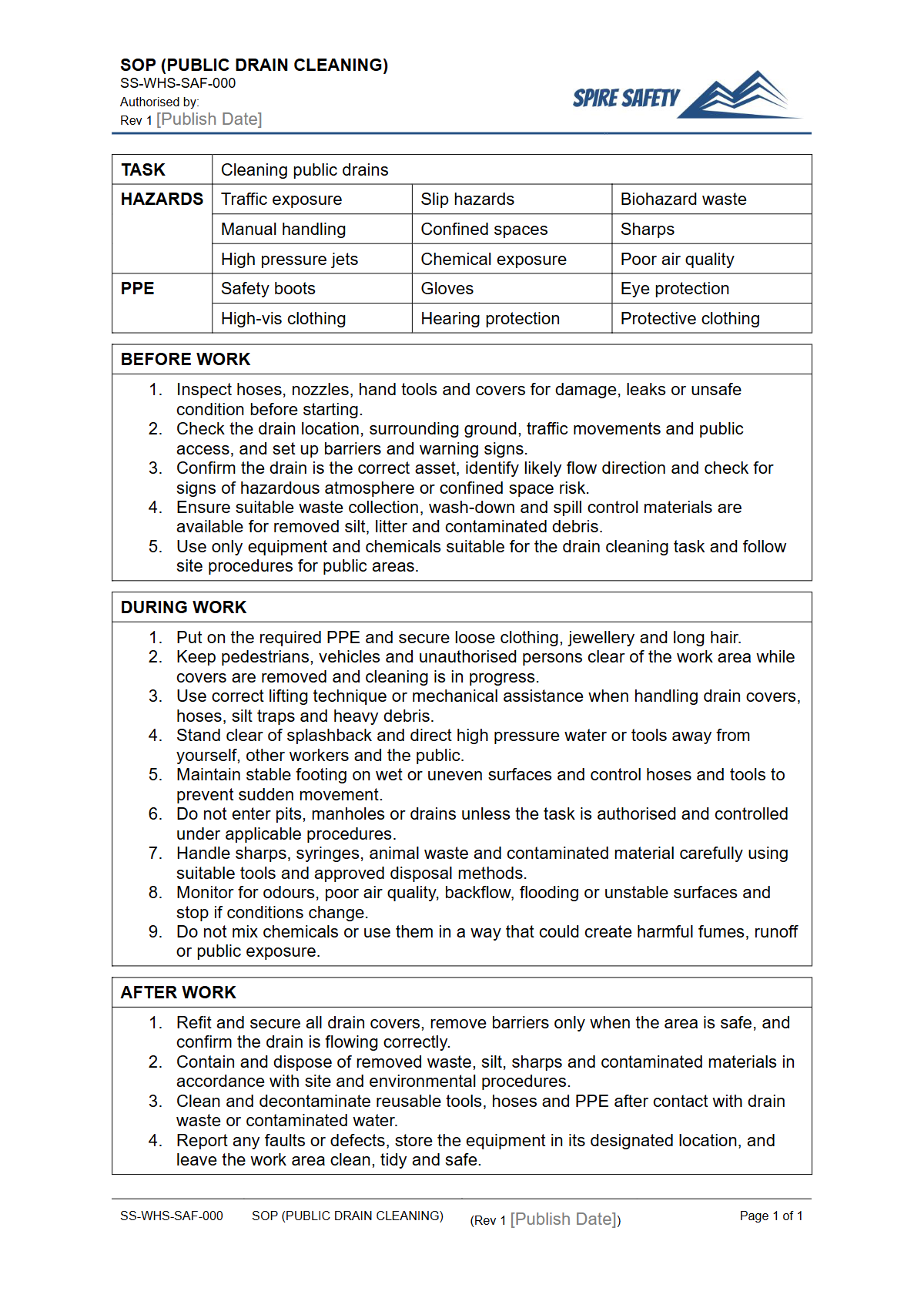
Download our free Safe Operating Procedure for public drain cleaning to formalise your safety processes. This customisable template helps you manage risks.
Free Safe Operating Procedure (Public Drain Cleaning) Template
DOCX • 126 KB + PDF
Updated Oct 2026
No signup required
Purpose of the Free Safe Operating Procedure (Public Drain Cleaning) Template
This document provides a structured framework for organisations conducting public drain cleaning activities. It is designed to help Persons Conducting a Business or Undertaking (PCBUs) outline the step-by-step process for safely completing the task, aligned with Australian WHS practices.
Using this free Safe Operating Procedure (Public Drain cleaning) Template as a foundation helps formalise your risk management for a high-risk activity. The template prompts you to identify and control hazards such as traffic interaction, confined spaces, biological contamination, hazardous gases, high-pressure equipment, and hazardous manual tasks.
Video walkthrough
How to use the Free Safe Operating Procedure (Public Drain Cleaning) Template
You can download this Safe Operating Procedure as a DOCX file for easy editing or as a PDF for quick reference. It is crucial to recognise that this document is a starting point, not a finished solution.
It is essential that you customise this template to reflect your specific workplace. We have provided a general structure, but you must add details about the specific equipment, chemicals, work locations, and personnel involved in your operations. A well-developed SOP is a critical component of your overall safety framework. Integrating task-specific procedures like this one into broader WHS management systems ensures a consistent and comprehensive approach to safety across your organisation.
If the customisation process seems complex or you lack the in-house expertise to address specific risks like confined space entry or chemical handling, seeking external guidance is a prudent step. Our team provides expert WHS consulting services to help businesses develop robust, practical, and effective safety documentation tailored to their unique operational needs.
When to Use This Safe Operating Procedure
An SOP is a living document used throughout the work cycle, not just a file to be stored away. It should be used to train new workers before they undertake any public drain cleaning tasks.
It also serves as an excellent tool for refresher training and toolbox talks to keep safety front-of-mind for experienced teams. The procedure should be reviewed as part of any pre-start checks. Furthermore, after any incident or near-miss, the SOP must be reviewed and updated to incorporate any lessons learned, which is a key activity verified during regular WHS compliance auditing.
Who Should Use This Document
This template is primarily for managers, supervisors, and safety professionals who are responsible for drafting and implementing safety procedures. They use the template to create a definitive document for the business.
The final, approved SOP is then used by the workers and operators who perform the drain cleaning; it is their guide to performing the task safely. Everyone performing the task must be thoroughly trained on the contents of the final, customised SOP.
Merely handing them the document is not sufficient training. This principle applies to all high-risk tasks, whether it's operating machinery as detailed in our free Trencher SOP or handling hazardous materials.
Key Hazards in Public Drain Cleaning
Public drain cleaning presents numerous serious hazards that must be managed through a formal risk assessment process. Traffic is a primary concern when working in public areas, requiring a detailed traffic management plan to protect both workers and the public.
Confined spaces like manholes and pits pose risks of oxygen deficiency, atmospheric contaminants, and engulfment, requiring strict entry protocols. Workers are also exposed to biological hazards from sewage and wastewater, and chemical hazards from cleaning agents or gases like hydrogen sulfide.
The use of plant and equipment also introduces risks. For instance, if an air compressor is used to power tools, its operation must be covered by a specific procedure, similar to the one outlined in our free Air Compressor SOP.
Essential Control Measures
Effective risk control relies on applying the hierarchy of controls, prioritising the elimination or substitution of hazards where possible. Key measures for public drain cleaning include:
- Planning: A thorough risk assessment must be conducted before any work begins. This includes identifying all potential hazards and determining appropriate controls, including emergency and rescue plans.
- Isolation: Implementing traffic control to isolate the work area from vehicles and pedestrians. Using lock-out/tag-out procedures for any machinery before maintenance or cleaning.
- Training: Ensuring all workers are competent and hold any necessary licenses or tickets, particularly for confined space entry and high-pressure water jetting.
- Personal Protective Equipment (PPE): Providing and ensuring the correct use of task-specific PPE, such as waterproof gloves, safety glasses or face shields, respiratory protection, and high-visibility clothing.
- Supervision: Providing adequate supervision by a competent person to ensure procedures are followed correctly.
Developing a comprehensive set of procedures can be a significant undertaking. For more examples and templates to assist in building your safety system, you can browse our library of free WHS resources to support your safety management efforts.
Common mistakes
Common mistakes to avoid
- Using a generic template without site-specific customisation.
- Failing to provide adequate training and supervision on the finalised SOP.
- Neglecting to conduct a pre-start risk assessment for each unique job site.
- Not having a specific, tested rescue plan in place for confined space entry.
Legal references
Legal considerations
The following legal requirements may be relevant to this type of work.
- Work Health and Safety Act (Harmonised) — Provides the primary duties for protecting workers and other people from work health and safety risks.
- Work Health and Safety Regulations (Harmonised) — Sets out requirements supporting the management of workplace hazards and risks.
The following codes may be relevant to this type of work.
- Managing WHS Risks Code of Practice — Provides practical guidance on identifying hazards, assessing risks and applying effective controls.
- Work Health and Safety Consultation, Cooperation and Coordination Code of Practice — Provides practical guidance on consulting workers and coordinating with other duty holders.
- Managing the Work Environment and Facilities Code of Practice — Provides practical guidance on safe work environments, workplace facilities and related controls.
Did you know
Hidden Dangers
Drains can contain hazardous gases like hydrogen sulfide, which is toxic and flammable. It is heavier than air and can accumulate in low-lying areas, displacing oxygen.
High-Pressure Risks
Water jetting equipment can operate at pressures high enough to pierce skin and cause severe injection injuries. These injuries are a medical emergency and can lead to amputation.
FAQ
Frequently asked questions
01Is this SOP template enough for WHS compliance?
02What are the main hazards of public drain cleaning?
03Who can sign off on a Safe Operating Procedure?
04How often should an SOP be reviewed?
Share this resource
Free Safe Operating Procedure (Public Drain Cleaning) Template
Browse Categories
How To Use It
- 1Download and open in Word or PDF.
- 2Replace the placeholders with your business details.
- 3Get it reviewed by a WHS specialist before rollout.
Need it customised?
Our WHS consultants can adapt this template to your site, run a gap analysis, or audit what you already have in place.
Book a Free Consultation WHS consulting servicesor call 1300 156 382
Related templates
- Free Safe Operating Procedure (Public Garden Watering) Template
- Free Safe Operating Procedure (Public Toilet Servicing) Template
- Free Safe Operating Procedure (Pump Alignment) Template
- Free Safe Operating Procedure (Pump Impeller Change) Template
- Free Safe Operating Procedure (Pump Priming) Template
- Free Safe Operating Procedure (Pump Seal Change) Template