
Free Safe Operating Procedure (Public Toilet Servicing) Template
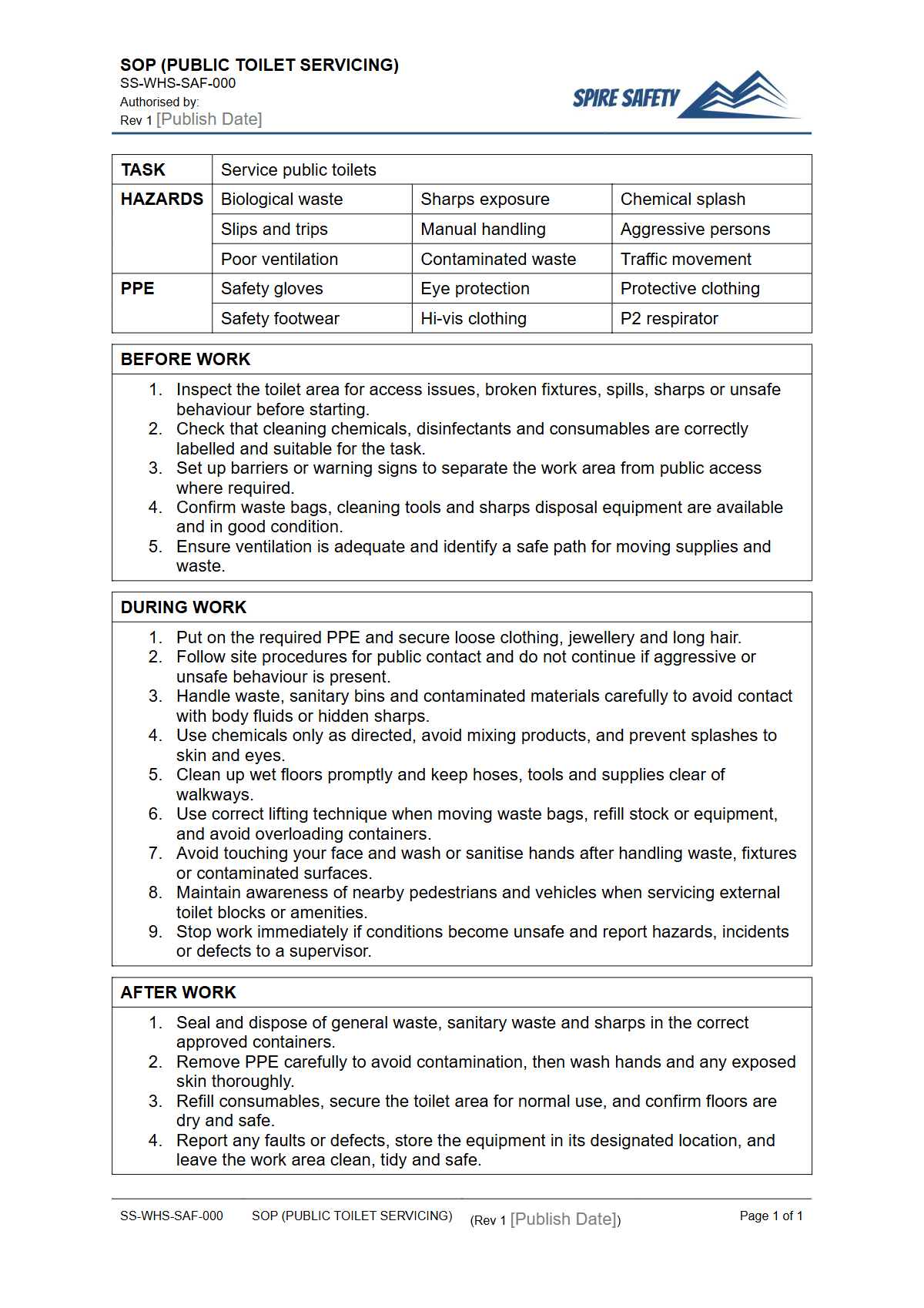
Download our free Safe Operating Procedure (Public Toilet Servicing) template. This DOCX and PDF resource helps outline safe work steps for cleaning staff.
Free Safe Operating Procedure (Public Toilet Servicing) Template
DOCX • 126 KB + PDF
Updated Oct 2026
No signup required
Purpose of the Free Safe Operating Procedure (Public Toilet Servicing) Template
Servicing public toilets involves significant health and safety risks, including exposure to biological hazards, hazardous chemicals, and manual handling injuries. This free Safe Operating Procedure (Public Toilet Servicing) Template provides a structured starting point for your business to formally document the step-by-step process for this task.
A well-developed SOP is a critical tool for managing risks, ensuring workers understand the required safety measures, and demonstrating WHS due diligence. Implementing clear procedures is a fundamental part of effective WHS management systems, helping to standardise safe work practices across your entire organisation.
Key Risks Addressed
This Safe Operating Procedure template prompts you to consider controls for common hazards associated with public toilet servicing, including:
- Biological Hazards: Exposure to bacteria, viruses, and other pathogens from contact with bodily fluids and contaminated surfaces.
- Chemical Hazards: Risks associated with handling, mixing, and using cleaning chemicals, including skin irritation, respiratory issues, and chemical burns.
- Manual Tasks: Strains and sprains from lifting heavy buckets, mopping, scrubbing, and carrying equipment.
- Slips, Trips, and Falls: Increased risk due to wet floors, trailing electrical cords, and working in potentially cluttered spaces.
- Sharps Injuries: Potential for contact with improperly disposed of needles or other sharp objects.
Video walkthrough
How to Use the Free Safe Operating Procedure (Public Toilet Servicing) Template
This document is available as a fully editable DOCX file, allowing for comprehensive customisation. A PDF version is also provided for easy distribution and printing.
To use the template effectively, you must adapt it to the specific circumstances of your workplace. This includes listing the exact cleaning chemicals used, the personal protective equipment (PPE) required, the specific equipment involved, and the unique layout of the facilities your team services.
Important: This is a template only. We have provided a framework based on Australian WHS principles, but you must customise it to reflect your actual processes and control measures.
We strongly recommend you consult with your workers during the drafting and review process to ensure the SOP is practical and effective. For expert assistance in tailoring safety documents to your operations, consider our WHS consulting services.
When to Use This Safe Operating Procedure
An SOP for public toilet servicing should be a core part of your daily operations and safety framework. It is used to:
- Train and induct new employees on the established safe method for completing the task.
- Provide a clear reference point for experienced workers to ensure consistency.
- Conduct toolbox talks or pre-start meetings to reinforce safety protocols.
- Investigate incidents or near misses to understand if procedural steps were followed.
- Review and improve work practices over time.
Regularly reviewing and updating your SOPs is a key part of maintaining safety standards. This process can be integrated into a scheduled program of WHS compliance auditing to ensure your documented procedures remain current and aligned with on-the-ground practices.
Who Should Use It
This Safe Operating Procedure is intended for use by multiple roles within a business:
- Cleaning and Maintenance Staff: As the primary users, this document guides their day-to-day work, ensuring they follow safe and consistent procedures.
- Supervisors and Managers: To train staff, monitor work, and enforce safety standards.
- WHS Officers and PCBUs: To meet their duty of care by providing safe systems of work and adequate training. Documented procedures like this SOP form an essential part of an occupational health and safety management system, which can be aligned with global standards through ISO 45001 consulting.
Find more templates and checklists to support your safety management system by browsing our complete free WHS resources library.
Common mistakes
Common mistakes to avoid
- Using a generic template without adding site-specific details like access, waste disposal, and emergency contacts.
- Failing to train workers on the SOP and confirm they understand the procedures before starting work.
- Not including steps for managing unexpected hazards like sharps, aggressive members of the public, or equipment failure.
- Forgetting to review and update the SOP after an incident or when new cleaning chemicals or equipment are introduced.
Legal references
Legal considerations
The following legal requirements may be relevant to this type of work.
- Work Health and Safety Act (Harmonised) — Provides the primary duties for protecting workers and other people from work health and safety risks.
- Work Health and Safety Regulations (Harmonised) — Sets out requirements supporting the management of workplace hazards and risks.
The following codes may be relevant to this type of work.
- Managing WHS Risks Code of Practice — Provides practical guidance on identifying hazards, assessing risks and applying effective controls.
- Work Health and Safety Consultation, Cooperation and Coordination Code of Practice — Provides practical guidance on consulting workers and coordinating with other duty holders.
- Managing the Work Environment and Facilities Code of Practice — Provides practical guidance on safe work environments, workplace facilities and related controls.
Did you know
Biological Hazards
Cleaning staff are at a high risk of exposure to biological hazards like bacteria (E. coli, Salmonella) and viruses. A documented SOP is a key administrative control measure to minimise infection risk.
Manual Task Injuries
According to Safe Work Australia, injuries from manual tasks are a leading cause of workers' compensation claims. Procedures for tasks like lifting heavy buckets or using floor scrubbers are crucial for prevention.
FAQ
Frequently asked questions
01What is the difference between an SOP and a Safe Work Method Statement (SWMS)?
02How often should a Public Toilet Servicing SOP be reviewed?
03Do I need to list every single chemical in the SOP?
04Can I use this template for cleaning private office toilets?
Share this resource
Free Safe Operating Procedure (Public Toilet Servicing) Template
Browse Categories
How To Use It
- 1Download and open in Word or PDF.
- 2Replace the placeholders with your business details.
- 3Get it reviewed by a WHS specialist before rollout.
Need it customised?
Our WHS consultants can adapt this template to your site, run a gap analysis, or audit what you already have in place.
Book a Free Consultation WHS consulting servicesor call 1300 156 382
Related templates
- Free Safe Operating Procedure (Pump Alignment) Template
- Free Safe Operating Procedure (Pump Impeller Change) Template
- Free Safe Operating Procedure (Pump Priming) Template
- Free Safe Operating Procedure (Pump Seal Change) Template
- Free Safe Operating Procedure (Pump Station Check) Template
- Free Safe Operating Procedure (Pump Test Rig) Template