
Free Safe Operating Procedure (Pump Station Check) Template
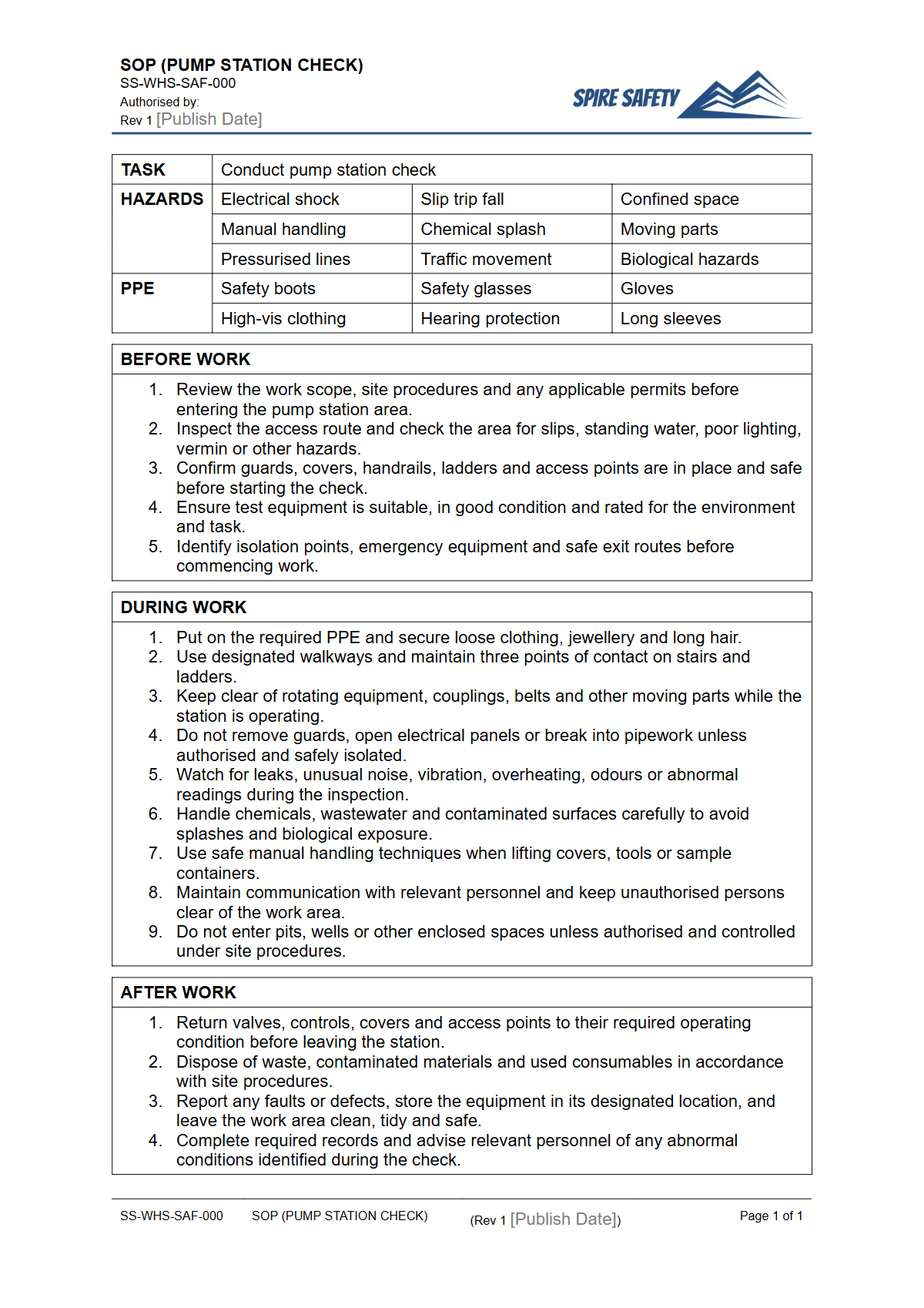
Our free Safe Operating Procedure (Pump Station Check) template provides a structured format for routine checks. Download this customisable DOCX to get started.
Free Safe Operating Procedure (Pump Station Check) Template
DOCX • 126 KB + PDF
Updated Oct 2026
No signup required
Purpose of the Free Safe Operating Procedure (Pump Station Check) Template
This free Safe Operating Procedure (Pump Station Check) template is designed to help your organisation establish and document a consistent process for inspecting and maintaining pump stations. Regular checks are critical for ensuring operational reliability and, more importantly, the safety of workers.
Pump stations can present significant hazards, including electrical risks, mechanical entanglement from moving parts like shafts and impellers, drowning, and exposure to hazardous substances or atmospheres in pits and wet wells.
Using a standardised SOP helps ensure that all essential safety and operational checks are completed methodically every time. It serves as a clear guide for operators and maintenance personnel, reducing the chance of overlooked steps that could lead to equipment failure or a serious incident.
This document formalises the required steps, personal protective equipment (PPE), and emergency responses, forming a key part of a safe system of work. It functions similarly to procedures for other fixed plant, such as a conveyer system SOP, by breaking down a complex task into manageable, safe steps.
Video walkthrough
How to use the Free Safe Operating Procedure (Pump Station Check) Template
This document is a starting point. To make it effective, you must adapt it to the unique circumstances of your workplace.
Download the DOCX file and customise it by incorporating details specific to your pump station's make and model, its function (e.g., stormwater, sewage, industrial process), and the identified hazards from your risk assessment. Consult the manufacturer's operating manual and maintenance guides to ensure all required checks are included.
A critical step in customisation is to walk through the procedure on-site with the workers who will be using it. This ensures the steps are logical, practical, and accurately reflect the task.
The finalised SOP should be integrated into your broader safety framework. A well-developed SOP is a cornerstone of effective WHS management systems, providing clear instructions that support your overall risk management strategy.
Important Note on Customisation
This is a template and not a complete Safe Operating Procedure. We are not familiar with your specific equipment, site conditions, or operational context.
It is your responsibility to ensure the final document is comprehensive, accurate, and addresses all relevant hazards at your workplace before implementation.
When to use this Safe Operating Procedure
An SOP for pump station checks is not a one-off document; it should be used consistently during specific operational phases. Key times to use this procedure include:
- Pre-start Checks: Before activating the pump station for a cycle, particularly after a period of shutdown or maintenance.
- Routine Inspections: As part of a scheduled maintenance plan (e.g., daily, weekly, or monthly checks) to monitor for wear and tear, leaks, unusual noises, or vibrations.
- Post-Maintenance Verification: After any repair or maintenance work, to confirm the pump station is functioning correctly and safely before it is returned to service.
- Operator Training and Competency Assessment: As a training tool to instruct new workers on the correct, safe method for conducting checks and as a basis for assessing their competency.
Who should use it
This SOP should be used by all personnel authorised to operate or maintain the pump station. This typically includes:
- Plant Operators: Individuals responsible for the day-to-day operation and monitoring of the equipment.
- Maintenance Personnel: Fitters, electricians, and technicians who perform scheduled maintenance, diagnostics, and repairs. These checks might involve auxiliary equipment common on site, such as that covered in an air compressor SOP.
- Supervisors and Managers: Those responsible for overseeing work, providing training, and ensuring procedures are followed correctly. Regular verification of SOP usage can be part of an internal review or a formal WHS compliance auditing program.
Every person using the SOP must be trained on its contents and be deemed competent to perform the tasks described. For personnel working with various types of pumps, it's essential they are familiar with the specific procedures for each, such as the distinct steps outlined in a free Boom Pump SOP for mobile concrete pumping.
You can explore our entire free WHS resources library for more templates to support your operations.
Common mistakes
Common mistakes to avoid
- Using a generic template without customising it for the specific pump model and site hazards.
- Failing to include clear emergency procedures for pump failure, flooding, or exposure to hazardous materials.
- Not providing practical training to workers on how to use the SOP correctly.
- Neglecting to review and update the SOP after an incident, a near miss, or when equipment is modified.
Legal references
Legal considerations
The following legal requirements may be relevant to this type of work.
- Work Health and Safety Act (Harmonised) — Provides the primary duties for protecting workers and other people from work health and safety risks.
- Work Health and Safety Regulations (Harmonised) — Sets out requirements supporting the management of workplace hazards and risks.
The following codes may be relevant to this type of work.
- Managing WHS Risks Code of Practice — Provides practical guidance on identifying hazards, assessing risks and applying effective controls.
- Work Health and Safety Consultation, Cooperation and Coordination Code of Practice — Provides practical guidance on consulting workers and coordinating with other duty holders.
- Managing the Work Environment and Facilities Code of Practice — Provides practical guidance on safe work environments, workplace facilities and related controls.
Did you know
Confined Space Dangers
Many pump station incidents occur in wet wells or pits, which are often classified as confined spaces. Without proper atmospheric testing and entry procedures, these areas can contain toxic gases or have dangerously low oxygen levels.
FAQ
Frequently asked questions
01What are the key hazards in a pump station?
02How often should pump station checks be performed?
03Is an SOP a legal requirement for pump stations in Australia?
04What is the difference between an SOP and a SWMS?
Share this resource
Free Safe Operating Procedure (Pump Station Check) Template
Browse Categories
How To Use It
- 1Download and open in Word or PDF.
- 2Replace the placeholders with your business details.
- 3Get it reviewed by a WHS specialist before rollout.
Need it customised?
Our WHS consultants can adapt this template to your site, run a gap analysis, or audit what you already have in place.
Book a Free Consultation WHS consulting servicesor call 1300 156 382
Related templates
- Free Safe Operating Procedure (Pump Test Rig) Template
- Free Safe Operating Procedure (Punch Press) Template
- Free Safe Operating Procedure (Quad Bike - Standard Operation) Template
- Free Safe Operating Procedure (Radial Arm Saw) Template
- Free Safe Operating Procedure (Radiant Heater) Template
- Free Safe Operating Procedure (Rail Car Cleaning) Template