
Free Safe Operating Procedure (Radiant Heater) Template
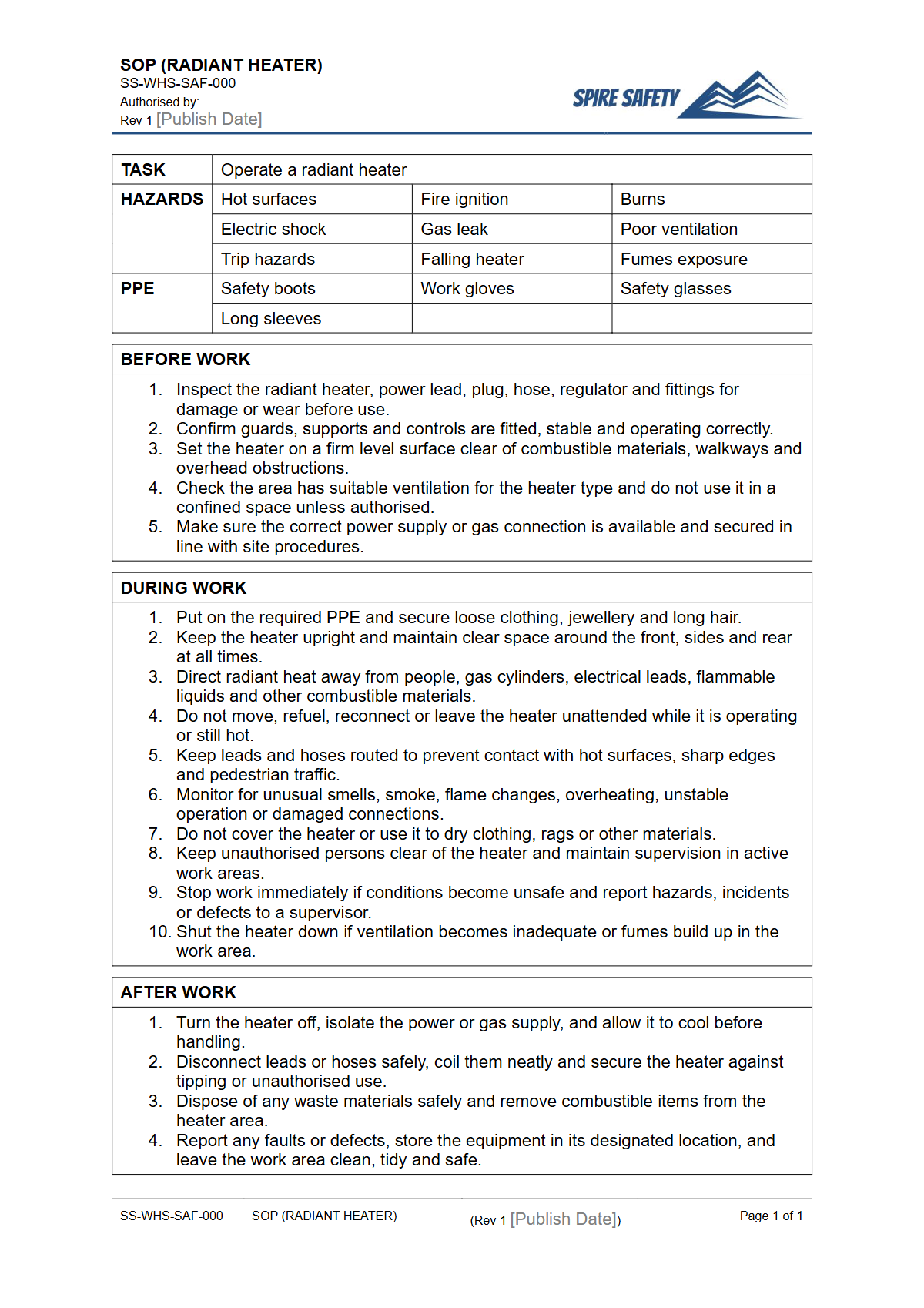
Download our free Safe Operating Procedure (Radiant Heater) Template to manage thermal hazards. This DOCX and PDF helps formalise your safety steps.
Free Safe Operating Procedure (Radiant Heater) Template
DOCX • 126 KB + PDF
Updated Oct 2026
No signup required
Purpose of the Free Safe Operating Procedure (Radiant Heater) Template
This Free Safe Operating Procedure (Radiant Heater) Template provides a structured framework for documenting the safe use of portable and fixed radiant heaters in your workplace. Its primary purpose is to help Persons Conducting a Business or Undertaking (PCBUs) manage risks associated with thermal hazards, electrical energy, and potential fire ignition.
By clearly outlining step-by-step instructions, pre-operational checks, and emergency responses, this SOP serves as a critical tool for worker training, induction, and ongoing risk management. A documented procedure demonstrates a commitment to providing a safe system of work, which is a fundamental requirement of Australian WHS legislation.
An effective Safe Operating Procedure forms a key component of a compliant and robust WHS management system. This template helps standardise operator behaviour, reduce the likelihood of incidents, and provides a clear reference point for supervisors and workers alike. Similar to procedures for other heat-generating equipment, like a Safe Operating Procedure for a deep fryer, it focuses on specific hazards unique to the equipment.
Key Hazards Addressed
Using this template will prompt you to consider and control for common radiant heater hazards, including:
- Thermal Burns: Direct contact with hot surfaces of the heater guard or elements.
- Fire and Explosion: Ignition of nearby flammable or combustible materials (e.g., paper, textiles, solvents) due to radiated heat.
- Electrical Hazards: Risks from damaged cords, improper connections, or internal faults leading to electric shock or fire.
- Air Quality: Risks from using fuel-powered (e.g., LPG) heaters in poorly ventilated areas, leading to carbon monoxide build-up.
Video walkthrough
How to use the Free Safe Operating Procedure (Radiant Heater) Template
To effectively use this Safe Operating Procedure (Radiant Heater) Template, you must adapt it to the specific context of your workplace. The downloaded document is a starting point, not a finished product.
A generic procedure cannot account for the unique variables of your site, equipment models, and operational environment.
Important: We provide this template as a guide. You must customise it by undertaking a site-specific risk assessment for the radiant heater(s) you use.
Identify all potential hazards and implement control measures that are relevant to your business. If you are unsure how to complete this process, we recommend seeking expert WHS consulting.
Customisation Checklist
- Equipment Details: Insert the specific make, model, and identification numbers for the heaters used at your site.
- Site-Specific Risks: Add any hazards unique to your environment, such as the presence of volatile chemicals or high foot traffic.
- Control Measures: Detail your specific controls, such as required clearance distances, mandatory inspection frequencies, and the type of fire extinguisher to be kept nearby. For other portable electrical tools, a similar process would be followed when customising an SOP for a circular saw.
- Emergency Contacts: Update the emergency procedures with your site-specific contact numbers and assembly points.
When to use it
A Safe Operating Procedure for a radiant heater should be formally integrated into your daily operations. It is not a document to be filed away and forgotten. Use it during:
- Worker Inductions: As a core training document for new employees or contractors who will work in areas where radiant heaters are used.
- Task-Specific Training: Before a worker is authorised to operate, move, or maintain a heater for the first time.
- Pre-Start Checks: As a checklist to guide the mandatory daily inspection before switching the unit on.
- Incident Investigations: As a benchmark to assess whether established procedures were followed.
- Refresher Training: Periodically, or when a new model of heater is introduced, to ensure knowledge remains current. Reviewing SOPs is a key activity in a formal safety review or WHS compliance auditing program.
Who should use it
This SOP is intended for use by several groups within an organisation:
- Workers and Operators: To understand and follow the correct, safe steps for using the equipment.
- Supervisors and Managers: To conduct training, enforce safe work practices, and monitor compliance with the procedure.
- WHS Representatives and Committees: As a tool for consultation and a reference during workplace inspections and safety meetings.
- PCBUs and Directors: To help meet their primary duty of care by ensuring safe systems of work are documented, implemented, and maintained across the business. While the hazards are different, the responsibility for implementation is the same as for an SOP for an air compressor or any other plant.
By implementing this procedure, you are taking a practical step towards safeguarding your team from preventable harm. For more templates and safety resources, browse our complete free WHS resources library.
Common mistakes
Common mistakes to avoid
- Placing heaters too close to flammable or combustible materials.
- Using indoor-only heaters in outdoor or wet areas.
- Connecting the heater to an underrated or damaged extension cord.
- Leaving heaters unattended in occupied spaces or overnight.
- Failing to inspect the cord, plug, and safety guards before each use.
Legal references
Legal considerations
The following legal requirements may be relevant to this type of work.
- Work Health and Safety Act (Harmonised) — Provides the primary duties for protecting workers and other people from work health and safety risks.
- Work Health and Safety Regulations (Harmonised) — Sets out requirements supporting the management of workplace hazards and risks.
The following codes may be relevant to this type of work.
- Managing WHS Risks Code of Practice — Provides practical guidance on identifying hazards, assessing risks and applying effective controls.
- Work Health and Safety Consultation, Cooperation and Coordination Code of Practice — Provides practical guidance on consulting workers and coordinating with other duty holders.
- Managing the Work Environment and Facilities Code of Practice — Provides practical guidance on safe work environments, workplace facilities and related controls.
Did you know
Clearance is Critical
Most fire incidents involving radiant heaters are caused by placing them too close to combustible materials. Australian standards typically require a minimum clearance of one metre from objects like furniture, curtains, and paper.
Tipping Point
Modern portable radiant heaters are often required to have a 'tip-over switch' that automatically cuts power if the unit is knocked over. This feature is a crucial defence against fires caused by an overturned heater.
FAQ
Frequently asked questions
01What is a Safe Operating Procedure for a radiant heater?
02Is this radiant heater SOP template free to download and use?
03How often should we review our radiant heater SOP?
04Who is responsible for creating a Safe Operating Procedure?
Share this resource
Free Safe Operating Procedure (Radiant Heater) Template
Browse Categories
How To Use It
- 1Download and open in Word or PDF.
- 2Replace the placeholders with your business details.
- 3Get it reviewed by a WHS specialist before rollout.
Need it customised?
Our WHS consultants can adapt this template to your site, run a gap analysis, or audit what you already have in place.
Book a Free Consultation WHS consulting servicesor call 1300 156 382
Related templates
- Free Safe Operating Procedure (Rail Car Cleaning) Template
- Free Safe Operating Procedure (Rail Car Coupling Check) Template
- Free Safe Operating Procedure (Rail Depot Waste) Template
- Free Safe Operating Procedure (Rail Platform Cleaning) Template
- Free Safe Operating Procedure (Rail Sanding Refill) Template
- Free Safe Operating Procedure (Rail Yard Housekeeping) Template