
Free Safe Operating Procedure (Rail Car Cleaning) Template
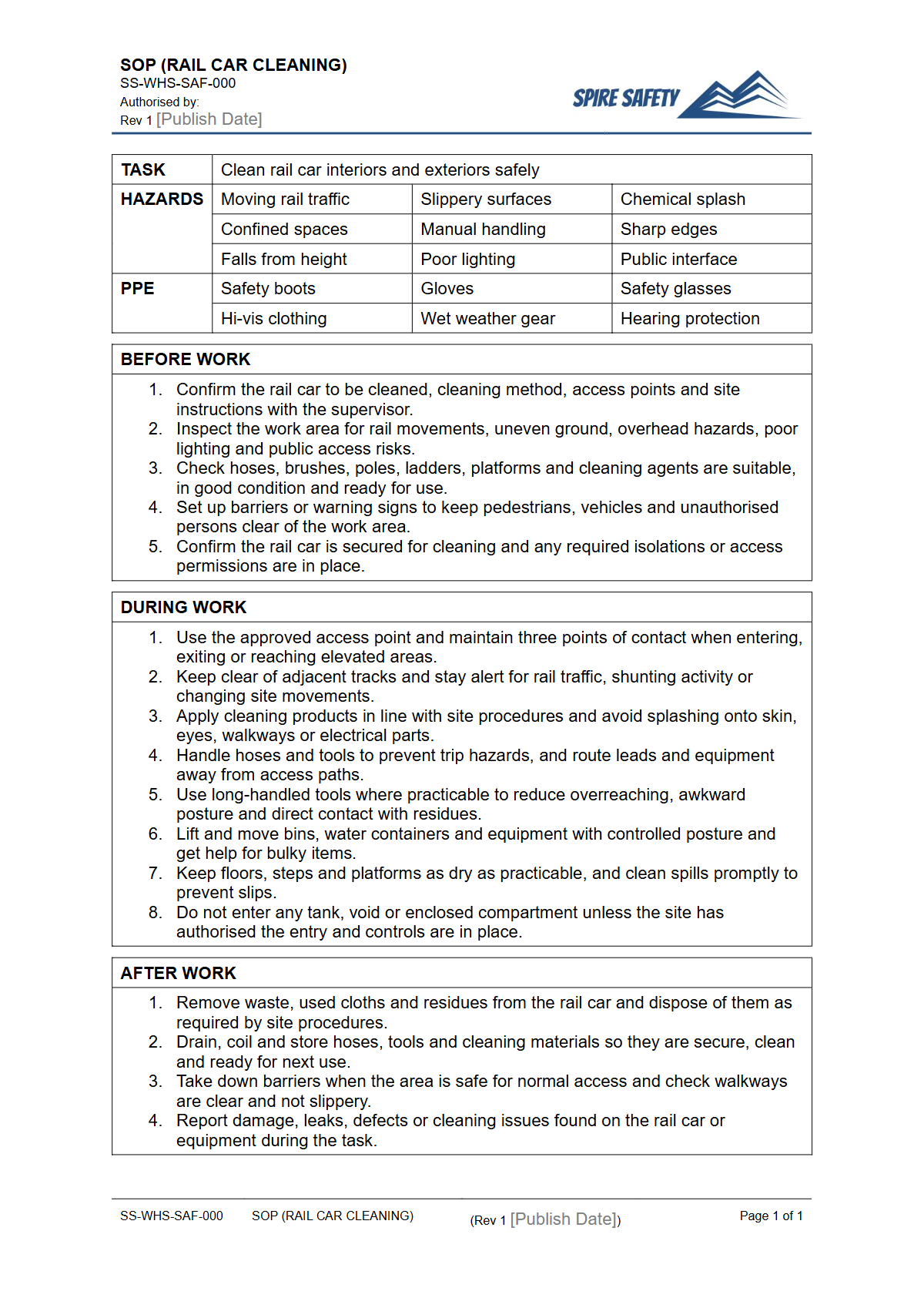
Download our free Safe Operating Procedure for rail car cleaning to formalise your safety processes. Customise this user-friendly template for your worksite.
Free Safe Operating Procedure (Rail Car Cleaning) Template
DOCX • 126 KB + PDF
Updated Oct 2026
No signup required
Purpose of the Free Safe Operating Procedure (Rail Car Cleaning) Template
Rail car cleaning is a high-risk task involving numerous hazards, from chemical exposure and confined spaces to slips, trips, and falls. This Free Safe Operating Procedure (Rail Car Cleaning) Template provides a structured framework for documenting a safe system of work for these activities.
A documented SOP is crucial for ensuring every worker understands the required steps, safety controls, and emergency responses associated with the job. It helps standardise procedures, reduce the likelihood of incidents, and demonstrate your organisation's commitment to safety.
By clearly defining the process, you can systematically address risks like manual handling injuries, exposure to cleaning agents, and interaction with moving plant. Integrating this SOP into your broader safety framework is a key step in managing your WHS duties.
A well-developed procedure forms a critical part of comprehensive WHS management systems, providing auditable evidence of your risk management processes.
Video walkthrough
How to use the Free Safe Operating Procedure (Rail Car Cleaning) Template
This template is provided in both DOCX and PDF formats for your convenience. The DOCX version is fully editable, allowing you to adapt it to your specific operational context. To use the template effectively, you should:
- Download the file and open it in your preferred word processor.
- Fill in the company-specific details at the top, including site location, manager details, and review dates.
- Systematically work through each section, replacing the placeholder text with information relevant to your worksite. Detail the exact types of rail cars, cleaning agents, tools (e.g., pressure washers, brushes), and Personal Protective Equipment (PPE) used.
- Conduct a risk assessment for the entire cleaning process and ensure the control measures listed in the SOP are sufficient to manage the identified risks.
Important: This document is a template only. You must customise it to reflect the specific hazards, equipment, chemicals, and control measures present in your workplace.
We recommend a comprehensive risk assessment before finalising your SOP. Procedures should be developed in consultation with the workers who perform the task.
Many rail yards are complex environments with multiple operations occurring simultaneously. Ensure your SOP for rail car cleaning considers interactions with other equipment and processes.
For example, if cleaning occurs near active freight lines, you may also need a Conveyer System SOP to manage associated risks.
When to use a Safe Operating Procedure
A Safe Operating Procedure for rail car cleaning should be a living document integrated into your daily operations. It is used in several key situations:
- Worker Training: Use the SOP as the primary training document for new employees or workers newly assigned to cleaning tasks.
- Pre-Start Checks: Workers should review the SOP before commencing work to refresh their understanding of the steps and safety controls.
- Refresher Training: The SOP should be a central part of periodic refresher training to ensure safe work habits are maintained.
- Incident Investigation: Following an incident or near miss, the SOP should be reviewed to determine if the procedure was followed and if it needs to be updated.
- Audits and Inspections: The document serves as evidence of your established safe work methods during internal or external safety audits. Periodic WHS compliance auditing helps verify that the procedures documented are being followed correctly in practice.
Who should use this template
This template is designed for use by various personnel within an organisation that operates or services rail fleets. Key users include:
- WHS Managers and Advisors: To develop, implement, and review safety documentation as part of the overall safety management system.
- Supervisors and Team Leaders: To train their teams, enforce safe work practices, and conduct pre-start briefings.
- Workers: As a clear, step-by-step guide on how to perform their cleaning duties safely.
- Training Coordinators: To form the basis of competency-based training and assessment materials.
The use of mobile plant is also common in rail environments. If your cleaning crews operate equipment like forklifts or elevated work platforms, ensure you have specific procedures for them.
For instance, teams that use versatile lifting equipment could benefit from our FREE Telehandler SOP Template. In some maintenance scenarios, high-pressure equipment is also used, making a reference like our Free Air Compressor SOP Template a useful guide for documenting similar pressure-related hazards.
This document is just one of many professionally developed documents available in our free WHS resources library to help you build out your safety system.
Common mistakes
Common mistakes to avoid
- Failing to customise the template for specific chemicals and equipment used at the worksite.
- Neglecting to train workers on the finalised SOP and verify their understanding before they start work.
- Not including clear emergency procedures for chemical spills, personal exposure, or equipment failure.
- Overlooking associated risks like working at height, confined spaces, or interaction with other mobile plant.
Legal references
Legal considerations
The following legal requirements may be relevant to this type of work.
- Work Health and Safety Act (Harmonised) — Provides the primary duties for protecting workers and other people from work health and safety risks.
- Work Health and Safety Regulations (Harmonised) — Sets out requirements supporting the management of workplace hazards and risks.
The following codes may be relevant to this type of work.
- Managing WHS Risks Code of Practice — Provides practical guidance on identifying hazards, assessing risks and applying effective controls.
- Work Health and Safety Consultation, Cooperation and Coordination Code of Practice — Provides practical guidance on consulting workers and coordinating with other duty holders.
- Managing the Work Environment and Facilities Code of Practice — Provides practical guidance on safe work environments, workplace facilities and related controls.
Did you know
Slips, Trips, and Falls
Slips, trips, and falls are a leading cause of serious injury in the Australian transport and storage industry. Documented cleaning procedures are essential for managing wet and potentially cluttered work areas to mitigate these common risks.
Confined Space Risks
Cleaning certain rail cars, such as tankers, can be classified as confined space entry. This task requires specific permits, gas monitoring, training, and rescue plans that go beyond a general cleaning SOP.
FAQ
Frequently asked questions
01What hazards are involved in rail car cleaning?
02Is a Safe Operating Procedure a legal requirement for rail car cleaning in Australia?
03How often should an SOP for rail car cleaning be reviewed?
04Can this template be used for cleaning other types of vehicles?
Share this resource
Free Safe Operating Procedure (Rail Car Cleaning) Template
Browse Categories
How To Use It
- 1Download and open in Word or PDF.
- 2Replace the placeholders with your business details.
- 3Get it reviewed by a WHS specialist before rollout.
Need it customised?
Our WHS consultants can adapt this template to your site, run a gap analysis, or audit what you already have in place.
Book a Free Consultation WHS consulting servicesor call 1300 156 382
Related templates
- Free Safe Operating Procedure (Rail Car Coupling Check) Template
- Free Safe Operating Procedure (Rail Depot Waste) Template
- Free Safe Operating Procedure (Rail Platform Cleaning) Template
- Free Safe Operating Procedure (Rail Sanding Refill) Template
- Free Safe Operating Procedure (Rail Yard Housekeeping) Template
- Free Safe Operating Procedure (Raised Bed Maintenance) Template