
Free Safe Operating Procedure (Raised Bed Maintenance) Template
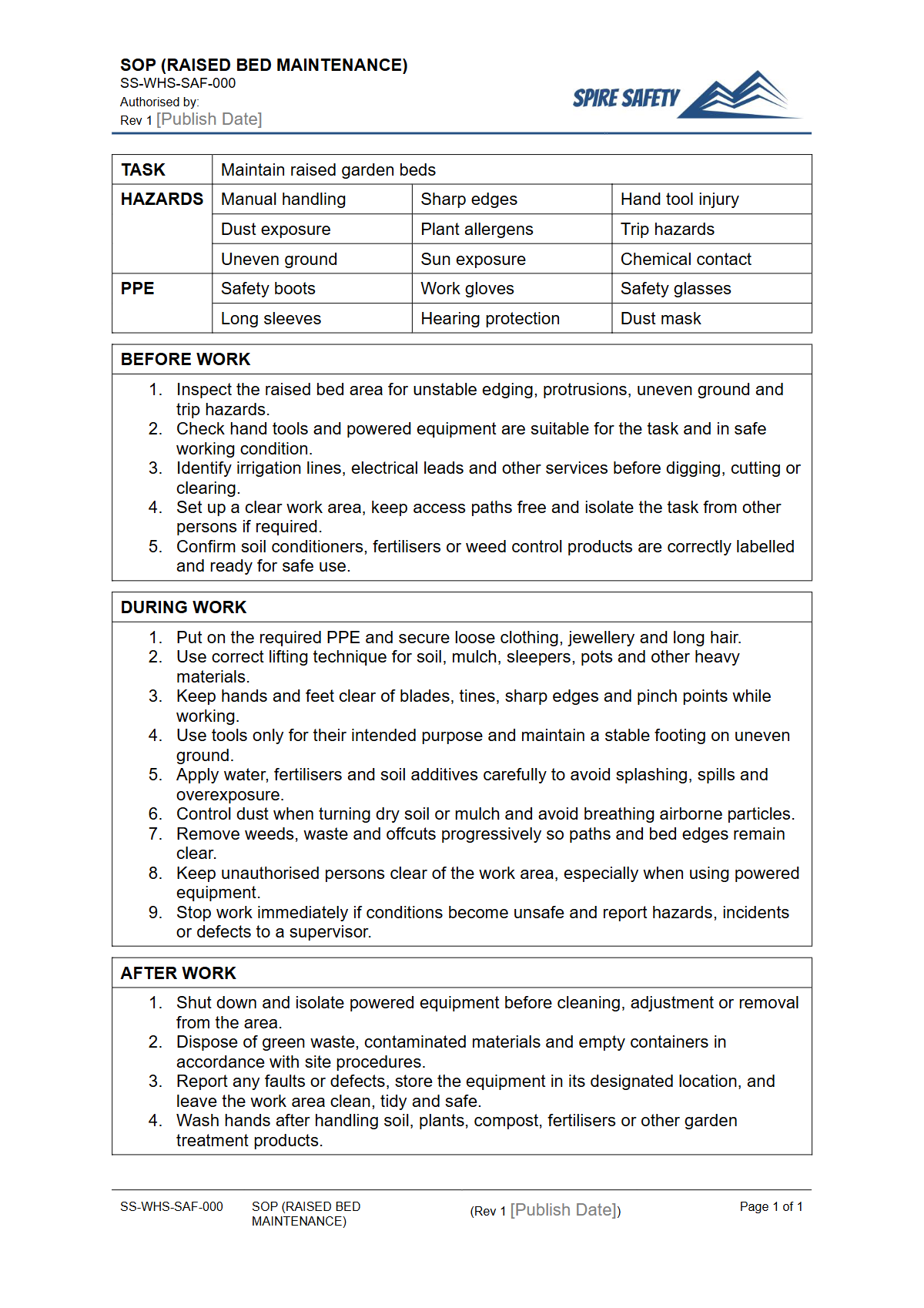
Download our free Safe Operating Procedure for raised bed maintenance. This template helps you outline safe work practices for horticultural tasks.
Free Safe Operating Procedure (Raised Bed Maintenance) Template
DOCX • 126 KB + PDF
Updated Oct 2026
No signup required
Purpose of the Free Safe Operating Procedure (Raised Bed Maintenance) Template
This free Safe Operating Procedure (Raised Bed Maintenance) template provides a structured starting point for documenting the safety steps involved in horticultural and landscaping tasks. Raised bed maintenance involves a range of activities, from preparing soil and planting to weeding and structural repairs, each with its own set of hazards.
Using a formal SOP helps a Person Conducting a Business or Undertaking (PCBU) meet their primary duty of care by providing a clear, safe system of work.
A documented procedure is an essential tool for risk management. It standardises the work method, minimises variation in how tasks are performed, and ensures control measures are consistently applied.
This helps reduce the risk of injuries associated with manual tasks, tool use, chemical handling, and exposure to biological hazards. It also serves as a critical document for worker training, inductions, and competency assessments.
This template is designed to be adapted to cover tasks from seeding, which can be detailed using our free Planter SOP template, to managing soil amendments and structural upkeep.
Video walkthrough
How to use the Free Safe Operating Procedure (Raised Bed Maintenance) Template
This resource is available for download as both a DOCX file and a PDF. The DOCX version is fully editable, allowing you to tailor it to the specific conditions of your workplace.
To effectively use this template, you should systematically work through each section, replacing the placeholder text with details relevant to your site, equipment, materials, and workforce. A well-drafted SOP is a key component of a broader WHS management system, providing clear instructions to workers and demonstrating due diligence.
The procedure should detail pre-start checks, operational steps, and post-task clean-up. Be specific about the Personal Protective Equipment (PPE) required, such as gloves, safety glasses, and covered footwear.
Also, include emergency procedures, outlining the response to potential incidents like sprains, cuts, or chemical exposure. For structural repairs involving timber, you may need to refer to specific tool procedures like our FREE Circular Saw SOP to manage high-risk activities.
Important Note: Customisation is Essential
Please note: this is a template document. To be effective, you must customise it to reflect the specific equipment, environment, and personnel in your workplace.
We strongly recommend conducting a thorough risk assessment to inform this customisation process, ensuring all identified hazards are controlled. The final document should be a practical tool that your workers can understand and follow easily.
When to use it
A Safe Operating Procedure for raised bed maintenance should be developed and implemented before any related work begins. It forms the basis of worker training and should be readily accessible in the work area for reference at all times.
Use this SOP during new worker inductions, for refresher training sessions, and as part of pre-start or toolbox talks to review risks before the task commences. It should also be a key document reviewed during any incident investigation or safety audit related to gardening or landscaping work. Reviewing your procedures can be a key outcome of regular WHS compliance auditing.
Who should use it
This SOP template is designed for use by anyone involved in the horticulture, landscaping, agriculture, and groundskeeping industries. This includes workers who perform the maintenance tasks, as well as their supervisors, managers, and safety officers.
PCBUs can use this template as a tool to meet their duties, and our WHS consulting services can assist in tailoring these documents to your specific operational needs. It is also a valuable resource for organisations that utilise volunteers for gardening activities, helping to ensure their safety is managed effectively. The principles can also apply to complex commercial operations where mechanised equipment is used, such as when installing drainage systems detailed in our free Trencher SOP template.
Ultimately, a robust SOP benefits the entire organisation by creating a safer work environment, improving operational consistency, and providing clear guidance for everyone involved. For more templates covering a wide range of tasks and equipment, you can browse our complete free WHS resources library.
Common mistakes
Common mistakes to avoid
- Using a generic template without customising it for site-specific equipment, materials, and hazards.
- Failing to involve workers who perform the task in the drafting and review process.
- Not providing adequate training on the finalised SOP before work commences.
- Forgetting to review and update the SOP after an incident, near miss, or change in procedure.
Legal references
Legal considerations
The following legal requirements may be relevant to this type of work.
- Work Health and Safety Act (Harmonised) — Provides the primary duties for protecting workers and other people from work health and safety risks.
- Work Health and Safety Regulations (Harmonised) — Sets out requirements supporting the management of workplace hazards and risks.
The following codes may be relevant to this type of work.
- Managing WHS Risks Code of Practice — Provides practical guidance on identifying hazards, assessing risks and applying effective controls.
- Work Health and Safety Consultation, Cooperation and Coordination Code of Practice — Provides practical guidance on consulting workers and coordinating with other duty holders.
- Managing the Work Environment and Facilities Code of Practice — Provides practical guidance on safe work environments, workplace facilities and related controls.
Did you know
Manual Task Injuries
Across Australia, injuries from hazardous manual tasks are the most common type of workplace injury. This makes documented procedures for physical jobs like gardening and landscaping crucial for risk management and injury prevention.
Soil-Borne Bacteria
Tetanus isn't the only risk from soil. Legionella longbeachae, often found in potting mix and compost, can cause a serious lung infection, highlighting the need for PPE like gloves and P2 masks when handling soils.
FAQ
Frequently asked questions
01What are the main hazards in raised bed maintenance?
02Is a Safe Operating Procedure a legal requirement in Australia?
03How often should I review a SOP for raised bed maintenance?
04Can I use this template for large-scale commercial gardening?
Share this resource
Free Safe Operating Procedure (Raised Bed Maintenance) Template
Browse Categories
How To Use It
- 1Download and open in Word or PDF.
- 2Replace the placeholders with your business details.
- 3Get it reviewed by a WHS specialist before rollout.
Need it customised?
Our WHS consultants can adapt this template to your site, run a gap analysis, or audit what you already have in place.
Book a Free Consultation WHS consulting servicesor call 1300 156 382
Related templates
- Free Safe Operating Procedure (Rangehood Cleaning) Template
- Free Safe Operating Procedure (RC Drill Rig) Template
- Free Safe Operating Procedure (RCD Testing) Template
- Free Safe Operating Procedure (Reach Truck) Template
- Free Safe Operating Procedure (Rebar Bender) Template
- Free Safe Operating Procedure (Rebar Cutter) Template