
Free Safe Operating Procedure (Reach Truck) Template
Establish clear safety guidelines for reach truck operation in your warehouse. Our free template helps you document procedures and manage risks.
Free Safe Operating Procedure (Reach Truck) Template
DOCX • 126 KB + PDF
Updated Oct 2026
No signup required
Purpose of the Free Safe Operating Procedure (Reach Truck) Template
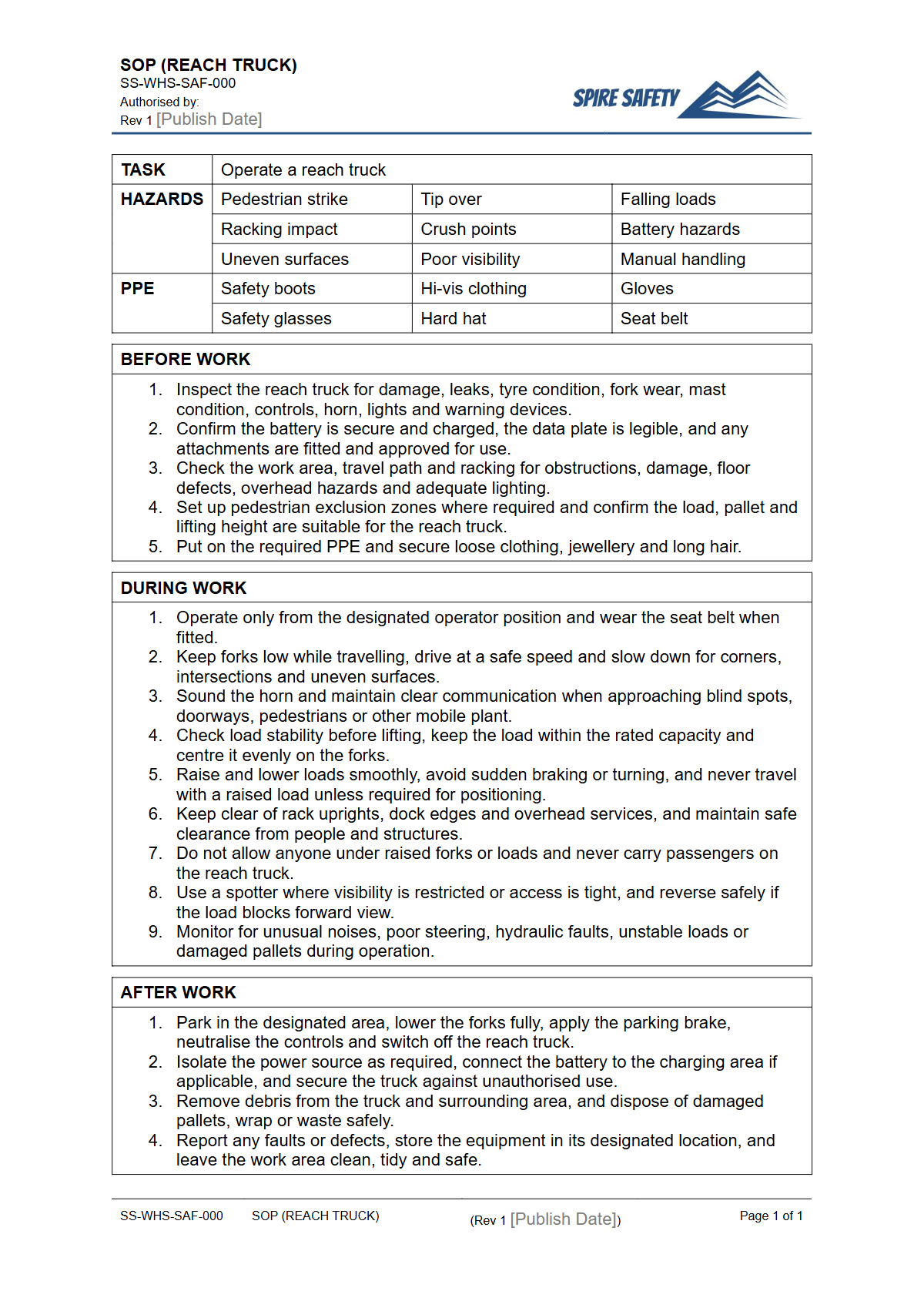
A Safe Operating Procedure (SOP) is a foundational document for managing workplace safety. This Free Safe Operating Procedure (Reach Truck) Template provides a structured framework for detailing the safe use of reach trucks in your warehouse or storage facility.
It guides you in creating clear, step-by-step instructions that minimise risk for operators and pedestrians. By thoroughly documenting processes from pre-start checks to shutdown, you help fulfil your duty of care under Australian WHS laws.
Using a standardised SOP ensures that all operators receive consistent instructions on how to handle the equipment safely, reducing the chance of incidents caused by inconsistent or incorrect practices. This document is a critical component of risk management for high-risk plant and equipment.
It also forms an essential part of your broader safety framework, which can be strengthened by implementing comprehensive WHS management systems to ensure all hazards are systematically controlled.
Video walkthrough
How to use the Free Safe Operating Procedure (Reach Truck) Template
This resource is available for download in both DOCX for easy editing and PDF for simple distribution. The key to an effective SOP is customisation.
While this template is aligned with Australian WHS best practices, it is a starting point and not a finished document. You must review and edit this template to reflect the specific hazards, layout, and work practices of your site.
To implement this SOP effectively:
- Consult with your licenced reach truck operators, supervisors, and health and safety representatives during the drafting process. Their practical experience is invaluable for identifying all relevant risks.
- Conduct a site-specific risk assessment for reach truck operations, covering aspects like aisle width, racking height, floor conditions, and interactions with other traffic.
- Adapt the document to include details about the specific make and model of reach trucks used in your workplace, as controls and capacities can vary.
- Once finalised and approved, use the SOP as a central tool for training all operators. Keep records of this training.
The principles outlined here for customising an SOP apply to various types of plant. For instance, if your site also uses other specialised materials handling equipment, you might find our free Telehandler SOP template a useful starting point for that machinery.
When to use a Safe Operating Procedure
An SOP for reach trucks should be developed and implemented before the equipment is used for the first time. It is a proactive safety measure, not a reactive one.
It should be readily accessible to all operators and supervisors in the work area, either in hard copy or digital format. It serves as a primary reference document during initial operator training and competency assessments.
The SOP is a living document and should be formally reviewed and updated on a regular basis. A review is essential whenever a new model of reach truck is introduced, after any incident or near miss involving the equipment, or when there are significant changes to the workplace layout or operational tasks.
Regular reviews can be integrated into your schedule of WHS compliance auditing to ensure procedures remain current and effective.
Who should use this Procedure
The primary audience for a reach truck SOP is the licenced operators who use the equipment daily. Clear, unambiguous instructions are vital for their safety and the safety of those working around them.
Beyond the operators themselves, several other roles should use and be familiar with this procedure.
Supervisors and managers must understand the SOP to effectively oversee work, conduct safety observations, and enforce safe practices. WHS and OHS personnel will use the SOP as a key part of the site's safety management system, using it to inform risk assessments, incident investigations, and training programs.
If your logistics operations involve frequent loading and unloading, ensure your procedures for other vehicles are just as robust, such as by using a Body Truck SOP template for delivery drivers.
Many warehouses also rely on automated systems alongside mobile plant. For these fixed installations, it is equally important to have documented safety procedures, like a Conveyer System SOP template, to manage associated risks. For more templates and safety documents, browse our complete free WHS resources library.
Common mistakes
Common mistakes to avoid
- Using a generic template without customising it for site-specific hazards.
- Failing to consult with operators during the development of the procedure.
- Not providing adequate training on the finalised SOP to all relevant workers.
- Forgetting to review and update the SOP after an incident or change in equipment.
Legal references
Legal considerations
The following legal requirements may be relevant to this type of work.
- Work Health and Safety Act (Harmonised) — Provides the primary duties for protecting workers and other people from work health and safety risks.
- Work Health and Safety Regulations (Harmonised) — Sets out requirements supporting the management of workplace hazards and risks.
The following codes may be relevant to this type of work.
- Managing WHS Risks Code of Practice — Provides practical guidance on identifying hazards, assessing risks and applying effective controls.
- Work Health and Safety Consultation, Cooperation and Coordination Code of Practice — Provides practical guidance on consulting workers and coordinating with other duty holders.
- Managing the Work Environment and Facilities Code of Practice — Provides practical guidance on safe work environments, workplace facilities and related controls.
Did you know
Tip-Over Risk
Reach trucks have a high centre of gravity, especially when the mast is extended. Most serious incidents involve tip-overs caused by turning too quickly, travelling with a raised load, or operating on uneven surfaces.
Narrow Aisle Specialists
Reach trucks are designed specifically for narrow-aisle warehousing. Their ability to 'reach' forward into racking allows them to operate in aisles much smaller than those required for a standard counterbalance forklift.
FAQ
Frequently asked questions
01What must be included in a Safe Operating Procedure for a reach truck?
02Is a high-risk work licence required to operate a reach truck in Australia?
03How often should we review our reach truck SOP?
04Can a generic SOP be used for all types of forklifts?
Share this resource
Free Safe Operating Procedure (Reach Truck) Template
Browse Categories
How To Use It
- 1Download and open in Word or PDF.
- 2Replace the placeholders with your business details.
- 3Get it reviewed by a WHS specialist before rollout.
Need it customised?
Our WHS consultants can adapt this template to your site, run a gap analysis, or audit what you already have in place.
Book a Free Consultation WHS consulting servicesor call 1300 156 382
Related templates
- Free Safe Operating Procedure (Rebar Bender) Template
- Free Safe Operating Procedure (Rebar Cutter) Template
- Free Safe Operating Procedure (Rebar Scanner) Template
- Free Safe Operating Procedure (Rebar Straightener) Template
- Free Safe Operating Procedure (Rebar Tying Tool) Template
- Free Safe Operating Procedure (Reception Area Cleaning) Template