
Free Safe Operating Procedure (Rebar Straightener) Template
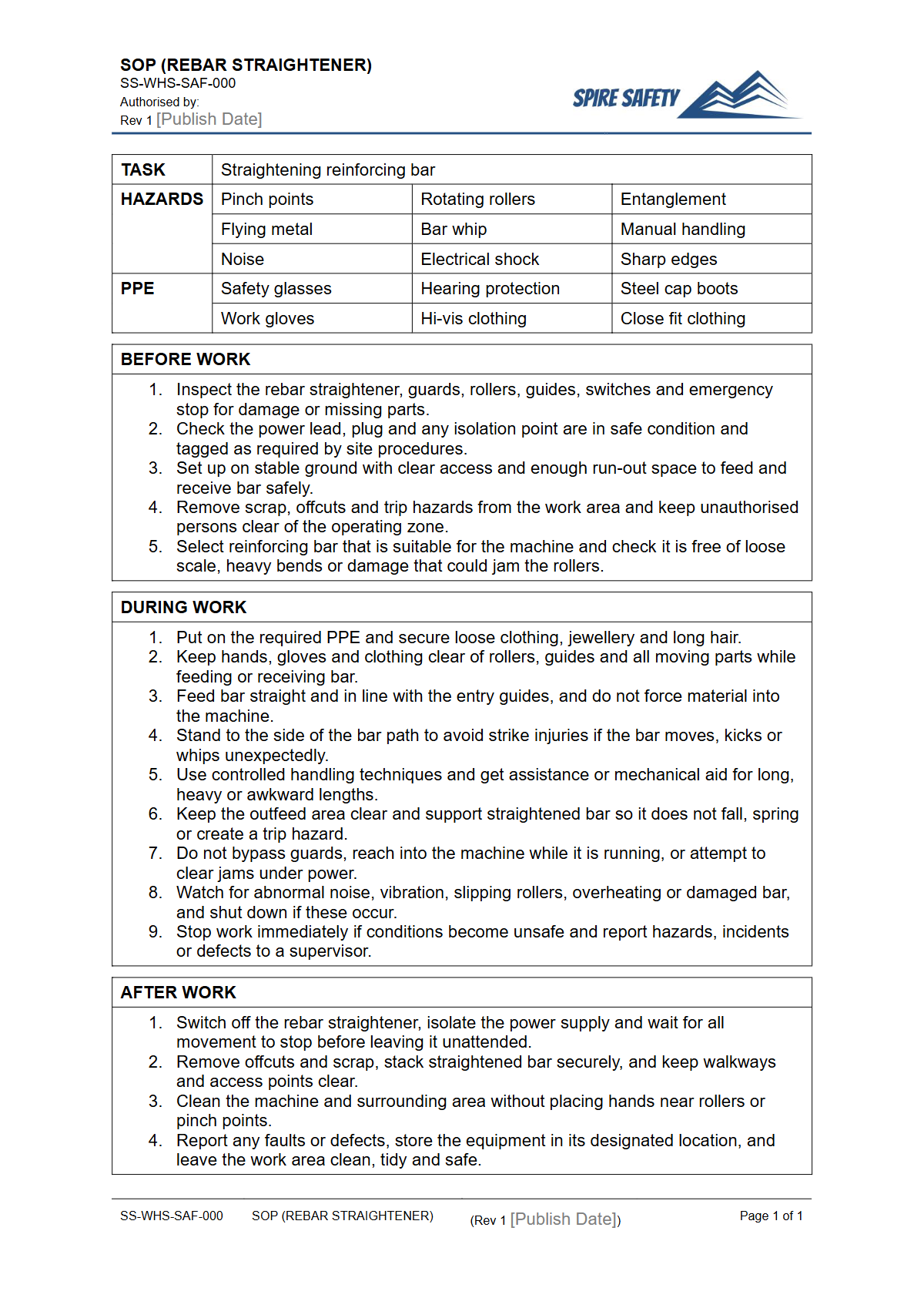
Standardise the safe operation of rebar straighteners in your workplace. Download our free Safe Operating Procedure (Rebar Straightener) Template today.
Free Safe Operating Procedure (Rebar Straightener) Template
DOCX • 126 KB + PDF
Updated Oct 2026
No signup required
Purpose of the Free Safe Operating Procedure (Rebar Straightener) Template
Operating a rebar straightener involves significant risks, including entanglement, crushing, and projectile hazards. This Free Safe Operating Procedure (Rebar Straightener) Template provides a structured framework for documenting the required steps to operate this machinery safely.
By establishing clear, step-by-step instructions, organisations can minimise operator error, control hazards at the source, and demonstrate a commitment to workplace safety. The SOP helps to standardise work practices, ensuring every operator follows the same safe method, regardless of their experience level.
A well-defined SOP is a critical component of a proactive safety culture. It serves as a key training document for new operators and a reference for experienced workers.
It also forms an essential part of a broader WHS management system, helping your business meet its duty of care obligations under Australian WHS legislation. Using this template helps you systematically identify hazards associated with rebar straightening and implement effective control measures.
Video walkthrough
How to use the Free Safe Operating Procedure (Rebar Straightener) Template
This template is available for download as a DOCX file for easy editing and a PDF for straightforward distribution. To effectively use this resource, you must adapt it to the specific make and model of the rebar straightener used at your site, as well as the unique environmental and operational conditions of your workplace.
A generic procedure is not sufficient; customisation is essential for effective risk management.
Follow these steps:
- Download: Choose the DOCX version to begin customisation.
- Consult: Involve operators, supervisors, and health and safety representatives in the drafting process. Their practical knowledge is invaluable for identifying all relevant risks.
- Customise: Add site-specific details, including emergency procedures, contact information, and rules specific to your machinery. Remove any steps that are not relevant to your equipment. We have provided a solid foundation, but you must build upon it to reflect your reality.
- Approve: Have the final SOP reviewed and approved by a competent person, such as a site manager or WHS advisor.
- Train: Ensure all operators are trained on the contents of the finalised SOP. Keep records of this training.
Many construction sites also require SOPs for other common equipment. You might find our Free Air Compressor SOP (Safe Operating Procedure) Template useful for standardising the use of this essential tool.
When to use a Rebar Straightener SOP
A Safe Operating Procedure for a rebar straightener should be used whenever the equipment is in operation. It is not just a document for initial training but a live reference tool that should be readily accessible to operators at all times.
It is particularly critical during high-risk activities, maintenance preparation, and when new or inexperienced workers are assigned to the task.
The SOP should be formally reviewed and, if necessary, updated when there is a change to the equipment, the work environment, or the process itself. Regular reviews, typically annually, are also recommended to ensure the procedure remains current and effective.
Conducting a WHS compliance audit can help identify gaps in your procedures and ensure they are being followed correctly on the ground.
Who should use this Safe Operating Procedure
This SOP is intended for several key roles within an organisation:
- Operators: The primary users who must follow the procedure to perform their work safely.
- Supervisors and Line Managers: Responsible for ensuring operators are trained and adhering to the SOP. They use it to conduct workplace inspections and performance observations.
- WHS Managers and Advisors: Use the SOP as a tool for risk assessment, incident investigation, and auditing safety performance.
- Maintenance Personnel: Refer to the SOP for lockout/tagout procedures and other safety requirements before commencing maintenance or repair work.
Standardising procedures across all heavy machinery is a best practice for risk management. For sites that also handle materials with lifting equipment, our FREE Telehandler SOP Template can help create consistent safety documentation for different plant types.
In addition to straightening rebar, many fabrication and construction tasks involve cutting materials. To ensure safety in these related activities, consider using our FREE Circular Saw SOP Template to document safe work practices.
This template is just one of many tools available. For more documents to help build out your safety system, browse our complete free WHS resources library.
Common mistakes
Common mistakes to avoid
- Failing to perform pre-start checks on machine guards and emergency stops.
- Wearing loose clothing, gloves, or jewellery that can become entangled in the rollers.
- Attempting to clear jams or make adjustments while the machine is still powered on.
- Using a generic SOP that hasn't been customised for the specific machine and workplace.
Legal references
Legal considerations
The following legal requirements may be relevant to this type of work.
- Work Health and Safety Act (Harmonised) — Provides the primary duties for protecting workers and other people from work health and safety risks.
- Work Health and Safety Regulations (Harmonised) — Sets out requirements supporting the management of workplace hazards and risks.
The following codes may be relevant to this type of work.
- Managing WHS Risks Code of Practice — Provides practical guidance on identifying hazards, assessing risks and applying effective controls.
- Work Health and Safety Consultation, Cooperation and Coordination Code of Practice — Provides practical guidance on consulting workers and coordinating with other duty holders.
- Managing the Work Environment and Facilities Code of Practice — Provides practical guidance on safe work environments, workplace facilities and related controls.
Did you know
Material Strength
The ribs on reinforcing bar (rebar) are not just for show; they increase its bond with concrete by up to 40%. Straightening bent rebar can affect its tensile strength and structural integrity if not done correctly.
FAQ
Frequently asked questions
01What hazards are associated with operating a rebar straightener?
02Is training required to use a rebar straightener?
03How often should a Safe Operating Procedure for a rebar straightener be reviewed?
04Can this SOP template be used for different models of rebar straighteners?
Share this resource
Free Safe Operating Procedure (Rebar Straightener) Template
Browse Categories
How To Use It
- 1Download and open in Word or PDF.
- 2Replace the placeholders with your business details.
- 3Get it reviewed by a WHS specialist before rollout.
Need it customised?
Our WHS consultants can adapt this template to your site, run a gap analysis, or audit what you already have in place.
Book a Free Consultation WHS consulting servicesor call 1300 156 382
Related templates
- Free Safe Operating Procedure (Rebar Tying Tool) Template
- Free Safe Operating Procedure (Reception Area Cleaning) Template
- Free Safe Operating Procedure (Reception Desk Cleaning) Template
- Free Safe Operating Procedure (Recliner Chair Cleaning) Template
- Free Safe Operating Procedure (Recycling Bay Cleanup) Template
- Free Safe Operating Procedure (Recycling Bin Service) Template