
Free Safe Operating Procedure (Rebar Tying Tool) Template
Download our free Safe Operating Procedure for rebar tying tools to define safety protocols on your construction site. Get your customisable DOCX and PDF now.
Free Safe Operating Procedure (Rebar Tying Tool) Template
DOCX • 126 KB + PDF
Updated Oct 2026
No signup required
Purpose of the Free Safe Operating Procedure (Rebar Tying Tool) Template
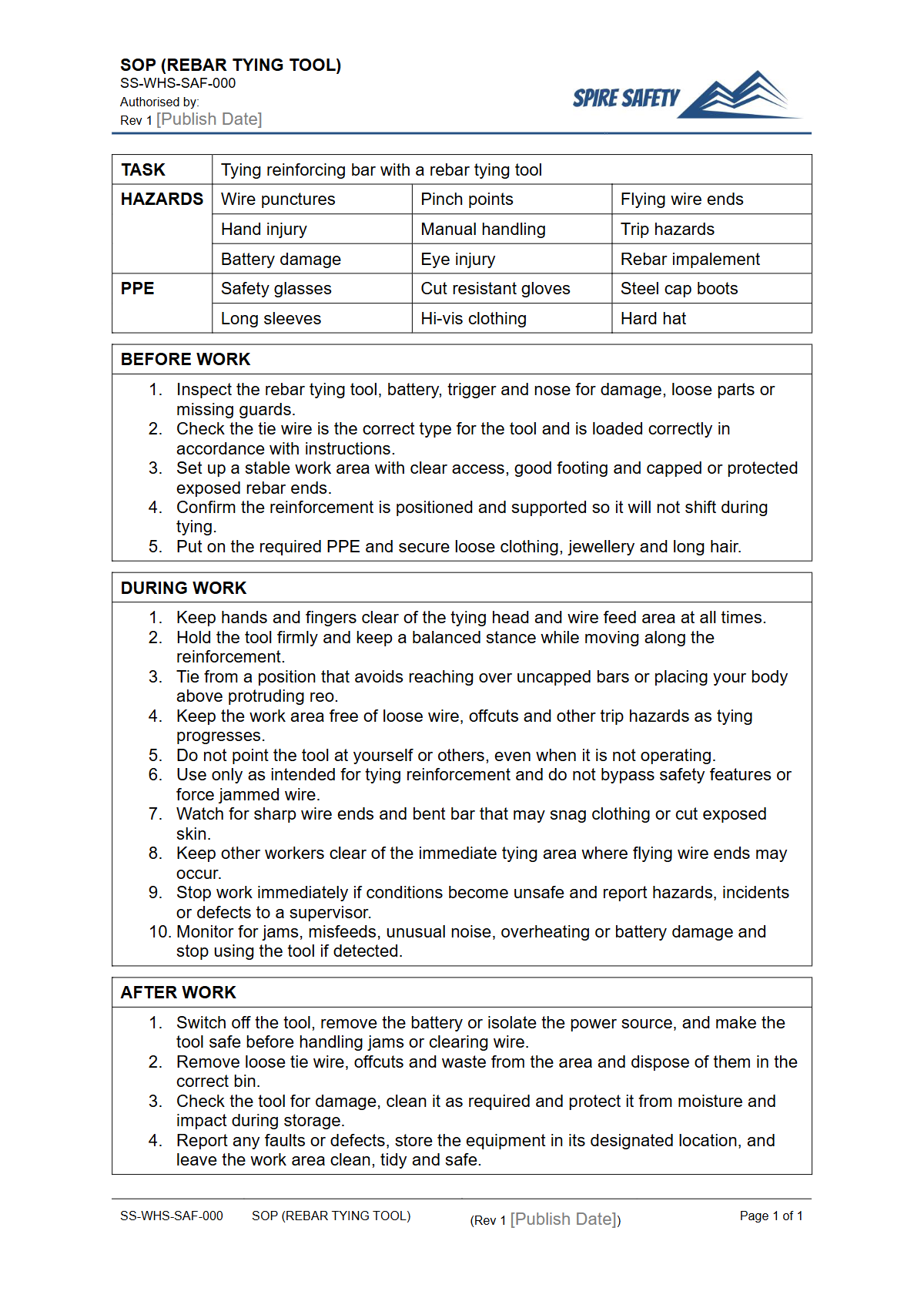
This Free Safe Operating Procedure (Rebar Tying Tool) Template provides a structured starting point for documenting the safety requirements for using a battery-powered rebar tyer on your worksite. Using this tool significantly improves efficiency and reduces the ergonomic strain associated with manual tying, but it also introduces specific hazards that must be controlled.
An SOP is a critical administrative control that outlines the step-by-step process for performing a task safely, helping to ensure workers understand the risks and the required precautions.
Key risks associated with rebar tying tools include musculoskeletal injuries from repetitive use in awkward postures, entanglement of clothing or hair in the tool's mechanism, and electrical hazards related to battery charging and maintenance. A comprehensive SOP helps your business meet its duty of care by providing clear instruction and forms a key component of your broader WHS management systems.
Video walkthrough
How to Use the Free Safe Operating Procedure (Rebar Tying Tool) Template
Our template is available in both DOCX and PDF formats for your convenience. The DOCX file is fully editable, allowing you to adapt the content to the specific models of rebar tying tools used at your workplace and incorporate your site-specific safety rules.
A clear, well-defined SOP is essential not just for rebar tools, but for all powered equipment on site; for example, you should also have a specific free Circular Saw SOP for operators of that equipment.
Important: This document is a template only. We have created it as a guide, but it must be customised to reflect the actual risks and control measures present in your workplace.
We strongly advise that you consult with your team, including operators and supervisors, during the drafting process to ensure the procedure is practical and effective. If you require expert assistance, our WHS consulting team can help tailor safety documentation to your needs.
What is included?
The template covers essential safety elements, including:
- Required Personal Protective Equipment (PPE) such as safety glasses and gloves.
- Pre-start checks to ensure the tool is in safe working order.
- A logical sequence for performing the tying task safely.
- Post-operation procedures, including cleaning, storage, and battery charging.
- Emergency procedures and associated risks.
When to Use a Safe Operating Procedure
An SOP for a rebar tying tool should be an integral part of your daily operations and safety management. It should be used before any worker operates the tool for the first time to ensure they are properly trained.
It serves as a vital document during employee inductions and task-specific training sessions. The SOP can also be used as a reference for pre-start meetings or toolbox talks to refresh workers' knowledge of key safety requirements.
Just as you would for other common site equipment like an air compressor, having the SOP readily available ensures consistency in safe work practices.
Who Should Use This Safe Operating Procedure
This Safe Operating Procedure is intended for use by multiple groups within an organisation. WHS managers, site supervisors, and team leaders will use it to establish and enforce safety standards for rebar tying tasks.
Workers who operate the tool must be trained on the contents of the SOP and use it to guide their work practices. It provides a clear benchmark for what a safe, competent performance of the task looks like. The document also supports processes for verifying competency for operators of various site equipment, which is equally important for larger plant covered by documents like our FREE Telehandler SOP Template.
The effectiveness of any SOP relies on it being a living document. It should be reviewed regularly—at least annually, or after any incident, near miss, or change in equipment or process.
These reviews can be integrated into your internal safety schedule or as part of a formal WHS compliance auditing program to ensure ongoing relevance and effectiveness. Spire Safety has a wide range of templates available in our free WHS resources library to help you build out your safety documentation.
Common mistakes
Common mistakes to avoid
- Failing to customise the template for the specific tool model and worksite conditions.
- Skipping pre-start operational and safety checks before use.
- Ignoring ergonomic risks by working in sustained awkward postures.
- Not wearing appropriate PPE, particularly safety glasses to protect from wire off-cuts.
Legal references
Legal considerations
The following legal requirements may be relevant to this type of work.
- Work Health and Safety Act (Harmonised) — Provides the primary duties for protecting workers and other people from work health and safety risks.
- Work Health and Safety Regulations (Harmonised) — Sets out requirements supporting the management of workplace hazards and risks.
The following codes may be relevant to this type of work.
- Managing WHS Risks Code of Practice — Provides practical guidance on identifying hazards, assessing risks and applying effective controls.
- Work Health and Safety Consultation, Cooperation and Coordination Code of Practice — Provides practical guidance on consulting workers and coordinating with other duty holders.
- Managing the Work Environment and Facilities Code of Practice — Provides practical guidance on safe work environments, workplace facilities and related controls.
Did you know
Ergonomic Advantage
Using a rebar tying tool can reduce the risk of musculoskeletal disorders by over 60% compared to manual tying, which often requires prolonged stooping and repetitive wrist-twisting motions.
Speed and Efficiency
A proficient operator with a rebar tying tool can complete a tie in less than a second, making them up to five times faster than traditional manual tying methods.
FAQ
Frequently asked questions
01What are the main hazards of using a rebar tying tool?
02Is a Safe Operating Procedure legally required for a rebar tying tool in Australia?
03How often should an SOP for a rebar tying tool be reviewed?
04Can this SOP template be used for different brands of rebar tyers?
Share this resource
Free Safe Operating Procedure (Rebar Tying Tool) Template
Browse Categories
How To Use It
- 1Download and open in Word or PDF.
- 2Replace the placeholders with your business details.
- 3Get it reviewed by a WHS specialist before rollout.
Need it customised?
Our WHS consultants can adapt this template to your site, run a gap analysis, or audit what you already have in place.
Book a Free Consultation WHS consulting servicesor call 1300 156 382
Related templates
- Free Safe Operating Procedure (Reception Area Cleaning) Template
- Free Safe Operating Procedure (Reception Desk Cleaning) Template
- Free Safe Operating Procedure (Recliner Chair Cleaning) Template
- Free Safe Operating Procedure (Recycling Bay Cleanup) Template
- Free Safe Operating Procedure (Recycling Bin Service) Template
- Free Safe Operating Procedure (Recycling Contamination) Template