
Free Safe Operating Procedure (Recycling Bay Cleanup) Template
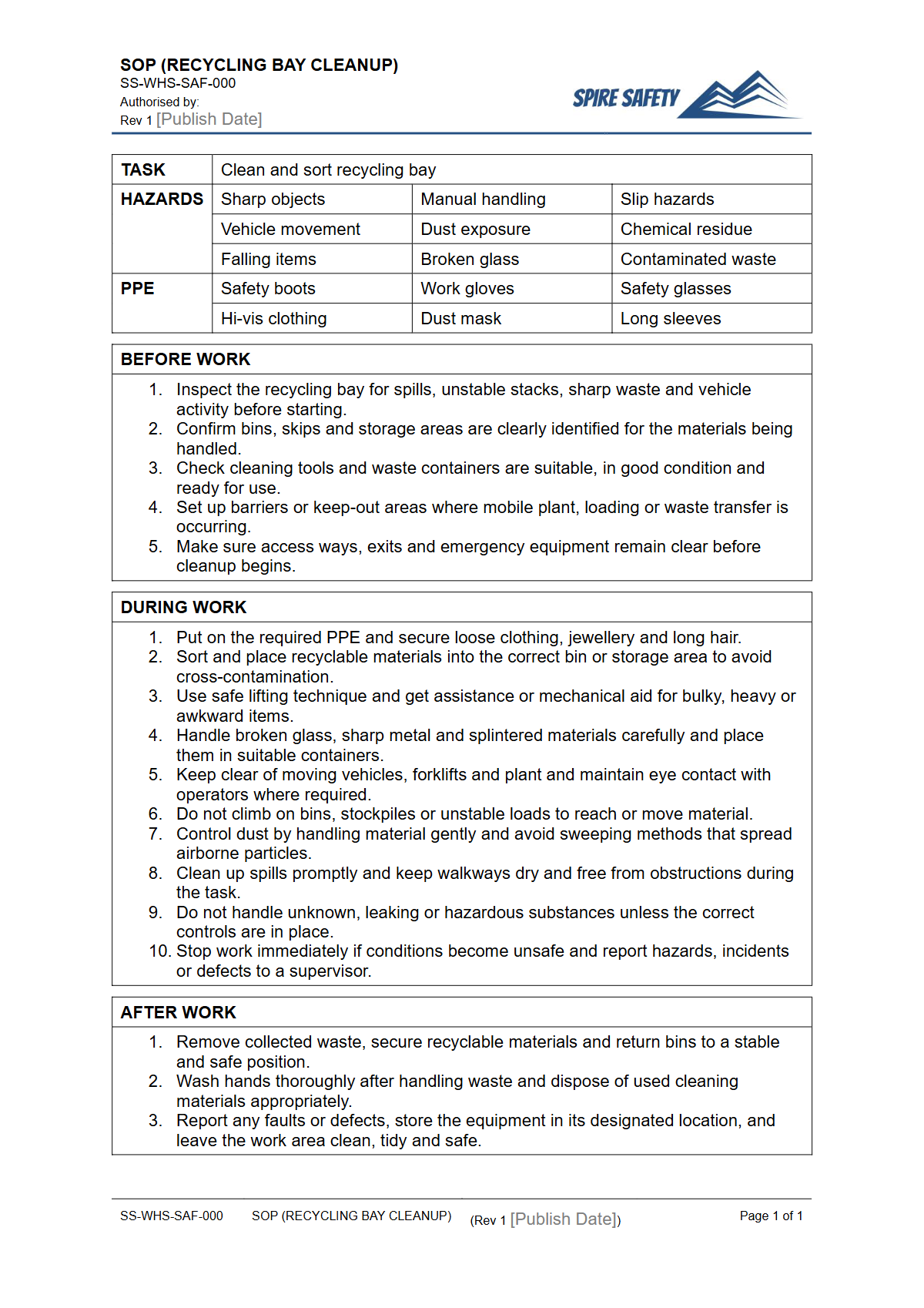
Streamline your recycling area procedures with our free Safe Operating Procedure (Recycling Bay Cleanup) template.
Free Safe Operating Procedure (Recycling Bay Cleanup) Template
DOCX • 126 KB + PDF
Updated Oct 2026
No signup required
Purpose of the Free Safe Operating Procedure (Recycling Bay Cleanup) Template
Managing a recycling bay involves specific risks that require clear, documented processes to ensure worker safety. This free Safe Operating Procedure (Recycling Bay Cleanup) template provides a structured starting point for your organisation to formalise its cleanup tasks.
Using an SOP helps to control hazards, standardise work methods, and provide a clear reference for training and supervision, forming a key part of your overall safety management system.
The primary purpose of this document is to guide workers through the required steps for safely cleaning and maintaining a recycling bay. It is designed to help you identify and control common hazards, ensuring a methodical approach to waste management and housekeeping.
Formalising these steps helps reduce the likelihood of incidents and supports your commitment to a safe working environment.
Key Hazards in a Recycling Bay
Recycling areas can present a unique combination of hazards that must be managed. This Safe Operating Procedure prompts you to consider controls for risks such as:
- Manual Tasks: Lifting heavy bins, carrying awkward materials, and repetitive movements can lead to musculoskeletal injuries.
- Slips, Trips, and Falls: Spilled liquids, loose materials, and uneven surfaces are common trip hazards.
- Cuts and Punctures: Sharp objects like broken glass, metal shards, or plastics hidden within waste materials.
- Plant and Equipment: Risks associated with machinery such as compactors, balers, or forklifts used within the bay. If your bay uses automated sorting, a dedicated SOP for a conveyor system is also essential.
- Hazardous Substances: Potential exposure to chemicals, biological waste, or dust generated during sorting and cleaning.
Video walkthrough
How to use the Free Safe Operating Procedure (Recycling Bay Cleanup) Template
This document is a template, not a finished procedure. To use it effectively, download the DOCX file and adapt it to the specific conditions of your workplace.
Effective safety documents are not created in isolation; they are developed through consultation with the people who do the work. A robust procedure is a fundamental part of your site's overall WHS management system.
Important: You must customise this template to reflect the specific equipment, materials, and hazards present in your recycling bay. We strongly recommend you consult with your workers during the drafting and review process to ensure the procedure is practical and reflects how the work is actually performed.
Once finalised, use the SOP as a basis for training and competency assessments.
Steps to Effective Implementation
Implementing the SOP is just as important as writing it. First, communicate the new or updated procedure to all relevant staff.
Provide practical training that walks them through each step, explaining the 'why' behind the safety controls. Supervisors should then monitor work practices to ensure the SOP is being followed correctly.
Any equipment used for moving heavy loads, such as forklifts or loaders, requires its own SOP and operator training; for example, our Telehandler SOP template can be adapted for this purpose.
When to use this Safe Operating Procedure
A Safe Operating Procedure for recycling bay cleanup should be used consistently as the standard for performing the task. It serves as a critical reference during:
- Routine Cleaning: For daily, weekly, or scheduled deep cleans of the recycling bay.
- Worker Training: As a core training document for new employees during their induction, and for refresher training for existing staff.
- Incident Investigation: To review whether established procedures were followed in the event of an accident or near-miss.
- Risk Assessments: As an existing control measure when conducting or reviewing a risk assessment for the area.
Procedures should also be reviewed periodically to ensure they remain current. Regular reviews are a core component of continuous improvement, and the findings can be verified through a WHS compliance audit to ensure ongoing effectiveness.
Who should use this document
This SOP is intended for use by a range of personnel within an organisation. Primarily, it is for the workers who are directly responsible for cleaning and maintaining the recycling bay.
They will use it as a step-by-step guide to perform their duties safely.
Additionally, WHS Managers, Site Supervisors, and Team Leaders should use this document to facilitate training, conduct workplace inspections, and supervise work. It provides a clear benchmark for safe performance, making it easier to identify non-conformances and provide corrective coaching.
For more tailored guidance on implementing procedures like this, specialist WHS consulting can help align your documents with operational needs. For more templates and checklists, browse our complete free WHS resources library.
Common mistakes
Common mistakes to avoid
- Failing to customise the template for site-specific hazards and equipment.
- Neglecting to consult with workers who perform the cleanup tasks.
- Not providing practical training on the finalised SOP.
- Forgetting to review and update the SOP after an incident or process change.
Legal references
Legal considerations
The following legal requirements may be relevant to this type of work.
- Work Health and Safety Act (Harmonised) — Provides the primary duties for protecting workers and other people from work health and safety risks.
- Work Health and Safety Regulations (Harmonised) — Sets out requirements supporting the management of workplace hazards and risks.
The following codes may be relevant to this type of work.
- Managing WHS Risks Code of Practice — Provides practical guidance on identifying hazards, assessing risks and applying effective controls.
- Work Health and Safety Consultation, Cooperation and Coordination Code of Practice — Provides practical guidance on consulting workers and coordinating with other duty holders.
- Managing the Work Environment and Facilities Code of Practice — Provides practical guidance on safe work environments, workplace facilities and related controls.
Did you know
Waste and Recycling Industry Risks
The waste and recycling industry has one of the highest rates of serious injury claims in Australia. The most common causes of injury are muscular stress from manual handling and being hit by moving objects.
FAQ
Frequently asked questions
01What should be included in an SOP for cleaning a recycling bay?
02How often should a Safe Operating Procedure be reviewed?
03Are workers required to follow an SOP?
04Can I use this template for any type of recycling facility?
Share this resource
Free Safe Operating Procedure (Recycling Bay Cleanup) Template
Browse Categories
How To Use It
- 1Download and open in Word or PDF.
- 2Replace the placeholders with your business details.
- 3Get it reviewed by a WHS specialist before rollout.
Need it customised?
Our WHS consultants can adapt this template to your site, run a gap analysis, or audit what you already have in place.
Book a Free Consultation WHS consulting servicesor call 1300 156 382
Related templates
- Free Safe Operating Procedure (Recycling Bin Service) Template
- Free Safe Operating Procedure (Recycling Contamination) Template
- Free Safe Operating Procedure (Recycling Dropoff Check) Template
- Free Safe Operating Procedure (Recycling Load Check) Template
- Free Safe Operating Procedure (Recycling Load Sorting) Template
- Free Safe Operating Procedure (Relief Valve Test) Template