
Free Safe Operating Procedure (Relief Valve Test) Template
Formalise the process for testing pressure relief valves in your workplace. Download our free Safe Operating Procedure (Relief Valve Test) Template now.
Free Safe Operating Procedure (Relief Valve Test) Template
DOCX • 126 KB + PDF
Updated Oct 2026
No signup required
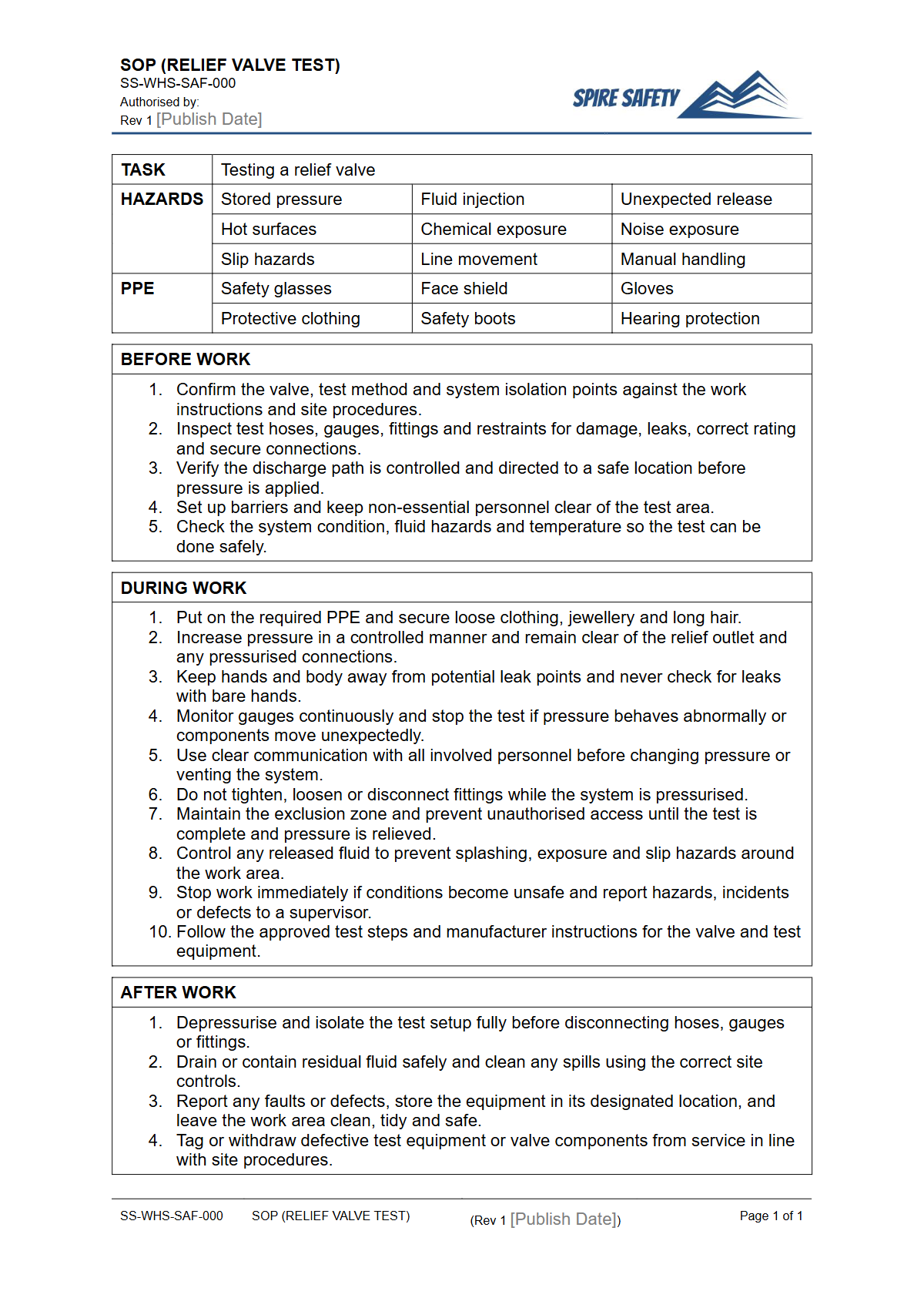
Purpose of the Free Safe Operating Procedure (Relief Valve Test) Template
Testing pressure relief valves is a critical safety task that prevents catastrophic failure of pressurised equipment like boilers, tanks, and air receivers. This Free Safe Operating Procedure (Relief Valve Test) Template provides a structured framework for documenting the steps required to perform these tests safely and effectively.
Using a standardised procedure helps ensure that every test is conducted consistently, risks are controlled, and compliance records are maintained. An SOP is a fundamental tool for managing high-risk tasks by clearly defining hazards and control measures.
The primary purpose of this Safe Operating Procedure is to eliminate or minimise risks associated with relief valve testing, such as exposure to stored energy, high-pressure fluids or gases, unexpected equipment activation, and excessive noise. By outlining a clear, step-by-step process, this template helps your organisation meet its duty of care under Australian WHS legislation.
It guides workers through pre-operational checks, safe isolation, the testing sequence itself, and post-test actions. The principles here are similar to those found in other equipment-specific procedures, like our free Air Compressor SOP template, which also deals with pressurised systems.
Key Elements of the Safe Operating Procedure
Our template is designed as a comprehensive starting point. It prompts you to detail essential safety information specific to your workplace, including:
- Hazard Identification: Lists common hazards such as stored pressure, projectiles, noise, and hazardous substances.
- Risk Control Measures: Specifies controls like isolation and lockout/tagout procedures, designated test areas, and required Personal Protective Equipment (PPE).
- Required PPE: A checklist for mandatory PPE, such as safety glasses, hearing protection, and safety boots.
- Step-by-Step Instructions: A logical sequence for performing the test, from initial preparation and isolation to the final checks and return to service.
- Emergency Procedures: Outlines immediate actions to take in case of an incident, such as uncontrolled pressure release or equipment failure.
Formalising these steps is a key part of demonstrating a systematic approach to safety. A well-written SOP acts as both a training tool for new workers and a reference for experienced personnel.
Integrating specific procedures like this into broader WHS management systems ensures that safety practices are embedded in your organisation's daily operations.
Video walkthrough
How to use the Free Safe Operating Procedure (Relief Valve Test) Template
This template is provided in both DOCX and PDF formats for your convenience. The DOCX file is fully editable, allowing you to tailor the document to the specific equipment, processes, and legislative requirements applicable to your workplace.
IMPORTANT: This document is a template and must be customised to your specific workplace. We cannot know the unique hazards of your site, the models of your equipment, or your internal procedures.
You must consult the valve and equipment manufacturer’s specifications, relevant Australian Standards, and conduct a site-specific risk assessment. Fill in the bracketed [placeholders] with details relevant to your machinery, personnel, and operational context.
To use the template effectively, gather all relevant information, including the valve's set pressure, the system's maximum allowable working pressure (MAWP), and the correct testing medium (e.g., air, nitrogen, water). Involve competent workers, such as maintenance fitters or engineers who perform the task, in the customisation process to ensure the SOP is practical and reflects actual on-the-ground practices.
Once finalised, the SOP should be used as part of worker training and competency verification for this task.
When to use a Safe Operating Procedure for Relief Valve Testing
This Safe Operating Procedure should be used every time a relief valve test is scheduled or required. The frequency of these tests is determined by several factors, including regulatory requirements, manufacturer's recommendations, and risk assessments based on the service conditions (e.g., corrosive environments may require more frequent testing).
Common triggers for conducting a relief valve test include:
- As part of a scheduled preventative maintenance program.
- Before commissioning new or repaired pressure equipment.
- After any overpressure event to ensure the valve is still functioning correctly.
- Following an extended shutdown period.
This systematic approach is crucial for all types of plant, including mobile equipment with hydraulic systems. For instance, procedures for maintaining heavy machinery often include checks on hydraulic relief valves, a principle you'll find in resources like our free Telehandler SOP template.
Who should use this Safe Operating Procedure
The testing of pressure relief valves is a high-risk activity that must only be performed by persons who are competent to do so. This typically includes qualified and experienced personnel such as:
- Mechanical Fitters
- Maintenance Technicians
- Pressure Welders
- Engineers with relevant expertise
A worker is deemed competent if they have received the necessary training, possess the relevant qualifications or experience, and have been assessed as capable of performing the task safely and correctly. Employers must maintain records of this training and competency.
The effectiveness of these records and the SOP itself can be verified through regular WHS compliance auditing to ensure procedures are being followed correctly.
Before using this SOP, the user must be familiar with the specific equipment, understand the principles of pressure systems, and be trained in the organisation's isolation and lockout/tagout procedures. You can find other examples of task-specific procedures, such as our Conveyer System SOP, to see how different roles and responsibilities are assigned. For more templates and safety documents, browse our extensive free WHS resources library.
Common mistakes
Common mistakes to avoid
- Testing a valve while the system is still live or not properly isolated and de-pressurised.
- Using an incorrect test pressure or testing medium, potentially damaging the valve or the system.
- Failing to document test results accurately, including pass/fail status, date, and the technician's name.
- Not immediately replacing or arranging for the repair of valves that fail the test, leaving the system unprotected.
Legal references
Legal considerations
The following legal requirements may be relevant to this type of work.
- Work Health and Safety Act (Harmonised) — Provides the primary duties for protecting workers and other people from work health and safety risks.
- Work Health and Safety Regulations (Harmonised) — Sets out requirements supporting the management of workplace hazards and risks.
The following codes may be relevant to this type of work.
- Managing WHS Risks Code of Practice — Provides practical guidance on identifying hazards, assessing risks and applying effective controls.
- Work Health and Safety Consultation, Cooperation and Coordination Code of Practice — Provides practical guidance on consulting workers and coordinating with other duty holders.
- Managing the Work Environment and Facilities Code of Practice — Provides practical guidance on safe work environments, workplace facilities and related controls.
Did you know
Stored Energy Hazard
A pressurised system contains significant stored energy. A catastrophic failure of a vessel or valve can release this energy with explosive force, posing a severe risk to workers and equipment within a large radius.
Legal Requirement
In Australia, Persons Conducting a Business or Undertaking (PCBUs) have a primary duty of care to ensure the safety of their plant and equipment, which includes regular inspection and testing of critical safety components like relief valves.
FAQ
Frequently asked questions
01What is a pressure relief valve?
02How often should relief valves be tested?
03Is this SOP template suitable for all types of relief valves?
04What PPE is needed for testing relief valves?
Share this resource
Free Safe Operating Procedure (Relief Valve Test) Template
Browse Categories
How To Use It
- 1Download and open in Word or PDF.
- 2Replace the placeholders with your business details.
- 3Get it reviewed by a WHS specialist before rollout.
Need it customised?
Our WHS consultants can adapt this template to your site, run a gap analysis, or audit what you already have in place.
Book a Free Consultation WHS consulting servicesor call 1300 156 382
Related templates
- Free Safe Operating Procedure (Remote Crane Control) Template
- Free Safe Operating Procedure (Resaw Machine) Template
- Free Safe Operating Procedure (Rescue Boat Launch) Template
- Free Safe Operating Procedure (Rescue Winch) Template
- Free Safe Operating Procedure (Resident Laundry Sort) Template
- Free Safe Operating Procedure (Resident Room Packdown) Template