
Free Safe Operating Procedure (Resaw Machine) Template
Download our free Safe Operating Procedure (Resaw Machine) template to help manage risks. This customisable DOCX and PDF is an ideal starting point.
Free Safe Operating Procedure (Resaw Machine) Template
DOCX • 126 KB + PDF
Updated Oct 2026
No signup required
Purpose of the Free Safe Operating Procedure (Resaw Machine) Template
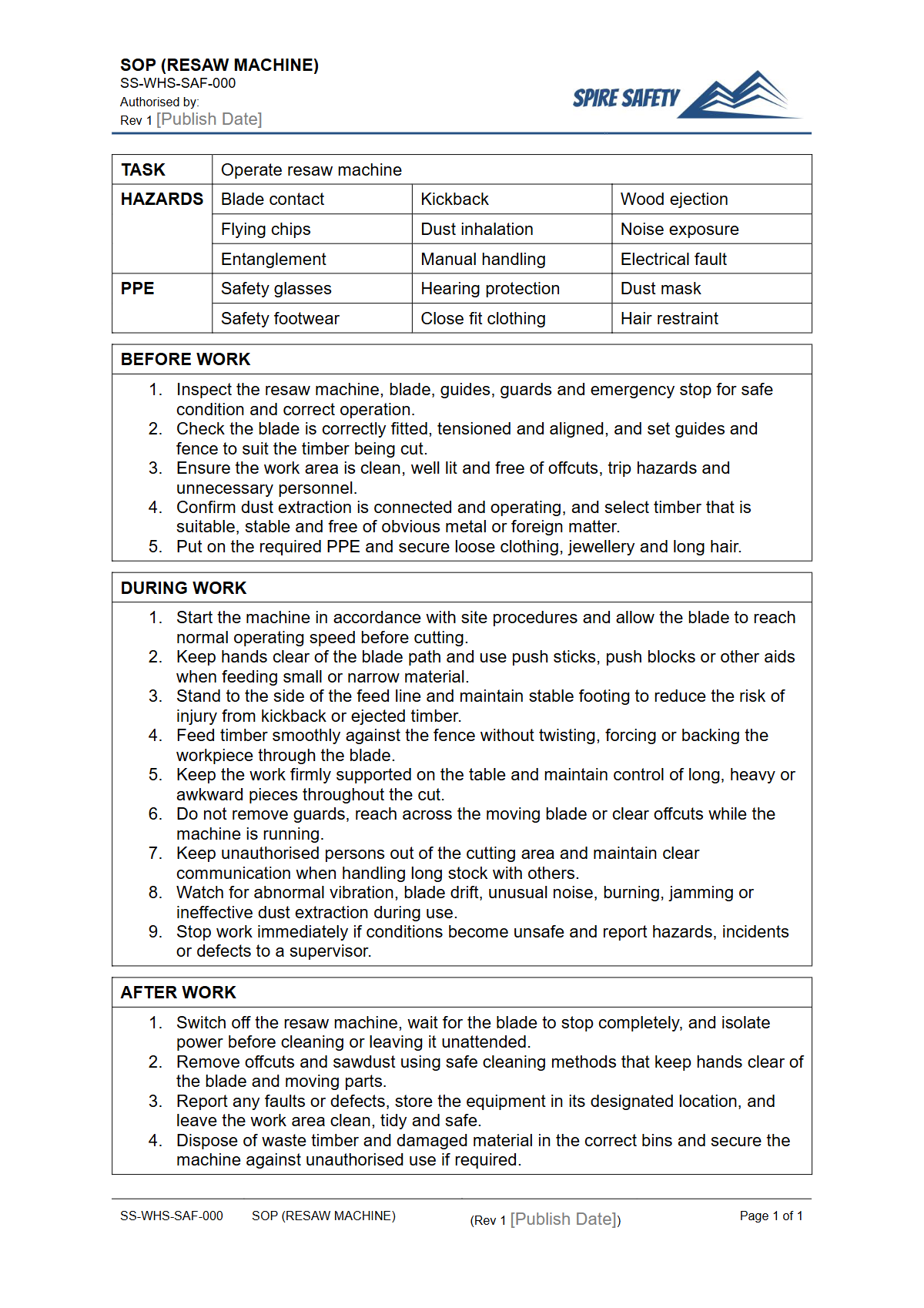
Operating a resaw machine involves significant risks, including blade contact, kickback, and entanglement. This free Safe Operating Procedure (Resaw Machine) Template provides a structured framework for documenting the required safety controls and work steps to minimise these hazards.
A well-developed SOP is a critical tool for standardising tasks, ensuring operational consistency, and demonstrating a commitment to workplace health and safety. It forms a key part of your safety management system by providing clear, written instructions that can be used for training, inductions, and daily reference by operators.
A specific, documented procedure helps ensure that every operator, regardless of experience level, follows the same safety-critical steps. It formalises the pre-start checks, correct operating techniques, and shutdown protocols that protect both the worker and the equipment. Similar to other workshop equipment, having a clear process is essential, just as it is for tools covered in our FREE Circular Saw SOP Template.
Video walkthrough
How to use the Free Safe Operating Procedure (Resaw Machine) Template
This template is a comprehensive starting point, designed to be adapted to your specific operational context. To use it effectively, download the DOCX file and customise it with details relevant to your workplace.
This includes inserting the specific make and model of your resaw machine, identifying key personnel and emergency contacts, and detailing your site-specific controls for hazards like wood dust, noise, and manual handling.
Important: This document must be customised to reflect the unique risks and control measures of your workplace. We strongly recommend consulting with the workers who actually operate the resaw machines.
Their direct experience is invaluable for creating a practical and effective procedure. Once customised, the SOP should be reviewed and approved by a competent person, such as a supervisor or WHS manager, before being implemented. It should be integrated as a core component of your broader WHS management systems.
When to use a Safe Operating Procedure
A Safe Operating Procedure for a resaw machine should be developed and in place before any worker is permitted to operate the equipment. It is a foundational document used in several key situations:
- Training and Induction: As the primary document for training new operators on the safe use of the machine.
- Refresher Training: For periodic reviews with experienced operators to reinforce safe work practices and introduce any new procedural changes.
- Risk Management: As a reference during risk assessments and hazard identification activities.
- Incident Investigation: To compare actual work practices against documented procedures following a near miss or incident.
- Audits and Inspections: To demonstrate that formalised, safe systems of work are in place and being followed.
Regularly reviewing your SOPs is a key activity in maintaining safety compliance. Procedures like this one are often examined during a WHS compliance audit to verify that documented processes are practical and actively used on the floor.
Who should use this Resaw Machine SOP
This SOP is designed for use by a range of personnel within an organisation to ensure a unified approach to safety:
- WHS Managers and Safety Officers: To develop, implement, and review safety documentation as part of the overall safety system.
- Supervisors and Workshop Foremen: To train workers, enforce procedures, and conduct pre-start checks and informal inspections.
- Workers and Machine Operators: As a direct guide for performing their tasks safely and as a tool for raising safety concerns.
- Training Coordinators: To form the basis of competency assessments and training programs for machinery operation.
In many industrial settings, different types of machinery work in tandem. For instance, a resaw might be fed by an automated process, highlighting the need for procedures covering all plant.
To manage associated risks, you may also find our FREE Conveyer System SOP Template useful.
Key Elements of the Safe Operating Procedure
Our template prompts you to detail several critical safety stages:
- Pre-Operational Checks: Inspecting blade condition and tension, guard placement, dust extraction systems, and emergency stops.
- Operational Sequence: Safe material handling, correct feed speeds, use of push sticks, operator positioning to avoid kickback zones, and waste removal.
- Shutdown Procedure: Powering down the machine, ensuring the blade has stopped completely, and end-of-shift cleaning and maintenance.
- Emergency Response: Steps to take in case of blade breakage, machine malfunction, fire, or injury.
Many workshops rely on compressed air for cleaning and tool operation, which carries its own set of risks. Ensure you have procedures for all supporting equipment by also referencing documents like our Free Air Compressor SOP Template. You can find these and more in our complete free WHS resources library to build a comprehensive safety framework.
Common mistakes
Common mistakes to avoid
- Using a generic template without customising it for the specific machine model, attachments, and workplace conditions.
- Failing to consult with experienced machine operators during the drafting process, resulting in a procedure that is impractical or misses key risks.
- Not providing adequate, hands-on training on the SOP's contents before allowing a worker to operate the machine unsupervised.
- Treating the SOP as a 'set and forget' document instead of reviewing and updating it regularly or after a near miss.
Legal references
Legal considerations
The following legal requirements may be relevant to this type of work.
- Work Health and Safety Act (Harmonised) — Provides the primary duties for protecting workers and other people from work health and safety risks.
- Work Health and Safety Regulations (Harmonised) — Sets out requirements supporting the management of workplace hazards and risks.
The following codes may be relevant to this type of work.
- Managing WHS Risks Code of Practice — Provides practical guidance on identifying hazards, assessing risks and applying effective controls.
- Work Health and Safety Consultation, Cooperation and Coordination Code of Practice — Provides practical guidance on consulting workers and coordinating with other duty holders.
- Managing the Work Environment and Facilities Code of Practice — Provides practical guidance on safe work environments, workplace facilities and related controls.
Did you know
Blade Tension is Critical
Incorrect blade tension is a leading cause of blade breakage, poor cut quality, and blade 'wander' on a resaw. This not only ruins the workpiece but significantly increases the risk of component failure and injury.
Wood Dust is a Carcinogen
Many types of wood dust are classified as carcinogenic to humans. An effective SOP must mandate the use of properly maintained dust extraction systems and appropriate personal protective equipment (PPE) to protect workers' long-term respiratory health.
FAQ
Frequently asked questions
01What are the most significant hazards associated with a resaw machine?
02Does this Safe Operating Procedure template replace a formal risk assessment?
03How often should a Resaw Machine SOP be reviewed?
04Who is responsible for enforcing the SOP on the workshop floor?
Share this resource
Free Safe Operating Procedure (Resaw Machine) Template
Browse Categories
How To Use It
- 1Download and open in Word or PDF.
- 2Replace the placeholders with your business details.
- 3Get it reviewed by a WHS specialist before rollout.
Need it customised?
Our WHS consultants can adapt this template to your site, run a gap analysis, or audit what you already have in place.
Book a Free Consultation WHS consulting servicesor call 1300 156 382
Related templates
- Free Safe Operating Procedure (Rescue Boat Launch) Template
- Free Safe Operating Procedure (Rescue Winch) Template
- Free Safe Operating Procedure (Resident Laundry Sort) Template
- Free Safe Operating Procedure (Resident Room Packdown) Template
- Free Safe Operating Procedure (Resident Room Setup) Template
- Free Safe Operating Procedure (Resin Mixing) Template