
Free Safe Operating Procedure (Resin Mixing) Template
Effectively manage the hazards associated with resin mixing in your workplace. Download our free Safe Operating Procedure (Resin Mixing) template today.
Free Safe Operating Procedure (Resin Mixing) Template
DOCX • 126 KB + PDF
Updated Oct 2026
No signup required
Purpose of the Free Safe Operating Procedure (Resin Mixing) Template
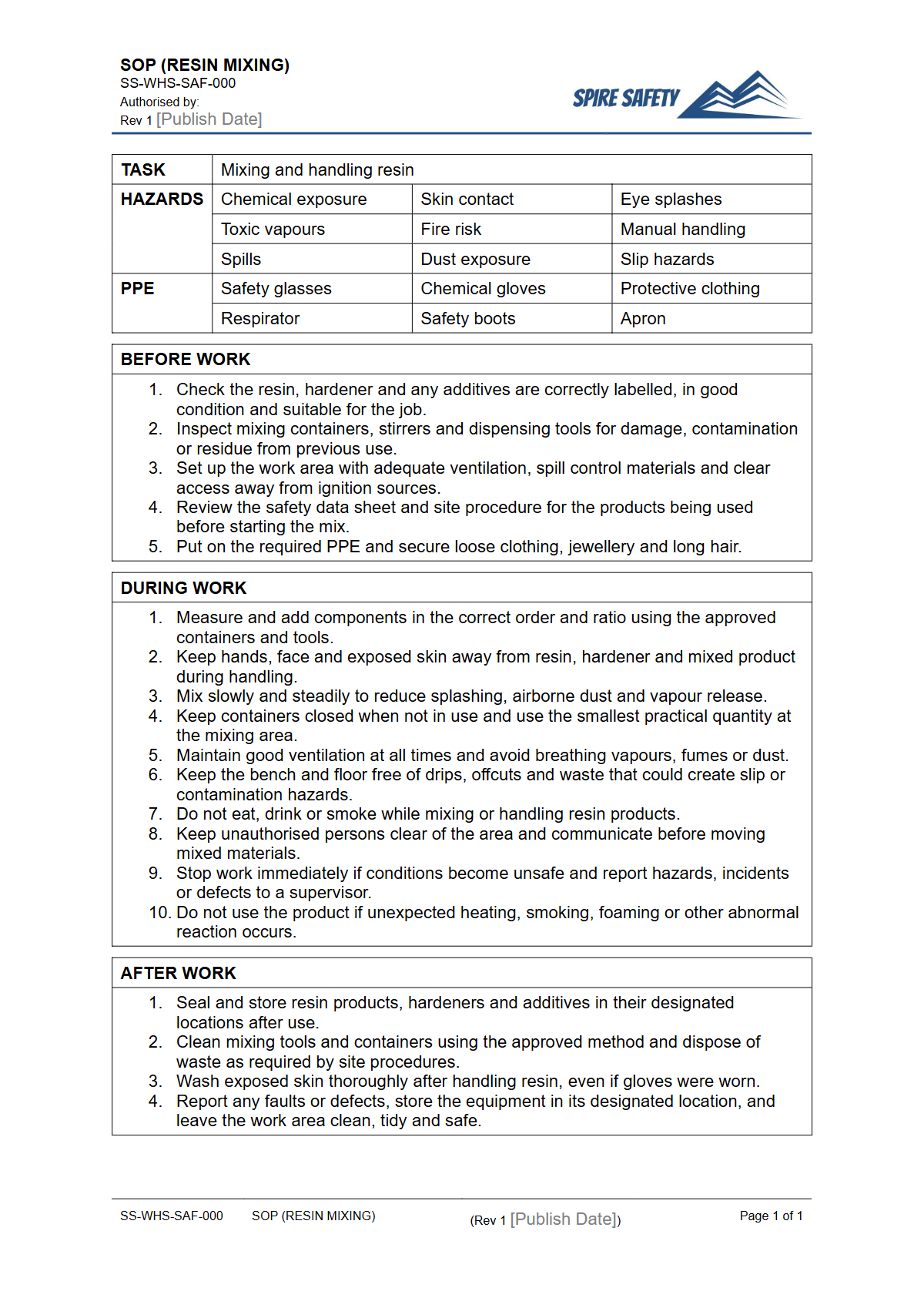
Working with resins involves significant health and safety risks, primarily from hazardous chemicals. This free Safe Operating Procedure (Resin Mixing) template provides a structured starting point for documenting the required safety controls for this task.
Using an SOP helps your organisation meet its duty of care by clearly defining the steps for mixing resins safely, minimising worker exposure to harmful vapours and substances, and preventing skin contact. It formalises risk controls such as personal protective equipment (PPE) selection, ventilation requirements, and emergency response actions, creating a safer working environment.
Properly implemented, a Safe Operating Procedure is a critical tool for training, hazard communication, and operational consistency. It supports compliance with Australian WHS regulations concerning hazardous chemicals by ensuring workers are informed of the risks and trained in the established control measures.
This process is a fundamental part of successfully implementing a WHS management system that protects your team from chemical-related injuries and illnesses.
Video walkthrough
How to use the Free Safe Operating Procedure (Resin Mixing) Template
This document is a template and must be customised to reflect the specific resins, equipment, and environment in your workplace. Download the DOCX file and consult with workers and supervisors to adapt it.
Your finished SOP should detail the exact types of resin and hardener used, referencing their Safety Data Sheets (SDS). Specify the precise mixing ratios, required PPE (e.g., nitrile gloves, safety glasses, respiratory protection), and steps for preparation, mixing, and clean-up.
It is essential to outline the specific engineering controls in place, such as the type and location of local exhaust ventilation. You should also include site-specific emergency procedures, detailing how to respond to spills, fires, or chemical exposures.
For other workshop tasks that require documented procedures, you might find our FREE Circular Saw SOP (Safe Operating Procedure) Template useful as a reference for structuring task-based controls.
A Note on Customisation
This template is a guide only. To be effective, it must be updated with information that is specific to your worksite, the equipment you use, and the chemicals you handle.
We are not responsible for any incidents that may occur from the use of this document. It is your responsibility to ensure all safety procedures are comprehensive, accurate, and compliant with current legislation.
When to Use a Safe Operating Procedure
A Safe Operating Procedure for resin mixing should be developed and implemented before any worker undertakes the task. It must be used as a primary training document for new employees and a refresher tool for existing staff.
The SOP should be readily accessible in the work area and reviewed whenever there is a change in the process, such as the introduction of a new resin product, new equipment, or a change in the work environment. Regular reviews ensure the procedure remains relevant and effective.
Performing periodic checks on its implementation and effectiveness can be integrated into your internal WHS compliance auditing schedule.
Who Should Use It
This Safe Operating Procedure is intended for all personnel involved in the resin mixing process. This includes:
- Workers: To understand and follow the approved, safe method for completing the task.
- Supervisors and Team Leaders: To induct and train workers, monitor adherence to the procedure, and ensure safety controls are maintained.
- WHS Managers and Personnel: To develop, implement, and review risk control measures as part of the broader safety management system.
By ensuring all relevant personnel use and understand the SOP, you create a consistent and safety-conscious approach to managing high-risk tasks. For other processes involving machinery with specific operational steps, consider adapting a similar procedural document, such as our Free Air Compressor SOP (Safe Operating Procedure) Template. For organisations with large-scale production, procedures for related equipment like a FREE Conveyer System SOP (Safe Operating Procedure) Template can also be developed.
You can explore our complete free WHS resources library for more templates to support your safety framework.
Common mistakes
Common mistakes to avoid
- Using the wrong type of gloves (e.g., latex, which offers poor protection against many resin chemicals).
- Mixing resin in a confined, poorly ventilated space without respiratory protection.
- Failing to consult the Safety Data Sheet (SDS) for each chemical component before starting work.
- Incorrect disposal of leftover resin and contaminated materials, which are often considered hazardous waste.
Legal references
Legal considerations
The following legal requirements may be relevant to this type of work.
- Work Health and Safety Act (Harmonised) — Provides the primary duties for protecting workers and other people from work health and safety risks.
- Work Health and Safety Regulations (Harmonised) — Sets out requirements supporting the management of workplace hazards and risks.
The following codes may be relevant to this type of work.
- Managing WHS Risks Code of Practice — Provides practical guidance on identifying hazards, assessing risks and applying effective controls.
- Work Health and Safety Consultation, Cooperation and Coordination Code of Practice — Provides practical guidance on consulting workers and coordinating with other duty holders.
- Managing the Work Environment and Facilities Code of Practice — Provides practical guidance on safe work environments, workplace facilities and related controls.
Did you know
Hidden Hazards
Many common two-part resins, such as epoxies and polyurethanes, contain sensitising agents. Repeated exposure, even at low levels, can lead to permanent allergic reactions like contact dermatitis or occupational asthma.
Check the SDS
The Safety Data Sheet (SDS) for a resin component is not just a formality; it's a critical document that lists hazardous ingredients, health effects, first aid measures, and required protective equipment. Always consult it before use.
FAQ
Frequently asked questions
01What PPE is required for mixing resin?
02How do I properly ventilate a resin mixing area?
03Is an SOP legally required for resin mixing in Australia?
04What should be in the emergency procedures section of a resin mixing SOP?
Share this resource
Free Safe Operating Procedure (Resin Mixing) Template
Browse Categories
How To Use It
- 1Download and open in Word or PDF.
- 2Replace the placeholders with your business details.
- 3Get it reviewed by a WHS specialist before rollout.
Need it customised?
Our WHS consultants can adapt this template to your site, run a gap analysis, or audit what you already have in place.
Book a Free Consultation WHS consulting servicesor call 1300 156 382
Related templates
- Free Safe Operating Procedure (Respirator Cleaning) Template
- Free Safe Operating Procedure (Retail Bagging) Template
- Free Safe Operating Procedure (Retail Display Setup) Template
- Free Safe Operating Procedure (Retail Shelf Cleaning) Template
- Free Safe Operating Procedure (Retail Stock Handling) Template
- Free Safe Operating Procedure (Retaining Wall Clean) Template