
Free Safe Operating Procedure (Retail Display Setup) Template
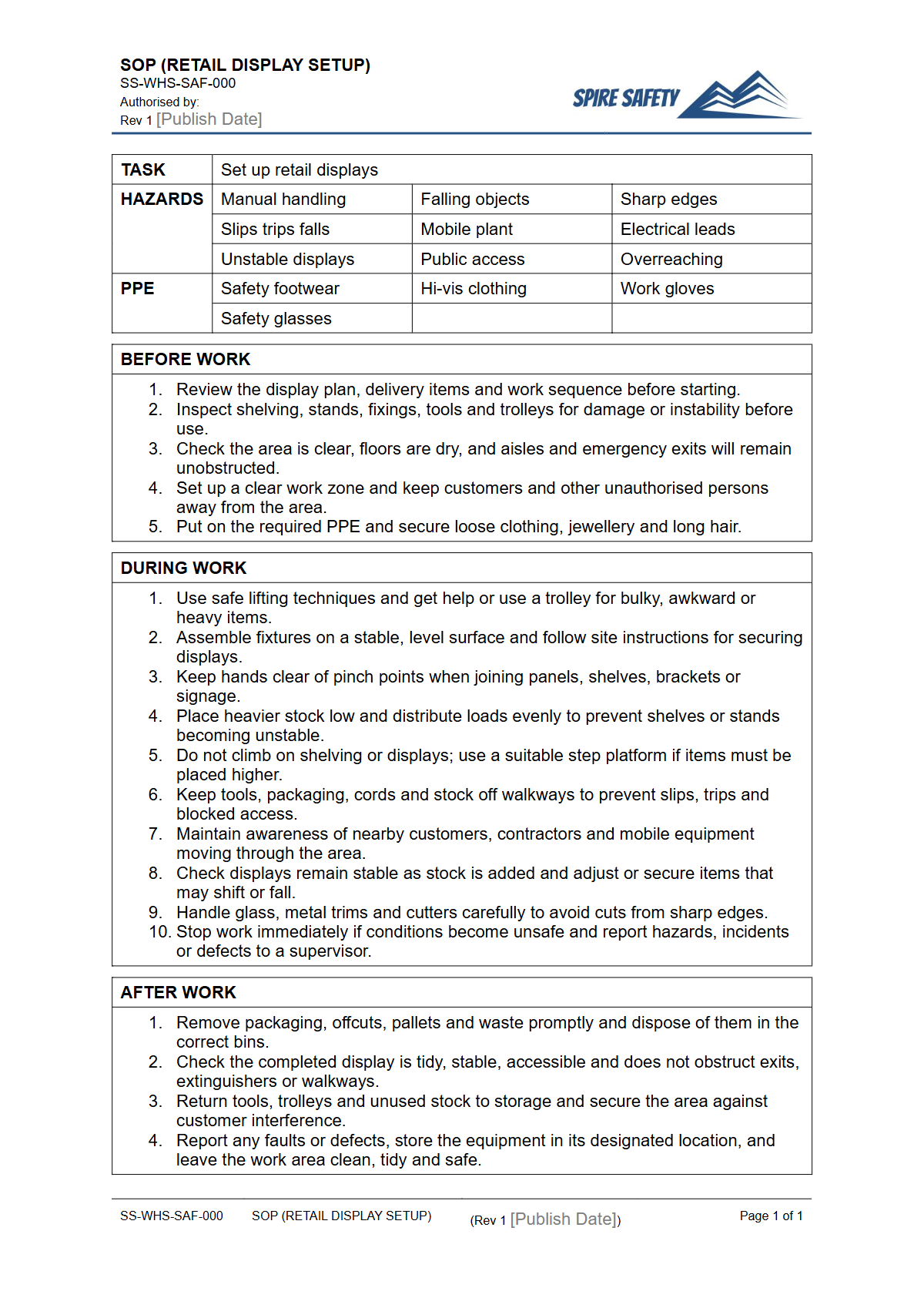
Download our free Safe Operating Procedure (Retail Display Setup) Template to formalise safety steps for your team.
Free Safe Operating Procedure (Retail Display Setup) Template
DOCX • 126 KB + PDF
Updated Oct 2026
No signup required
Purpose of the Free Safe Operating Procedure (Retail Display Setup) Template
Setting up and changing retail displays, from simple shelving to complex promotional structures, involves numerous workplace hazards. This free Safe Operating Procedure (Retail Display Setup) Template provides a structured framework to document and manage these risks, ensuring tasks are performed safely and consistently.
Using a formal SOP helps a Person Conducting a Business or Undertaking (PCBU) meet their primary duty of care under Australian WHS laws.
Key risks addressed by this procedure include:
- Manual Handling: Lifting, carrying, and positioning heavy or awkward items like mannequins, shelving units, and stock.
- Slips, Trips, and Falls: Obstacles, packaging materials, and spills in the work area can create trip hazards, while using ladders or steps to access higher areas introduces the risk of falls.
- Cuts and Lacerations: Using tools like box cutters, scissors, or other assembly equipment without proper procedure or personal protective equipment (PPE).
- Public Interaction: Working in areas accessible to customers requires specific controls to prevent public injury from falling objects or trip hazards.
By implementing a clear SOP, you standardise safe work practices, create a valuable training tool for new and existing employees, and demonstrate a commitment to safety. This document is a foundational element in a comprehensive WHS management system, helping to embed safe behaviour into your daily operations.
Video walkthrough
How to use the Free Safe Operating Procedure (Retail Display Setup) Template
Our downloadable template is available in both DOCX and PDF formats for your convenience. The DOCX file is fully editable, allowing you to tailor it to your specific retail environment. To effectively implement this Safe Operating Procedure for Retail Display Setup, follow these steps:
1. Download and Customise: Download the DOCX template and add your company name, logo, and other relevant details.
Review each section and modify the content to reflect the specific displays, tools, equipment, and environment in your store.
2. Consult with Your Team: WHS regulations require consultation with workers.
Share the draft SOP with the visual merchandisers, retail assistants, and managers who perform these tasks. Their feedback is invaluable for identifying practical risks and effective controls that may have been missed.
3. Finalise and Approve: Incorporate feedback from your team and have the final document approved by a manager or safety officer.
This formalises it as an official workplace procedure.
4. Train All Relevant Staff: Ensure every team member involved in setting up displays is trained on the procedures outlined in the SOP.
Keep records of this training for compliance purposes.
5. Review and Update: An SOP is a living document.
It should be reviewed regularly (at least annually) and updated whenever a new type of display is introduced, new equipment is used, or after an incident or near-miss occurs.
Important: It's crucial to remember that this is a template, not a finished document. We have designed it as a starting point, and you must customise it to reflect the specific equipment, environment, and tasks at your workplace. For tasks that involve constructing displays from raw materials, you may need additional procedures like our free Circular Saw SOP.
When to use this Safe Operating Procedure
This SOP should be referenced before and during any task involving the assembly, installation, modification, or dismantling of retail displays. It is particularly important in the following situations:
- New Display Setups: When installing a new promotional or seasonal display for the first time.
- Major Store Resets: During significant changes to the store layout that involve moving multiple fixtures and displays.
- Training New Employees: As a core part of the induction and training process for new team members responsible for visual merchandising.
- Refresher Training: For periodic refresher training to ensure all team members remain aware of the safe work practices.
- Post-Incident Investigation: As a reference document when investigating an incident or near-miss to determine if procedural gaps contributed to the event.
Integrating this SOP into your planning process and conducting WHS compliance audits helps ensure that safety is considered before work begins, not as an afterthought.
Who should use this Safe Operating Procedure
This procedure is intended for all personnel involved in the lifecycle of retail displays. This includes, but is not limited to:
- Visual Merchandisers: The primary users who design and implement display concepts.
- Retail Store Managers: Responsible for overseeing store operations and ensuring a safe work environment for their team.
- Team Leaders/Supervisors: Responsible for direct supervision and ensuring procedures are followed on the shop floor.
- Retail Assistants: Any staff member tasked with assisting in the setup, movement, or pack-down of displays.
Ultimately, the PCBU holds the overall responsibility for providing a safe system of work. For retailers with large back-of-house operations, this SOP can be used alongside others, such as our free Conveyer System SOP, to manage risks across the entire site.
For businesses needing further guidance on implementing tailored safety documents, Spire Safety offers expert WHS consulting to help build robust and practical safety systems.
Common mistakes
Common mistakes to avoid
- Using chairs, crates, or shelving as a makeshift ladder instead of a proper step stool or ladder.
- Leaving packaging, tools, and other materials on the floor, creating serious trip hazards for staff and customers.
- Failing to consult with the team members who actually perform the work when drafting the procedure.
- Not training new staff on the SOP before they are required to set up displays.
Legal references
Legal considerations
The following legal requirements may be relevant to this type of work.
- Work Health and Safety Act (Harmonised) — Provides the primary duties for protecting workers and other people from work health and safety risks.
- Work Health and Safety Regulations (Harmonised) — Sets out requirements supporting the management of workplace hazards and risks.
The following codes may be relevant to this type of work.
- Managing WHS Risks Code of Practice — Provides practical guidance on identifying hazards, assessing risks and applying effective controls.
- Work Health and Safety Consultation, Cooperation and Coordination Code of Practice — Provides practical guidance on consulting workers and coordinating with other duty holders.
- Managing the Work Environment and Facilities Code of Practice — Provides practical guidance on safe work environments, workplace facilities and related controls.
Did you know
Retail Injury Rates
According to Safe Work Australia, the retail trade industry has one of the highest frequencies of serious workers' compensation claims, with body stressing (manual handling) being the leading cause of injury.
Consultation is Key
Engaging your team in the creation of an SOP is not just good practice—it's a legal requirement. Workers who perform the task have firsthand knowledge of the risks and are best placed to suggest practical control measures.
FAQ
Frequently asked questions
01What are the main hazards when setting up retail displays?
02Does this SOP template cover electrical safety for illuminated displays?
03How often should a Safe Operating Procedure for retail displays be reviewed?
04Why can't I just use this retail display SOP template as-is?
Share this resource
Free Safe Operating Procedure (Retail Display Setup) Template
Browse Categories
How To Use It
- 1Download and open in Word or PDF.
- 2Replace the placeholders with your business details.
- 3Get it reviewed by a WHS specialist before rollout.
Need it customised?
Our WHS consultants can adapt this template to your site, run a gap analysis, or audit what you already have in place.
Book a Free Consultation WHS consulting servicesor call 1300 156 382
Related templates
- Free Safe Operating Procedure (Retail Shelf Cleaning) Template
- Free Safe Operating Procedure (Retail Stock Handling) Template
- Free Safe Operating Procedure (Retaining Wall Clean) Template
- Free Safe Operating Procedure (Return Freight Handling) Template
- Free Safe Operating Procedure (Returned Goods Handling) Template
- Free Safe Operating Procedure (Rewinder) Template