
Free Safe Operating Procedure (Return Freight Handling) Template
Manage returned goods safely with our free Safe Operating Procedure for return freight handling. Customise this template (DOCX/PDF) to fit your workplace.
Free Safe Operating Procedure (Return Freight Handling) Template
DOCX • 126 KB + PDF
Updated Oct 2026
No signup required
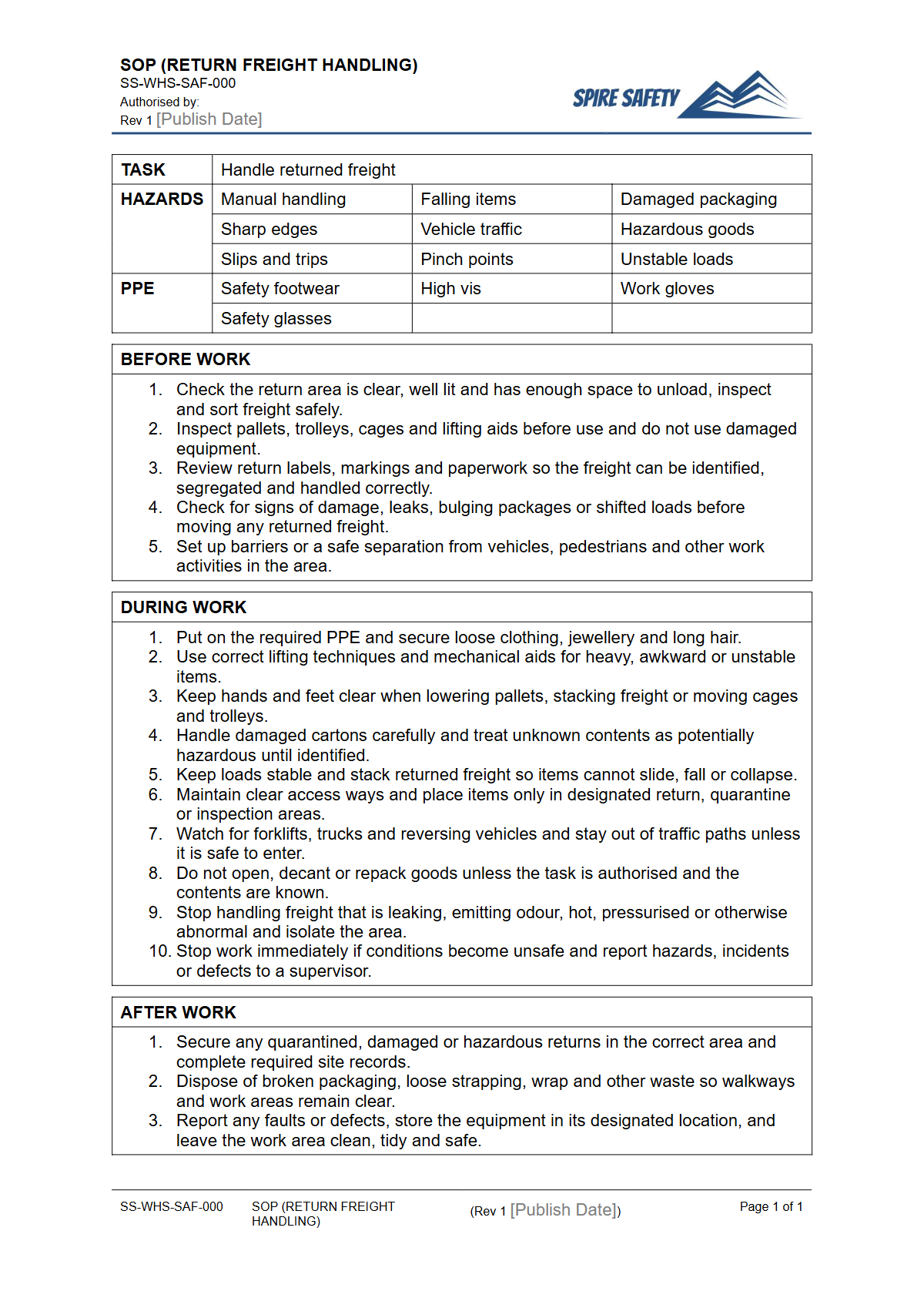
Purpose of the Free Safe Operating Procedure (Return Freight Handling) Template
Managing returned goods presents unique challenges that go beyond standard receiving procedures. This Free Safe Operating Procedure (Return Freight Handling) Template provides a structured starting point for your business to document a safe system of work for this specific task.
It is designed to help you identify hazards and implement controls for the entire process, from receiving and inspecting returned items to their final processing, repackaging, or disposal. Properly managing this workflow helps protect your workers from risks like manual handling injuries, exposure to unknown substances, and incidents involving vehicles or mobile plant.
A documented procedure ensures consistency and clarity, forming a critical part of your overall safety management system. It outlines the expected safe work behaviours for all personnel involved in handling returned stock.
For related tasks involving vehicles, you may also find value in our Body Truck SOP template, which covers vehicle-specific safety checks and operations.
Video walkthrough
How to use the Free Safe Operating Procedure (Return Freight Handling) Template
This template is provided in both DOCX and PDF formats for your convenience. The DOCX file is fully editable, allowing you to tailor the content to the specific realities of your workplace.
To use it effectively, download the document and work through each section, adding or removing details to match your site's layout, equipment, freight types, and internal processes. This customisation is a critical step in creating a truly effective procedure.
Customisation is Essential
Remember, this is a template, not a finished document. We have not been to your worksite and cannot know your unique operational risks.
You must adapt this Safe Operating Procedure to reflect the specific hazards and control measures relevant to your organisation. Effective customisation involves consulting directly with the workers who perform the tasks, as their input is invaluable for creating a practical and effective safety document.
Integrating this SOP into a robust WHS management system helps ensure that safety procedures are consistently applied, reviewed, and improved across your entire operation, rather than existing in isolation.
When to use this Safe Operating Procedure
This Safe Operating Procedure should be used as the primary reference document for all activities involving returned freight. It should be readily accessible to workers in the receiving, returns, or dispatch areas. Key times to reference the SOP include:
- During the induction and training of new warehouse or logistics staff.
- As a pre-start refresher before handling a large or unusual volume of returns.
- When conducting a risk assessment for returns processing.
- As a guide for supervisors monitoring work practices.
- During incident investigations related to freight handling.
Its effectiveness should be periodically checked as part of your commitment to continuous improvement, which can be verified through activities like regular WHS compliance auditing.
Who should use this Safe Operating Procedure
This document is intended for a range of personnel within a business that handles physical goods. Key users include:
- Warehouse and Logistics Staff: The primary users who perform the day-to-day tasks of receiving, inspecting, and processing returned goods.
- Supervisors and Team Leaders: To monitor compliance, provide instruction, and ensure safety standards are met.
- WHS Managers and Officers: As a tool for risk management, training, and building a comprehensive safety system.
- Training Coordinators: To use as a basis for developing practical training modules and competency assessments.
For tasks that require working at height, such as retrieving items from high shelving, this procedure should be used alongside equipment-specific documents like our Safe Operating Procedure for step ladders.
Key Hazards in Return Freight Handling
The process of handling returned freight can expose workers to numerous hazards if not managed correctly. This SOP template prompts you to consider controls for common risks, including:
- Hazardous Manual Tasks: Lifting, carrying, pushing, and pulling heavy or awkward items, leading to sprains and strains.
- Slips, Trips, and Falls: Caused by packaging debris, liquid from damaged goods, or poor housekeeping in the returns area.
- Mobile Plant Interaction: Collisions or contact with forklifts, pallet jacks, or other vehicles operating in the same space. Consider using dedicated documents like our Telehandler SOP template for specific equipment.
- Cuts and Lacerations: From using box cutters, or from sharp edges on damaged products or packaging materials like strapping.
- Chemical Exposure: Handling leaking or unlabelled containers with unknown substances.
Effectively identifying and controlling these hazards is fundamental to WHS compliance. If you require assistance with complex risk assessments or SOP development, seeking professional WHS consulting can provide expert guidance and support.
Common mistakes
Common mistakes to avoid
- Using a generic receiving SOP that doesn't address the unique risks of returned goods.
- Failing to quarantine and inspect returned items for damage or leaks before re-stocking.
- Neglecting to provide specific training on the SOP, assuming staff will just read it.
- Not updating the procedure after an incident or change in warehouse layout or equipment.
Legal references
Legal considerations
The following legal requirements may be relevant to this type of work.
- Work Health and Safety Act (Harmonised) — Provides the primary duties for protecting workers and other people from work health and safety risks.
- Work Health and Safety Regulations (Harmonised) — Sets out requirements supporting the management of workplace hazards and risks.
The following codes may be relevant to this type of work.
- Managing WHS Risks Code of Practice — Provides practical guidance on identifying hazards, assessing risks and applying effective controls.
- Work Health and Safety Consultation, Cooperation and Coordination Code of Practice — Provides practical guidance on consulting workers and coordinating with other duty holders.
- Managing the Work Environment and Facilities Code of Practice — Provides practical guidance on safe work environments, workplace facilities and related controls.
Did you know
Manual Handling Risks
Musculoskeletal disorders, often from manual handling tasks like lifting and moving freight, account for a significant portion of all serious workers' compensation claims in Australia.
Consultation is Key
Under model WHS laws, employers must consult with workers on health and safety matters. Involving your team in developing an SOP makes it more practical and effective.
FAQ
Frequently asked questions
01What is a Safe Operating Procedure for return freight handling?
02Why is a specific SOP needed for returned goods?
03Who is responsible for developing a Return Freight Handling SOP?
04How often should we review our freight handling SOPs?
Share this resource
Free Safe Operating Procedure (Return Freight Handling) Template
Browse Categories
How To Use It
- 1Download and open in Word or PDF.
- 2Replace the placeholders with your business details.
- 3Get it reviewed by a WHS specialist before rollout.
Need it customised?
Our WHS consultants can adapt this template to your site, run a gap analysis, or audit what you already have in place.
Book a Free Consultation WHS consulting servicesor call 1300 156 382
Related templates
- Free Safe Operating Procedure (Returned Goods Handling) Template
- Free Safe Operating Procedure (Rewinder) Template
- Free Safe Operating Procedure (Rice Cooker) Template
- Free Safe Operating Procedure (Ride-On Mower Operation) Template
- Free Safe Operating Procedure (Rigging Gear Storage) Template
- Free Safe Operating Procedure (Rigging Setup) Template