
Free Safe Operating Procedure (Ride-On Mower Operation) Template
Download our free Safe Operating Procedure (Ride-On Mower Operation) template.
Free Safe Operating Procedure (Ride-On Mower Operation) Template
DOCX • 163 KB + PDF
Updated Oct 2026
No signup required
Purpose of the Free Safe Operating Procedure (Ride-On Mower Operation) Template
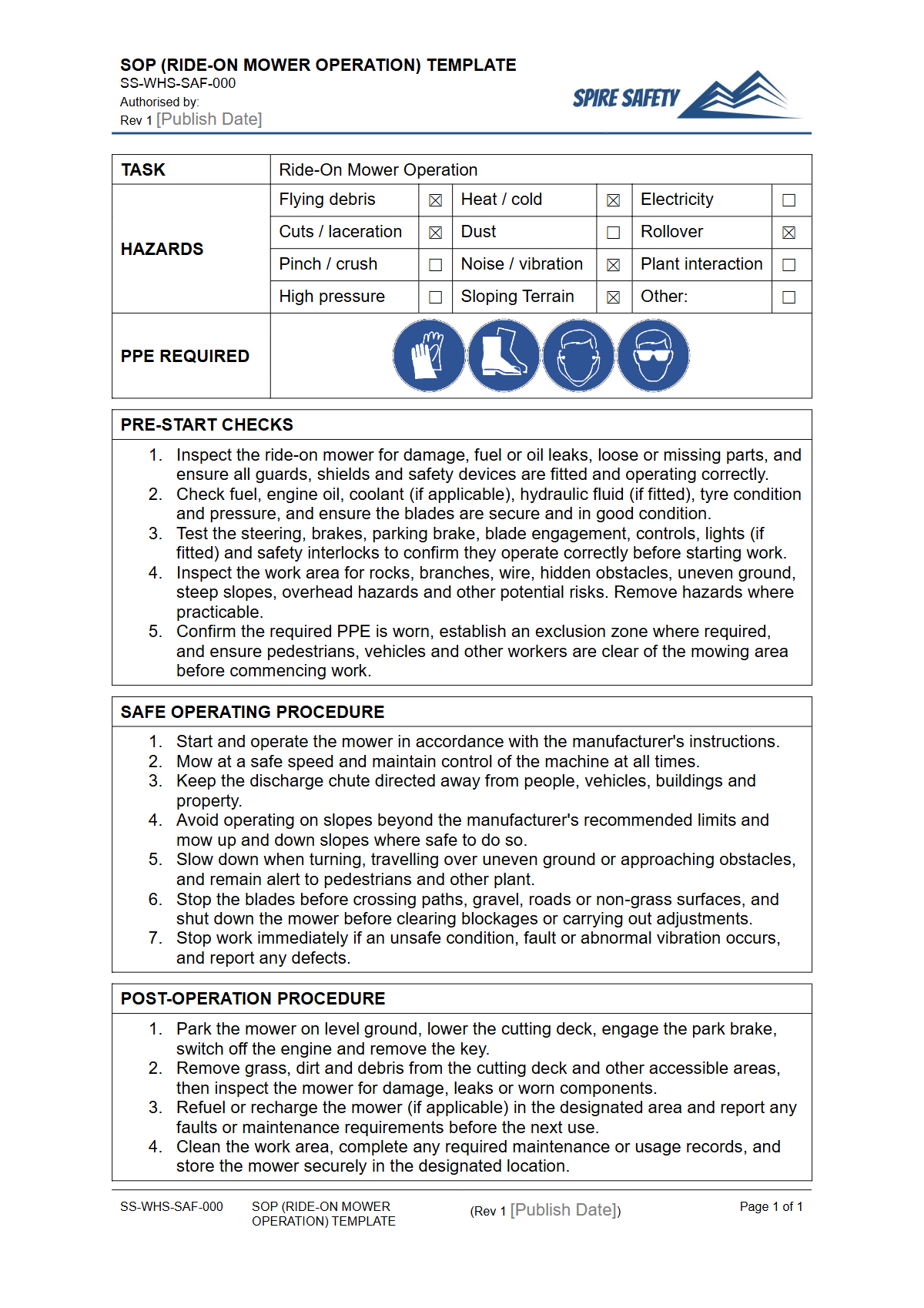
Operating a ride-on mower involves significant risks, including rollovers on uneven ground, contact with rotating blades, and injuries from projectiles. This Free Safe Operating Procedure (Ride-On Mower Operation) Template provides a structured framework for documenting the required steps to operate this equipment safely.
A documented SOP helps standardise your organisation’s approach, control identified hazards, and provide a clear reference for training and supervision. By implementing a clear procedure, you establish a consistent method that guides workers to perform the task safely every time, reducing the likelihood of incidents and injuries. This is a fundamental part of managing risks associated with groundskeeping machinery, similar to the controls needed for larger equipment detailed in our Free Tractor SOP (Safe Operating Procedure) Template.
Video walkthrough
How to use the Free Safe Operating Procedure (Ride-On Mower Operation) Template
This document is a template that must be customised to reflect the specific equipment, environment, and work practices at your site. To use it effectively:
- Download the template in your preferred format (DOCX for easy editing or PDF).
- Replace the placeholder text with information specific to your make and model of ride-on mower and your workplace’s unique conditions.
- Consult with the workers who will be using the equipment. Their practical experience is invaluable for identifying hazards and refining the procedure.
- Integrate the finalised SOP into your broader WHS management systems, ensuring it is used for training and risk assessments.
- Ensure all operators are trained on the contents of the finalised SOP and their competency is verified before they are authorised to use the mower.
- Schedule regular reviews of the SOP to ensure it remains current and effective.
Important: We have provided this template as a starting point. It is your responsibility to ensure the final document is tailored to the specific plant, tasks, and hazards present in your workplace to manage your safety obligations.
Key Elements of a Ride-On Mower SOP
A comprehensive Safe Operating Procedure for a ride-on mower should cover several critical stages of the task. Our template guides you through documenting these key areas:
- Pre-Start Checks: A detailed checklist of inspections to be performed before starting the engine, including checking fluid levels, tyre pressure, safety guards, emergency stops, and the condition of the blades.
- Operational Sequence: Step-by-step instructions for safely starting, operating, and manoeuvring the mower. This includes guidelines for mowing on different terrains, avoiding obstacles, and managing speed.
- Shut-Down Procedure: The correct sequence for parking the mower, disengaging the blades, turning off the engine, and securing the equipment.
- Required Personal Protective Equipment (PPE): Specifies the mandatory PPE for operators, such as steel-capped boots, hearing protection, eye protection, and high-visibility clothing.
- Emergency Procedures: Clear instructions on how to respond to common emergencies, such as rollovers, fires, or mechanical failures.
For related groundskeeping tasks, consider adapting a similar procedural approach, such as that outlined in our free Edger SOP Template, to maintain consistency in your safety documentation.
When to use this Safe Operating Procedure
A Safe Operating Procedure is a versatile tool used throughout the safety management lifecycle. It is essential for worker inductions and task-specific training, providing a benchmark for expected performance.
The SOP should be a key reference document during pre-task risk assessments like a Safe Work Method Statement (SWMS) or Take 5. Following an incident or near miss involving a ride-on mower, the SOP serves as a baseline to review whether procedures were followed and if they need improvement.
Regular reviews, often as part of a WHS compliance auditing program, ensure the document remains relevant to current practices.
Who should use this Safe Operating Procedure
This SOP is designed for use by multiple roles within an organisation. Persons Conducting a Business or Undertaking (PCBUs) and their managers can use it to fulfil their duty of care by providing a safe system of work.
Supervisors rely on it to train workers, monitor performance, and enforce safe practices on-site. WHS and safety professionals use it as a foundational document for risk assessments and building broader safety programs.
Most importantly, the equipment operators themselves use it as a clear, practical guide for performing their job safely. Having a standardised procedure for common equipment helps maintain a consistent safety standard across all operations, whether for mowers or other workshop machinery covered in resources like our free Air Compressor SOP template.
By properly customising and implementing this SOP, your organisation can significantly improve safety outcomes for all personnel involved in ride-on mower operations. Feel free to explore our complete free WHS resources library for more templates to support your safety management system.
Common mistakes
Common mistakes to avoid
- Mowing on slopes that are too steep for the mower's stability limits.
- Disabling or removing safety features such as guards or automatic shut-off switches.
- Attempting to clear a clogged cutting deck or adjust blades while the engine is running.
- Allowing other people, especially children, to ride as passengers on the mower.
Legal references
Legal considerations
The following legal requirements may be relevant to this type of work.
- Work Health and Safety Act (Harmonised) — Provides the primary duties for protecting workers and other people from work health and safety risks.
- Work Health and Safety Regulations (Harmonised) — Sets out requirements supporting the management of workplace hazards and risks.
The following codes may be relevant to this type of work.
- Managing WHS Risks Code of Practice — Provides practical guidance on identifying hazards, assessing risks and applying effective controls.
- Work Health and Safety Consultation, Cooperation and Coordination Code of Practice — Provides practical guidance on consulting workers and coordinating with other duty holders.
- Managing the Work Environment and Facilities Code of Practice — Provides practical guidance on safe work environments, workplace facilities and related controls.
Did you know
Rollover Risk
Ride-on mower rollovers are a leading cause of fatal incidents. Most occur on slopes, embankments, or near retaining walls, highlighting the importance of assessing terrain before mowing.
Blade Speed
The tips of a ride-on mower's blades can spin at speeds of up to 300 km/h. This high speed can turn small objects like stones or twigs into dangerous high-velocity projectiles.
FAQ
Frequently asked questions
01What should be included in pre-start checks for a ride-on mower SOP?
02How often should a Safe Operating Procedure for a ride-on mower be reviewed?
03Is specific training required to operate a ride-on mower at work?
04What personal protective equipment (PPE) is needed for operating a ride-on mower?
Share this resource
Free Safe Operating Procedure (Ride-On Mower Operation) Template
Browse Categories
How To Use It
- 1Download and open in Word or PDF.
- 2Replace the placeholders with your business details.
- 3Get it reviewed by a WHS specialist before rollout.
Need it customised?
Our WHS consultants can adapt this template to your site, run a gap analysis, or audit what you already have in place.
Book a Free Consultation WHS consulting servicesor call 1300 156 382
Related templates
- Free Safe Operating Procedure (Rigging Gear Storage) Template
- Free Safe Operating Procedure (Rigging Setup) Template
- Free Safe Operating Procedure (Road Broom) Template
- Free Safe Operating Procedure (Road Marking Machine) Template
- Free Safe Operating Procedure (Road Profiler) Template
- Free Safe Operating Procedure (Road Saw) Template