
Free Safe Operating Procedure (Road Saw) Template
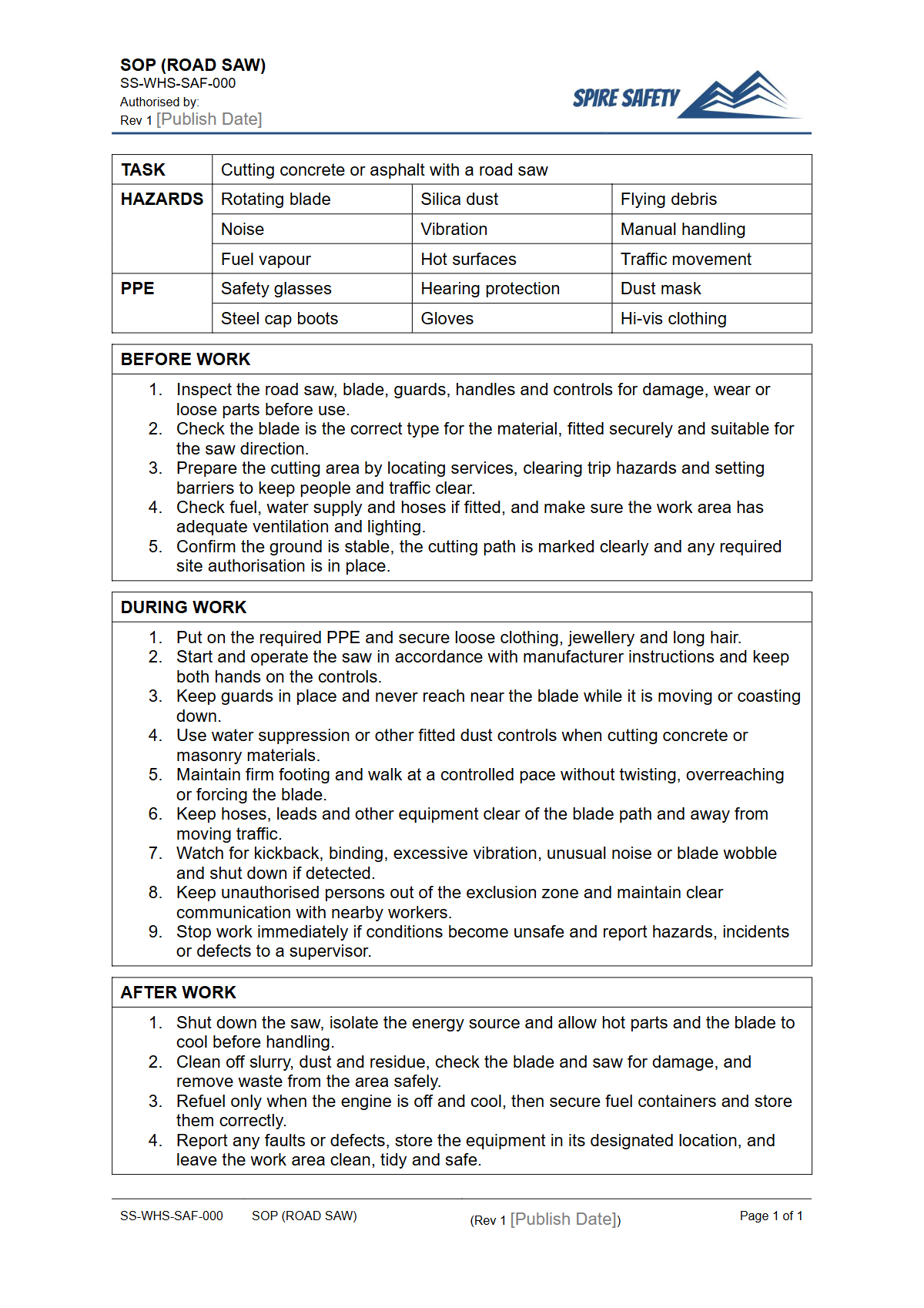
Download our free Safe Operating Procedure (Road Saw) Template. This structured document helps you outline step-by-step instructions for safe road saw use.
Free Safe Operating Procedure (Road Saw) Template
DOCX • 126 KB + PDF
Updated Oct 2026
No signup required
Purpose of the Free Safe Operating Procedure (Road Saw) Template
A Safe Operating Procedure (SOP) is a foundational document for managing risk in any workplace. For high-risk equipment like road saws, it is an essential control measure.
Our free Safe Operating Procedure (Road Saw) Template provides a structured starting point for documenting the step-by-step process for using this powerful cutting equipment safely. This template is designed to help your organisation meet its work health and safety obligations by outlining hazards, required personal protective equipment (PPE), and the safe method for completing the task.
Systematically addressing these steps helps prevent injuries, equipment damage, and costly project delays.
Developing and implementing robust SOPs demonstrates a commitment to worker safety and is a key element of proactive risk management. Documenting safe work methods forms a critical part of your organisation's overall WHS management systems. This not only helps in training and supervising workers but also serves as a clear record of the safety standards you have established for specific tasks.
Using this template helps ensure all operators are aware of the risks and follow the same approved, safe procedure every time.
Video walkthrough
How to use the Free Safe Operating Procedure (Road Saw) Template
This resource is available for immediate download in both DOCX and PDF formats. The DOCX version is fully editable, allowing you to tailor the content to the specific models of road saws used at your worksite, the materials being cut (e.g., concrete, asphalt), and your unique operational environment.
It is crucial to integrate your site-specific risk assessment findings into the document.
IMPORTANT: This document is a template only. We have provided it as a starting point, but you must customise it to reflect the specific hazards, equipment, and control measures relevant to your workplace and tasks.
Generic procedures are insufficient; your SOP must be specific to be effective. The same principle of customisation applies to other cutting tools, which is why our FREE Circular Saw SOP Template also requires site-specific details.
When to use a Safe Operating Procedure
A Safe Operating Procedure for a road saw should be used as a constant reference point for safety. It is not a document to be filed away and forgotten. It should be readily accessible and used:
- During Training and Induction: To teach new and inexperienced workers the correct, safe method for operating a road saw.
- For Pre-start or Toolbox Talks: To review key safety steps and hazards before work begins, especially if conditions have changed.
- As an On-the-Job Reference: Workers should be able to consult the SOP if they are unsure about any aspect of the task.
- For Refresher Training: To ensure long-term employees have not developed unsafe habits and are up-to-date with current procedures.
- During Incident Investigations: To help determine if a deviation from the established procedure contributed to an incident or near-miss.
For related ground-disturbing work, you may need other specific procedures. For example, if extensive channeling is required, your team might also consult our FREE Trencher SOP Template to ensure all associated risks are managed.
Who should use this Template
Multiple roles within an organisation have a responsibility to use and be familiar with a Road Saw SOP:
- Workers/Operators: They are the primary users who must follow the procedure to complete their work safely.
- Supervisors and Forepersons: They are responsible for ensuring workers are trained on the SOP and follow it consistently. They must monitor compliance and provide guidance.
- WHS Managers/Officers: They typically oversee the development, review, and implementation of SOPs as part of the broader safety management system. They can use the finalised SOP as a benchmark during safety inspections and formal WHS compliance auditing to verify safe practices are being followed.
- Trainers and Assessors: They use the SOP as a core training document to ensure consistent and safe instruction for all operators.
On larger civil construction projects, a road saw is just one piece of plant among many. Teams may also be operating heavy equipment requiring its own set of procedures, such as those detailed in our FREE Grader SOP (Safe Operating Procedure) Template. Find more documents to support your safety programs by browsing our complete free WHS resources library.
Common mistakes
Common mistakes to avoid
- Failing to customise the template for site-specific conditions and saw models.
- Not using adequate dust suppression (water) when cutting concrete or asphalt, creating a silica dust hazard.
- Using a worn, damaged, or incorrect type of diamond blade for the material being cut.
- Neglecting to thoroughly inspect the work area for underground services (pipes, cables) before starting a cut.
Legal references
Legal considerations
The following legal requirements may be relevant to this type of work.
- Work Health and Safety Act (Harmonised) — Provides the primary duties for protecting workers and other people from work health and safety risks.
- Work Health and Safety Regulations (Harmonised) — Sets out requirements supporting the management of workplace hazards and risks.
The following codes may be relevant to this type of work.
- Managing WHS Risks Code of Practice — Provides practical guidance on identifying hazards, assessing risks and applying effective controls.
- Work Health and Safety Consultation, Cooperation and Coordination Code of Practice — Provides practical guidance on consulting workers and coordinating with other duty holders.
- Managing the Work Environment and Facilities Code of Practice — Provides practical guidance on safe work environments, workplace facilities and related controls.
Did you know
Silica Dust Hazard
Road saws cutting concrete, brick or stone can generate high levels of respirable crystalline silica (RCS). This hazardous dust can cause serious, incurable lung diseases like silicosis, making on-tool water suppression a critical control measure.
Kickback Risk
A primary danger with road saws is kickback, where the blade suddenly binds in the cut, forcing the machine violently back towards the operator. This is often caused by a worn blade, improper technique, or hitting a hidden object.
FAQ
Frequently asked questions
01What key information should be included in a Road Saw SOP?
02Is a Safe Operating Procedure a legal requirement in Australia?
03How often should a Road Saw SOP be reviewed?
04Can this template be used for other types of cutting equipment?
Share this resource
Free Safe Operating Procedure (Road Saw) Template
Browse Categories
How To Use It
- 1Download and open in Word or PDF.
- 2Replace the placeholders with your business details.
- 3Get it reviewed by a WHS specialist before rollout.
Need it customised?
Our WHS consultants can adapt this template to your site, run a gap analysis, or audit what you already have in place.
Book a Free Consultation WHS consulting servicesor call 1300 156 382
Related templates
- Free Safe Operating Procedure (Road Stabiliser) Template
- Free Safe Operating Procedure (Roadside Litter Pickup) Template
- Free Safe Operating Procedure (Robot Cell Entry) Template
- Free Safe Operating Procedure (Rock Anchor Drill) Template
- Free Safe Operating Procedure (Rock Drill) Template
- Free Safe Operating Procedure (Rock Garden Maintenance) Template