
Free Safe Operating Procedure (Rock Drill) Template
Our free Safe Operating Procedure (Rock Drill) Template provides a framework for managing hazards associated with rock drill use. Download the template today.
Free Safe Operating Procedure (Rock Drill) Template
DOCX • 126 KB + PDF
Updated Oct 2026
No signup required
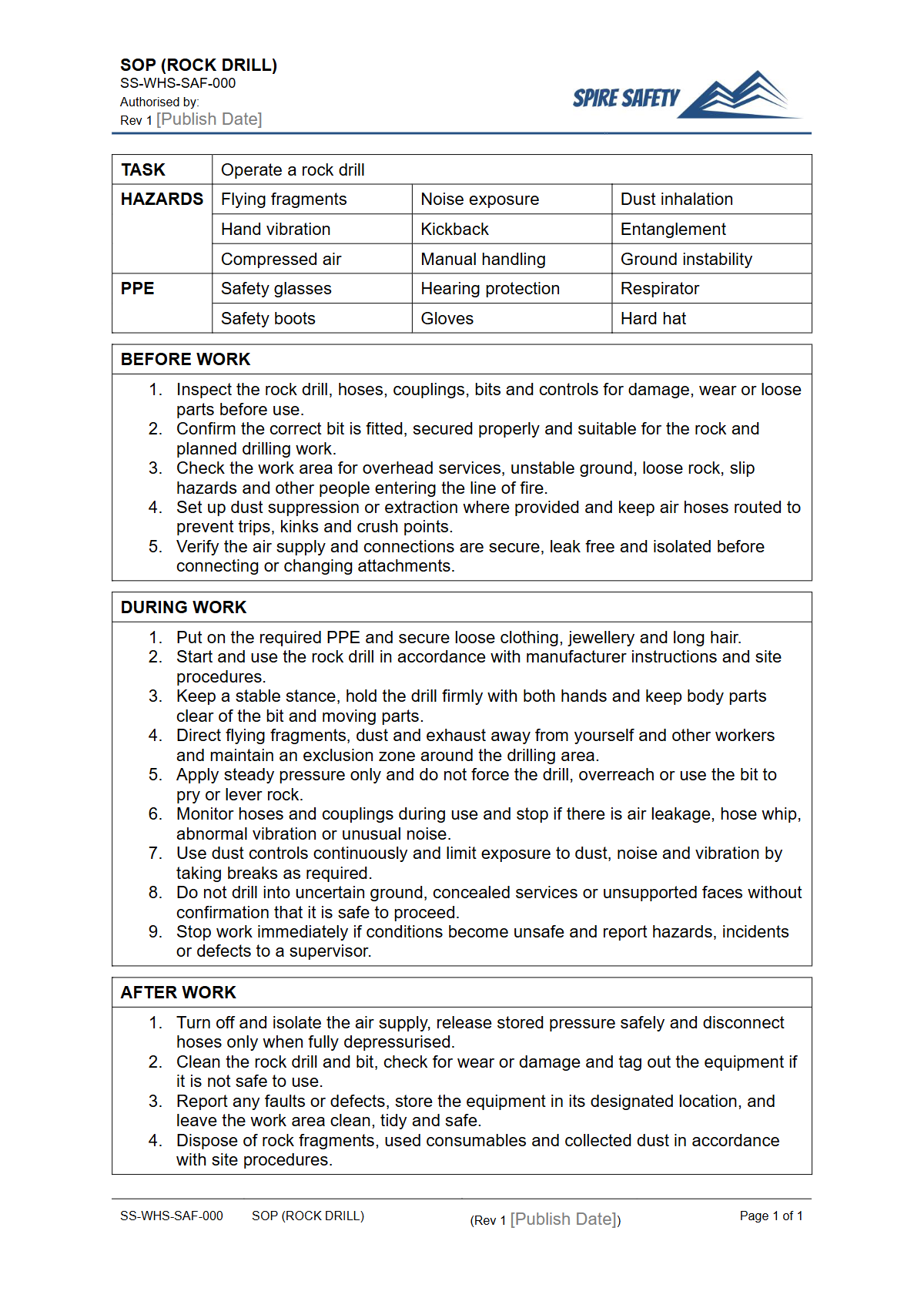
Purpose of the Free Safe Operating Procedure (Rock Drill) Template
This Free Safe Operating Procedure (Rock Drill) Template is designed to help you create a documented process for the safe use of pneumatic, hydraulic, or electric rock drills. Operating a rock drill introduces significant workplace hazards, including extreme noise, vibration, and hazardous dust.
A clear, well-defined SOP is a fundamental tool for instructing workers on the required steps to perform their tasks safely and consistently. Implementing a robust SOP helps standardise operations, minimises human error, and demonstrates a commitment to risk management as part of your WHS management systems.
Key Hazards Associated with Rock Drills
Developing a specific procedure for rock drills is critical due to the high-risk nature of the equipment. Key hazards that must be controlled include:
- Noise: High decibel levels leading to permanent noise-induced hearing loss.
- Vibration: Exposure to hand-arm vibration, which can cause Hand-Arm Vibration Syndrome (HAVS), a permanent and debilitating condition.
- Dust: Generation of respirable crystalline silica (RCS) when drilling concrete, rock, or masonry, which can lead to silicosis.
- Musculoskeletal Injury: Strains and sprains from handling the heavy and powerful tool, often in awkward postures.
- Flying Debris: Risk of eye or skin injuries from rock chips or drill bit failure. This is a common risk with many power tools, as detailed in our free Circular Saw SOP.
Video walkthrough
How to use the Free Safe Operating Procedure (Rock Drill) Template
This procedure is provided as a DOCX file for easy customisation and a PDF for straightforward printing and distribution. To use the template effectively, you must adapt it to your specific operational context.
This includes detailing the make and model of your equipment, the specific types of tasks performed, and the control measures your organisation has in place. Many rock drills are powered by compressed air, so it may be useful to consult our free Air Compressor SOP to ensure the entire system is covered.
Important: This document is a starting point. We have developed it to be aligned with general Australian WHS principles, but it is not a complete, out-of-the-box solution.
You must thoroughly review and customise the template to accurately reflect the unique hazards, risks, and control measures present in your workplace. This includes consulting with your workers and incorporating their feedback.
When to Use a Rock Drill SOP
A Safe Operating Procedure for rock drills should be a core part of your daily operations and safety management. It should be used:
- During worker training and induction: As a primary training document for new operators.
- For pre-start checks and task planning: As a checklist and reference before work begins.
- During competency assessments: To verify that operators understand and can apply the safe procedure.
- For incident investigations: To review whether the established procedure was followed.
- As evidence during safety reviews: To demonstrate how risks are being managed during WHS compliance auditing.
Who Should Use This Procedure
This SOP template is intended for use by various personnel within an organisation. Persons conducting a business or undertaking (PCBUs) can use it to fulfil their primary duty of care.
Safety Managers and Supervisors can use it to standardise procedures and deliver training. Most importantly, Operators and workers who use rock drills must be trained on the final, customised procedure and use it as their guide for safe work.
SOPs are vital for many types of high-risk plant, and you may find similar resources like our FREE Trencher SOP Template useful for other site activities.
Integrating SOPs into Your Safety Framework
An SOP is not a 'set and forget' document. For it to remain effective, it must be treated as a living document within your safety management system. This involves regular reviews, updates following any changes to equipment or processes, and ongoing consultation with the workers who use it every day. If you need assistance embedding procedures like this into your broader safety framework, consider seeking expert WHS consulting to ensure your systems are practical and effective.
Common mistakes
Common mistakes to avoid
- Using a generic template without customising it for the specific rock drill model and worksite.
- Failing to implement dust suppression controls like water feeds or dust extraction systems.
- Neglecting to monitor and manage operator exposure to noise and vibration.
- Not providing adequate operator training on the specific procedure and emergency actions.
Legal references
Legal considerations
The following legal requirements may be relevant to this type of work.
- Work Health and Safety Act (Harmonised) — Provides the primary duties for protecting workers and other people from work health and safety risks.
- Work Health and Safety Regulations (Harmonised) — Sets out requirements supporting the management of workplace hazards and risks.
The following codes may be relevant to this type of work.
- Managing WHS Risks Code of Practice — Provides practical guidance on identifying hazards, assessing risks and applying effective controls.
- Work Health and Safety Consultation, Cooperation and Coordination Code of Practice — Provides practical guidance on consulting workers and coordinating with other duty holders.
- Managing the Work Environment and Facilities Code of Practice — Provides practical guidance on safe work environments, workplace facilities and related controls.
Did you know
Vibration Exposure
Prolonged use of rock drills is a primary cause of Hand-Arm Vibration Syndrome (HAVS), a permanent and debilitating condition. Exposure limits are set by WHS regulations to manage this risk.
Silica Dust Risk
Drilling into concrete, stone, or rock can generate respirable crystalline silica (RCS) dust. Inhaling RCS can lead to silicosis, a serious and incurable lung disease.
FAQ
Frequently asked questions
01Is a Safe Operating Procedure a legal requirement for rock drills in Australia?
02How often should a rock drill SOP be reviewed?
03What's the difference between an SOP and a SWMS?
04What PPE is required for using a rock drill?
Share this resource
Free Safe Operating Procedure (Rock Drill) Template
Browse Categories
How To Use It
- 1Download and open in Word or PDF.
- 2Replace the placeholders with your business details.
- 3Get it reviewed by a WHS specialist before rollout.
Need it customised?
Our WHS consultants can adapt this template to your site, run a gap analysis, or audit what you already have in place.
Book a Free Consultation WHS consulting servicesor call 1300 156 382
Related templates
- Free Safe Operating Procedure (Rock Garden Maintenance) Template
- Free Safe Operating Procedure (Rock Scaling) Template
- Free Safe Operating Procedure (Rod Spinner) Template
- Free Safe Operating Procedure (Roll Cage Handling) Template
- Free Safe Operating Procedure (Roll Cage Loading) Template
- Free Safe Operating Procedure (Roll Cage Unloading) Template