
Free Safe Operating Procedure (Roll Cage Unloading) Template
Manage manual handling risks with our free Safe Operating Procedure (Roll Cage Unloading) Template.
Free Safe Operating Procedure (Roll Cage Unloading) Template
DOCX • 126 KB + PDF
Updated Oct 2026
No signup required
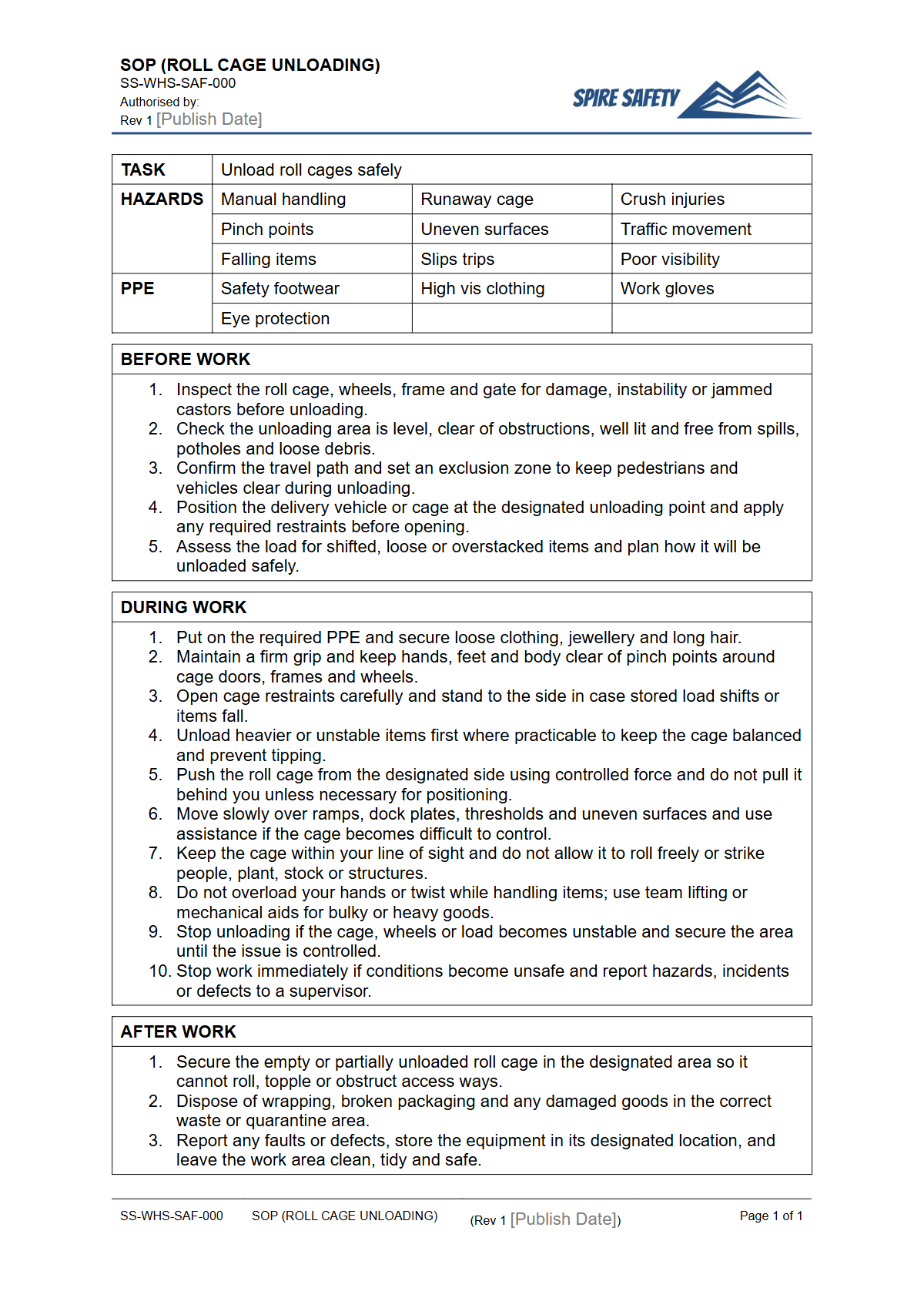
Purpose of the Free Safe Operating Procedure (Roll Cage Unloading) Template
Unloading roll cages from vehicles is a common task in retail, logistics, and warehousing, but it carries significant risks, including musculoskeletal injuries, crush hazards, and property damage. A Safe Operating Procedure (SOP) provides clear, step-by-step instructions for performing this task safely and efficiently.
This free Safe Operating Procedure (Roll Cage Unloading) Template is a structured starting point, designed to help your organisation document its specific processes. By formalising your procedures, you can standardise safe work practices, assist in training new employees, and demonstrate your commitment to managing workplace health and safety risks effectively.
This template is aligned with Australian WHS principles and encourages a systematic approach to identifying hazards and implementing control measures. It guides you through documenting pre-operational checks, the unloading sequence, and post-task responsibilities, ensuring that all workers understand the expected standards of safe behaviour.
Video walkthrough
How to use the Free Safe Operating Procedure (Roll Cage Unloading) Template
To get the most value from this resource, follow these steps:
- Download: Select the DOCX format for easy editing or the PDF for straightforward printing and viewing.
- Customise: This is the most critical step. You must adapt the template to reflect the specific equipment, environment, and processes at your workplace. This includes adding site-specific details, machine models, and unique hazards. We strongly recommend consulting with the workers who actually perform the task, as their direct experience is invaluable for creating a practical and effective SOP.
- Review and Approve: Once customised, have the SOP reviewed by a supervisor, manager, or safety professional to ensure it is accurate and comprehensive.
- Train and Implement: Use the finalised SOP as a training tool for all relevant personnel. Ensure it is readily accessible to workers in the areas where roll cages are unloaded.
Developing robust, site-specific documentation can be complex. If you need expert assistance in tailoring templates or developing your safety framework, our WHS consulting services can provide guidance aligned with best practice.
When to use it
A Safe Operating Procedure for roll cage unloading is not a document to be filed away and forgotten. It should be an active part of your daily operations and safety management system.
Use it during new employee induction and task-specific training to establish a baseline for safe performance. It also serves as a critical reference for refresher training and competency assessments.
In the event of an incident or near miss involving roll cages, the SOP provides a benchmark against which to review current practices. Regular reviews of your SOPs are a key component of maintaining and improving your WHS management systems.
Who should use it
This template is designed for use by a range of personnel within any organisation that handles roll cages. This includes:
- WHS and Safety Managers: To develop and standardise safety documentation as part of the broader safety system.
- Supervisors and Team Leaders: To train their teams, supervise the task, and enforce safe work practices.
- Workers: As a clear, accessible guide on how to perform their job safely, reducing their risk of injury.
- Training Coordinators: To form the basis of training programs and competency assessments.
The principles outlined are relevant across industries such as transport and logistics, retail distribution, and warehousing. For businesses managing multiple material handling processes, it's beneficial to have consistent documentation, such as our FREE Conveyer System SOP Template for related tasks.
Key Elements of the Safe Operating Procedure
A comprehensive SOP for roll cage unloading should cover the entire lifecycle of the task. Our template prompts you to detail the following critical areas.
Hazard Identification and Risk Controls
The document provides space to list potential hazards associated with the task, such as manual handling injuries (sprains, strains), being struck by the cage or its contents, slips, trips, falls, and crush injuries. For each hazard, you must document the control measures in place, following the hierarchy of controls.
Examples include using vehicles with tail lifts (engineering), maintaining a tidy unloading bay (administration), and providing appropriate PPE like gloves and safety footwear (PPE).
Pre-Operational Checks
Before any movement occurs, workers should perform a series of checks. This includes inspecting the roll cage for damage (e.g., faulty wheels, broken straps, sharp edges), ensuring the vehicle is securely parked with brakes applied, and verifying that the unloading area is clear of obstructions and personnel.
Documenting these checks helps foster a proactive safety culture. Conducting periodic reviews ensures these controls remain effective, a process that can be formalised through a WHS compliance auditing program.
Step-by-Step Unloading Procedure
This is the core of the SOP. It outlines the logical sequence for safely moving the roll cage from the vehicle to its destination.
Key steps include correct positioning of the tail lift, securing the cage for descent, techniques for pushing versus pulling, navigating ramps and doorways, and managing team lifting if required. For facilities that use more complex machinery for loading and unloading, it's vital to have specific procedures, such as those detailed in our FREE Telehandler SOP Template.
Emergency Procedures
The SOP should briefly outline actions to take in an emergency, such as what to do if a cage topples, someone is injured, or a load becomes unstable. This includes identifying emergency stop locations (if applicable), first aid response, and reporting procedures.
By thoroughly completing each section of this template, you create a valuable tool that supports a safe and productive work environment. For more templates and safety guides, feel free to browse our complete free WHS resources library.
Common mistakes
Common mistakes to avoid
- Overloading cages beyond their safe weight capacity or stacking goods unstably.
- Attempting to move cages on steep ramps, uneven ground, or cluttered pathways without assistance.
- Using cages with damaged wheels, brakes, or frames, which compromises stability and control.
- Failing to communicate with other workers in the area, leading to collisions or interference.
Legal references
Legal considerations
The following legal requirements may be relevant to this type of work.
- Work Health and Safety Act (Harmonised) — Provides the primary duties for protecting workers and other people from work health and safety risks.
- Work Health and Safety Regulations (Harmonised) — Sets out requirements supporting the management of workplace hazards and risks.
The following codes may be relevant to this type of work.
- Managing WHS Risks Code of Practice — Provides practical guidance on identifying hazards, assessing risks and applying effective controls.
- Work Health and Safety Consultation, Cooperation and Coordination Code of Practice — Provides practical guidance on consulting workers and coordinating with other duty holders.
- Managing the Work Environment and Facilities Code of Practice — Provides practical guidance on safe work environments, workplace facilities and related controls.
Did you know
Manual Task Risks
According to Safe Work Australia, hazardous manual tasks are a leading cause of workplace injury, with sprains and strains from lifting, pushing, and pulling objects accounting for a significant portion of serious workers' compensation claims.
Push, Don't Pull
Where possible, it is almost always safer to push a roll cage rather than pull it. Pushing allows for better visibility, uses stronger leg muscles, and keeps the body in a more stable, less strained posture.
FAQ
Frequently asked questions
01What is a Safe Operating Procedure for roll cage unloading?
02Are roll cages considered 'plant' under WHS law?
03What are the main hazards when unloading roll cages?
04Who is responsible for ensuring roll cages are unloaded safely?
Share this resource
Free Safe Operating Procedure (Roll Cage Unloading) Template
Browse Categories
How To Use It
- 1Download and open in Word or PDF.
- 2Replace the placeholders with your business details.
- 3Get it reviewed by a WHS specialist before rollout.
Need it customised?
Our WHS consultants can adapt this template to your site, run a gap analysis, or audit what you already have in place.
Book a Free Consultation WHS consulting servicesor call 1300 156 382
Related templates
- Free Safe Operating Procedure (Roller Door Cleaning) Template
- Free Safe Operating Procedure (Roller Door Operation) Template
- Free Safe Operating Procedure (Roller Painting) Template
- Free Safe Operating Procedure (Roller Shutter Reset) Template
- Free Safe Operating Procedure (Rolling Mill) Template
- Free Safe Operating Procedure (Roof Access Hatch) Template