
Free Safe Operating Procedure (Roller Door Operation) Template
Clearly outline the steps for safely operating roller doors in your workplace. Download our free, customisable Safe Operating Procedure template now.
Free Safe Operating Procedure (Roller Door Operation) Template
DOCX • 126 KB + PDF
Updated Oct 2026
No signup required
Purpose of the Free Safe Operating Procedure (Roller Door Operation) Template
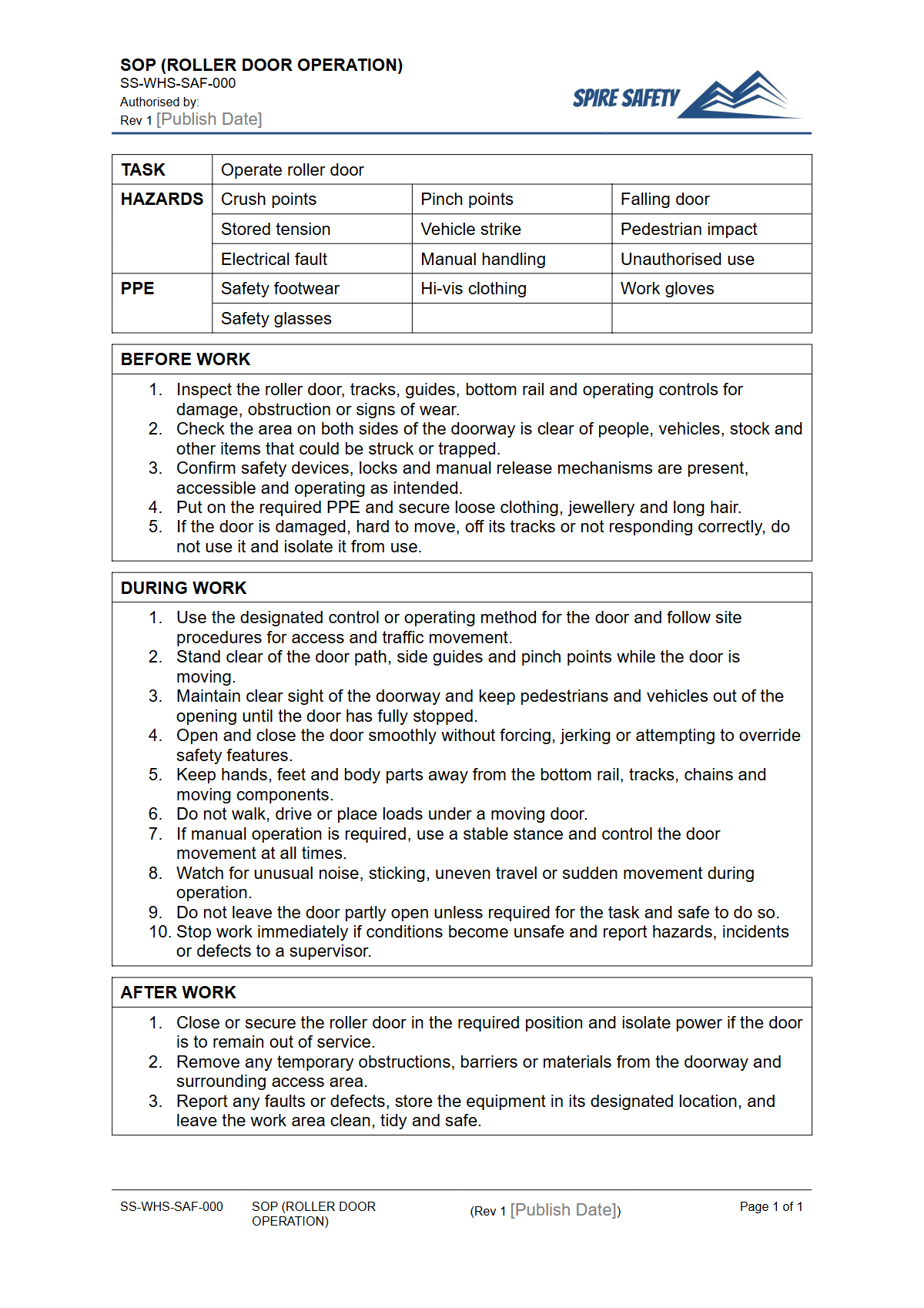
Effectively managing workplace risks associated with powered doors is crucial for preventing serious injuries from crushing, impact, or entanglement. Our Free Safe Operating Procedure (Roller Door Operation) Template provides a structured framework for documenting the required steps to operate industrial and commercial roller doors safely.
Using this Safe Operating Procedure helps a Person Conducting a Business or Undertaking (PCBU) fulfil their primary duty of care to provide and maintain a safe system of work.
A documented SOP ensures that all workers follow a consistent, approved method for operating roller doors, minimising human error and reinforcing safe behaviour. It serves as a vital tool for worker training and induction, and forms a key component of your overall WHS management systems by formalising your risk control measures for this common piece of plant.
Video walkthrough
How to use the Free Safe Operating Procedure (Roller Door Operation) Template
This document is available for immediate download in both DOCX and PDF formats. The DOCX version is fully editable, allowing you to adapt it to your specific operational needs.
A generic procedure is not sufficient; an effective SOP must be tailored to the unique context of your workplace.
Note: It is essential that you customise this document to reflect the specific equipment, environment, and work practices at your site. We've provided a comprehensive structure based on Australian WHS principles, but you must add your site-specific details to ensure it is effective. This includes details about the make and model of the door, its location, and any surrounding hazards.
Just like you would detail specific steps for other machinery, such as with our FREE Conveyer System SOP, specificity is key to a useful document.
Key Sections to Customise
Pay close attention to the following sections in the template, ensuring you replace the placeholder text with information relevant to your workplace:
- Hazards & Risks: Identify all potential hazards associated with your roller doors, such as crushing points, pinch points, electrical hazards, and risks from falling parts.
- Personal Protective Equipment (PPE): Specify any PPE required for operation or maintenance, such as high-visibility clothing if the door opens onto a traffic area.
- Pre-Operational Checks: Detail the daily or pre-start inspections operators must perform. This could include checking that safety sensors are clear and functional, visually inspecting tracks and cables, and confirming the emergency stop mechanism works. Similar to checks you might perform for other powered equipment using our Free Air Compressor SOP Template, these steps are vital.
- Operating Procedure: Provide clear, step-by-step instructions for opening and closing the door, including how to use manual override systems if applicable.
- Emergency Procedures: Outline the steps to take in case of malfunction, power failure, or an accident, including who to contact and where emergency controls are located.
When to use a Roller Door SOP
A Safe Operating Procedure for roller doors should be a living document integrated into your daily operations. It is used to:
- Train new employees, contractors, and visitors on the safe method of operation.
- Provide a reference point for all workers to ensure they are following the correct procedure.
- Conduct refresher training to reinforce safe work practices.
- Form the basis of workplace observations and competency assessments.
- Review and update operational processes as part of regular WHS compliance auditing or after an incident.
Who should use this Safe Operating Procedure
This Safe Operating Procedure is intended for a range of personnel within an organisation. Supervisors and managers should use it as a tool for training and for monitoring compliance with safe work practices.
WHS professionals can use it to ensure risks are being systematically managed. Most importantly, employees and contractors who operate the roller doors must be trained on the SOP and have easy access to it as a reference guide in their work area.
The procedure is also crucial for workers operating mobile plant in the vicinity of roller doors, ensuring they understand the risks and operational protocols. For complex interactions, you may need to cross-reference this document with other procedures, such as our FREE Telehandler SOP Template. By standardising procedures, you create a safer, more predictable environment for everyone.
You can explore our entire collection in the free WHS resources library for more templates to support your safety system.
Common mistakes
Common mistakes to avoid
- Failing to perform and document daily pre-operational safety checks.
- Attempting to 'beat the door' by running or driving underneath it as it closes.
- Neglecting the manufacturer's recommended maintenance schedule, leading to catastrophic failure.
- Using a generic SOP template without customising it for the specific door model and work environment.
Legal references
Legal considerations
The following legal requirements may be relevant to this type of work.
- Work Health and Safety Act (Harmonised) — Provides the primary duties for protecting workers and other people from work health and safety risks.
- Work Health and Safety Regulations (Harmonised) — Sets out requirements supporting the management of workplace hazards and risks.
The following codes may be relevant to this type of work.
- Managing WHS Risks Code of Practice — Provides practical guidance on identifying hazards, assessing risks and applying effective controls.
- Work Health and Safety Consultation, Cooperation and Coordination Code of Practice — Provides practical guidance on consulting workers and coordinating with other duty holders.
- Managing the Work Environment and Facilities Code of Practice — Provides practical guidance on safe work environments, workplace facilities and related controls.
Did you know
Maintenance is Key
Poorly maintained roller doors are a leading cause of incidents. The powerful springs and lifting mechanisms are under extreme tension and can fail catastrophically if not regularly inspected and serviced by a qualified technician.
Sensor Safety
Most modern commercial roller doors must include safety features like photoelectric beams or pressure-sensitive safety edges. These systems detect obstructions and automatically reverse the door's direction, a crucial feature for preventing crushing injuries.
FAQ
Frequently asked questions
01What are the main hazards associated with industrial roller doors?
02Is an SOP a legal requirement for roller doors in Australia?
03How often should our roller door SOP be reviewed?
04What training should be provided for roller door operation?
Share this resource
Free Safe Operating Procedure (Roller Door Operation) Template
Browse Categories
How To Use It
- 1Download and open in Word or PDF.
- 2Replace the placeholders with your business details.
- 3Get it reviewed by a WHS specialist before rollout.
Need it customised?
Our WHS consultants can adapt this template to your site, run a gap analysis, or audit what you already have in place.
Book a Free Consultation WHS consulting servicesor call 1300 156 382
Related templates
- Free Safe Operating Procedure (Roller Painting) Template
- Free Safe Operating Procedure (Roller Shutter Reset) Template
- Free Safe Operating Procedure (Rolling Mill) Template
- Free Safe Operating Procedure (Roof Access Hatch) Template
- Free Safe Operating Procedure (Roof Anchor Use) Template
- Free Safe Operating Procedure (Roof Cleaning) Template