
Free Safe Operating Procedure (Rolling Mill) Template
Effectively manage hazards associated with rolling mill operations with our comprehensive template. Download your customisable Safe Operating Procedure now.
Free Safe Operating Procedure (Rolling Mill) Template
DOCX • 126 KB + PDF
Updated Oct 2026
No signup required
Purpose of the Free Safe Operating Procedure (Rolling Mill) Template
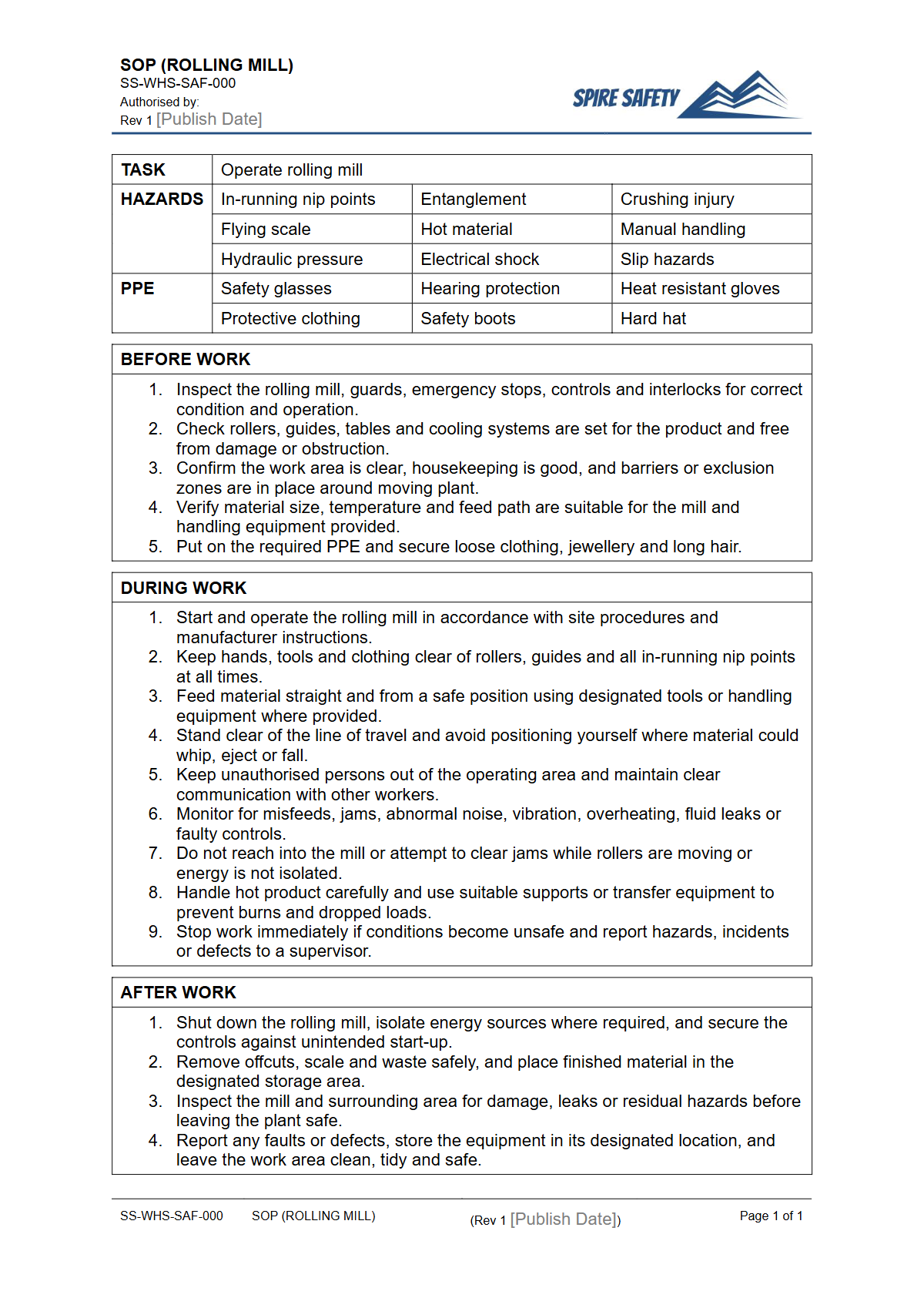
This Free Safe Operating Procedure (Rolling Mill) Template provides a structured framework for documenting the required steps to operate rolling mill machinery safely. Rolling mills present significant risks, including entanglement in rollers, crushing injuries from moving parts, burns from hot materials, high noise levels, and manual handling risks.
Using a standardised SOP helps to control these hazards effectively.
The purpose of this Safe Operating Procedure is to standardise procedures, assist in operator training, and serve as a key component of your overall risk management strategy. This document is a foundational tool for a Person Conducting a Business or Undertaking (PCBU) to meet their primary duty of care. In complex production lines, material flow between machines also requires formal procedures, such as those detailed in a FREE Conveyer System SOP.
Video walkthrough
How to use the Free Safe Operating Procedure (Rolling Mill) Template
To get the most value from this Free Safe Operating Procedure (Rolling Mill) Template, you must adapt it to the specific machinery, materials, and environment of your workplace. A generic procedure is not sufficient to control site-specific risks.
Always consult the manufacturer’s operating manual and incorporate its recommendations into your finalised document.
This template is a starting point. We strongly advise that you customise it in consultation with operators and supervisors to reflect your unique operational risks and control measures. The process should include:
- Downloading the DOCX file and forming a review team that includes operators, supervisors, and health and safety representatives (HSRs).
- Conducting a site-specific risk assessment for each rolling mill to identify all potential hazards and existing control measures.
- Populating the template with details specific to your machinery model, including emergency stop locations, guarding mechanisms, and required Personal Protective Equipment (PPE).
- Including clear, step-by-step instructions for pre-operational checks, start-up, operation, shutdown, and cleaning procedures.
- Formally approving the final Safe Operating Procedure and using it as a basis for operator training and competency assessments.
- Scheduling regular reviews (e.g., annually or after an incident) to ensure the procedure remains current and effective.
For organisations aiming for best practice, integrating individual SOPs into broader WHS management systems creates a more robust and sustainable safety culture.
Key Elements of an Effective Rolling Mill Safe Operating Procedure
An effective SOP for a rolling mill should be clear, concise, and easy for operators to understand. It must go beyond simply listing steps and should actively inform workers about risks and controls. Key sections to include are:
- Hazard Identification: Clearly list all known hazards associated with the task, such as entanglement, crushing, thermal hazards, noise, and ergonomic strains.
- Risk Control Measures: Specify the controls required to mitigate each hazard. This includes engineering controls like fixed guarding and interlocks, administrative controls like exclusion zones and lock-out tag-out (LOTO) procedures, and mandatory PPE.
- Personal Protective Equipment (PPE): Detail all mandatory PPE, such as heat-resistant gloves, safety glasses or face shields, hearing protection, and steel-capped boots.
- Emergency Procedures: Outline the correct steps for an emergency shutdown, detail the location of first aid kits and fire extinguishers, and provide contact information for first aid officers and emergency services.
- Maintenance and Cleaning: Include specific instructions for safe isolation and lock-out tag-out (LOTO) procedures that must be followed before any maintenance or cleaning work begins. Ancillary equipment used in the process, like those covered in a Free Air Compressor SOP, must also have their own dedicated procedures.
When to use this Safe Operating Procedure
A Safe Operating Procedure is a dynamic document used throughout the lifecycle of the plant and its operation. It should be actively used during:
- Induction and Training: For new operators or as a tool for refresher training for existing staff to ensure competency.
- Pre-Operational Checks: As a formal checklist for operators to complete before starting the machinery each day.
- Task Planning: As a reference document when planning non-routine tasks or conducting a job safety analysis (JSA). The insights gained can be valuable input for a broader WHS consulting engagement.
- Incident Investigations: To help determine if a deviation from the established safe procedure contributed to an incident or near miss.
- Workplace Audits: During internal or external safety audits to verify that prescribed safe work practices are being consistently followed on the workshop floor.
Who should use this Safe Operating Procedure
Responsibility for safety is shared, and the SOP is a critical tool for multiple roles within an organisation:
- PCBU/Management: To fulfil their duty of care by providing and maintaining a safe system of work.
- Supervisors: To train, monitor, and enforce safe work practices among their teams. They are responsible for ensuring operators understand and adhere to the SOP.
- Operators: As a direct guide for performing their tasks safely and consistently. Operators must be trained on the SOP and have their competency verified before being authorised to use the machinery.
- WHS Professionals: To integrate the SOP into the wider safety management system and use it as a tool for workplace inspections, risk assessments, and continuous improvement initiatives.
During maintenance, moving heavy components like rollers or motors may require specialised equipment. Ensure a corresponding FREE Telehandler SOP is in place for such tasks.
A periodic WHS compliance audit provides independent verification that your SOPs are being implemented effectively across the organisation. For more document templates to support your safety management system, explore our complete free WHS resources library.
Common mistakes
Common mistakes to avoid
- Using a generic SOP from another workplace without customising it for your specific machinery and risks.
- Failing to adequately train all operators on the contents of the finalised SOP.
- Neglecting to review and update the SOP after a process change, near miss, or incident.
- Developing the SOP in isolation without consulting the workers who actually operate the rolling mill.
Legal references
Legal considerations
The following legal requirements may be relevant to this type of work.
- Work Health and Safety Act (Harmonised) — Provides the primary duties for protecting workers and other people from work health and safety risks.
- Work Health and Safety Regulations (Harmonised) — Sets out requirements supporting the management of workplace hazards and risks.
The following codes may be relevant to this type of work.
- Managing WHS Risks Code of Practice — Provides practical guidance on identifying hazards, assessing risks and applying effective controls.
- Work Health and Safety Consultation, Cooperation and Coordination Code of Practice — Provides practical guidance on consulting workers and coordinating with other duty holders.
- Managing the Work Environment and Facilities Code of Practice — Provides practical guidance on safe work environments, workplace facilities and related controls.
Did you know
A Long History
The basic principles of rolling mills have been in use for centuries, with the first known designs for rolling metal appearing in a drawing by Leonardo da Vinci and the first mills being built in the late 16th century.
Machinery Risks
The manufacturing industry accounts for a significant portion of serious workers' compensation claims in Australia, with injuries involving machinery being a primary cause. Entanglement and being crushed are among the most severe and frequent types of incidents.
FAQ
Frequently asked questions
01What should be included in a rolling mill SOP?
02How often should a Safe Operating Procedure for a rolling mill be reviewed?
03Is this rolling mill SOP template compliant with Australian WHS laws?
04Who is responsible for developing a rolling mill SOP?
Share this resource
Free Safe Operating Procedure (Rolling Mill) Template
Browse Categories
How To Use It
- 1Download and open in Word or PDF.
- 2Replace the placeholders with your business details.
- 3Get it reviewed by a WHS specialist before rollout.
Need it customised?
Our WHS consultants can adapt this template to your site, run a gap analysis, or audit what you already have in place.
Book a Free Consultation WHS consulting servicesor call 1300 156 382
Related templates
- Free Safe Operating Procedure (Roof Access Hatch) Template
- Free Safe Operating Procedure (Roof Anchor Use) Template
- Free Safe Operating Procedure (Roof Cleaning) Template
- Free Safe Operating Procedure (Roof Cutter) Template
- Free Safe Operating Procedure (Roof Drain Clearing) Template
- Free Safe Operating Procedure (Roof Gutter Inspection) Template