
Free Safe Operating Procedure (Roof Anchor Use) Template
Download our Free Safe Operating Procedure (Roof Anchor Use) Template to manage risks when working at heights. Get your customisable DOCX and PDF now.
Free Safe Operating Procedure (Roof Anchor Use) Template
DOCX • 126 KB + PDF
Updated Oct 2026
No signup required
Purpose of the Free Safe Operating Procedure (Roof Anchor Use) Template
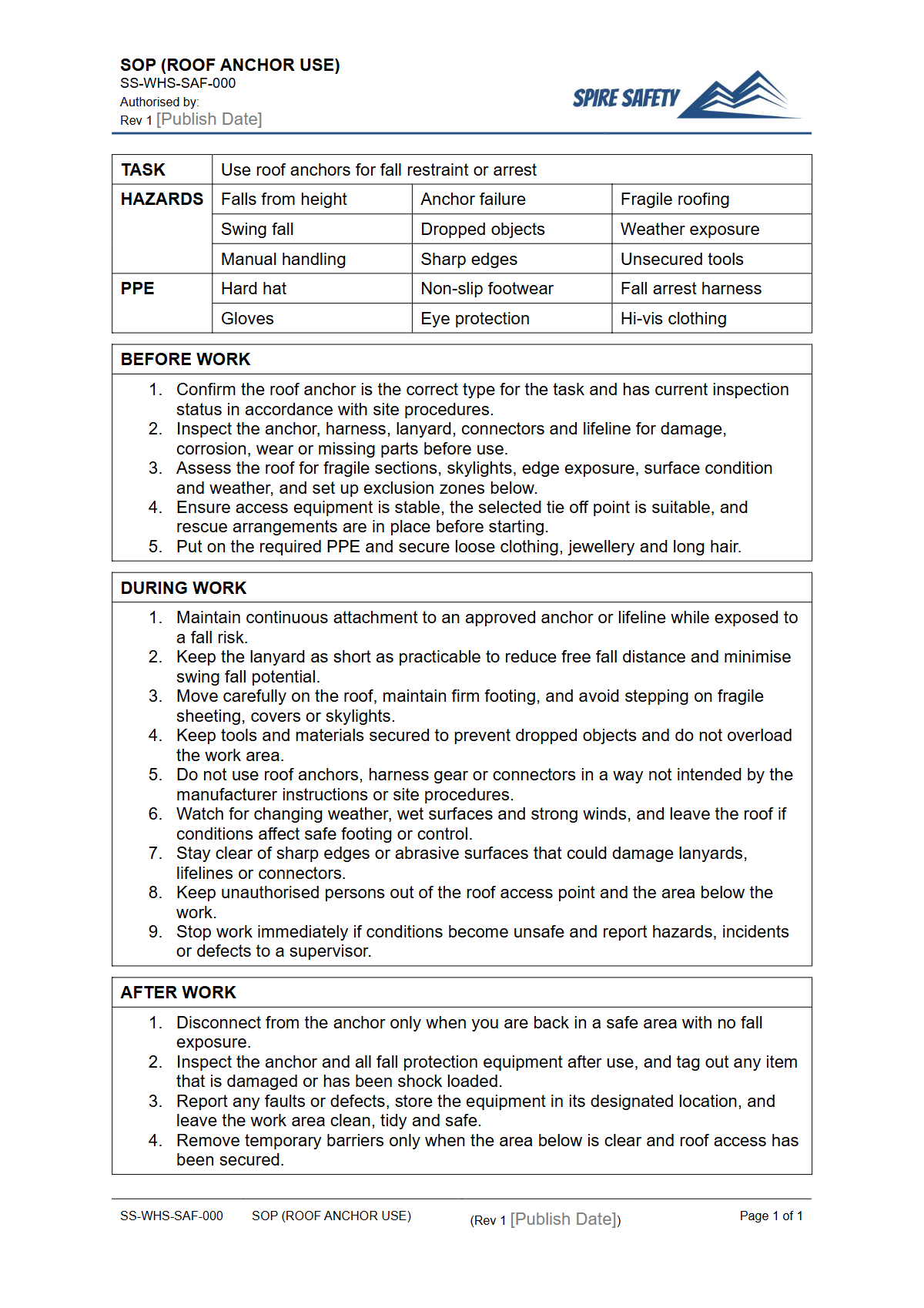
Working at heights is a high-risk activity, and the correct use of fall protection equipment is non-negotiable. This Free Safe Operating Procedure (Roof Anchor Use) Template provides a structured starting point for documenting the safe installation, inspection, and use of roof anchor points.
It helps organisations formalise procedures, train workers, and meet their duty of care under Australian WHS legislation. A documented SOP is a critical component for ensuring every worker follows a consistent, safe method, reducing the risk of falls and serious injury.
Using a standardised template ensures key safety elements are not overlooked. This includes pre-start checks, assessment of the roof structure, correct attachment techniques, and post-use inspection protocols. Formalising these steps helps embed safe work practices into your organisation’s daily operations and forms a key part of comprehensive WHS management systems.
Video walkthrough
How to use the Free Safe Operating Procedure (Roof Anchor Use) Template
Download this Safe Operating Procedure in your preferred format (DOCX or PDF). The DOCX version is fully editable, allowing you to tailor the content to your specific operational needs.
It is designed as a foundation, not a finished document.
Important: It is crucial that you customise this template to reflect the specific roof anchors, fall arrest systems, and site conditions at your workplace. We have provided a structured framework, but you must ensure the final document is specific to your operational context and a comprehensive risk assessment.
You must consult the manufacturer’s instructions for every piece of equipment and incorporate those specific requirements into the final SOP.
Once customised, this document should be used for worker training, toolbox talks, and on-site reference. For more procedural documents, you can browse our full free WHS resources library for a wide range of templates covering various tasks and equipment.
What this Roof Anchor SOP covers
This template guides you through documenting critical control measures, including:
- Pre-operational checks: Inspecting the harness, lanyard, connectors, and the anchor point itself for any signs of damage, wear, or corrosion.
- Anchor selection and installation: Procedures for verifying the suitability of the roof structure and correctly installing the anchor according to manufacturer specifications.
- Attachment and use: Steps for securely connecting to the anchor and maintaining safe movement while at height.
- Disconnection and storage: Correct procedures for detaching from the system and properly storing all equipment to prevent damage.
- Emergency procedures: Outlining the initial steps for a fall-related emergency, including rescue plans.
When to use it
A Safe Operating Procedure for roof anchor use should be a core document for any task involving work at heights where fall arrest systems are required. It should be developed before work begins and used as a reference for the duration of the job.
Specific applications include pre-work planning, new worker induction and training, and regular refresher training sessions. The SOP also serves as a critical reference document during regular WHS compliance auditing to verify that established procedures are being followed correctly.
For tasks involving lifting materials to the roof level, ensure operators are trained on relevant equipment. Our FREE Telehandler SOP Template provides a procedural framework for this type of plant.
Who should use it
This SOP is intended for use by multiple parties within an organisation. Primarily, workers who perform tasks at height (such as roofers, plumbers, solar installers, and maintenance staff) must be trained on and follow the procedure.
Additionally, supervisors and managers are responsible for implementing the SOP, ensuring workers understand it, and monitoring its application on site. A Person Conducting a Business or Undertaking (PCBU) should ensure such procedures are developed, implemented, and reviewed as part of their primary duty of care.
For businesses needing assistance in developing and implementing such frameworks, engaging with expert WHS consulting support can provide valuable guidance.
While this SOP focuses on roof anchors, other machinery on site also requires documented procedures. For example, groundwork might involve using specific plant, and our FREE Trencher SOP Template can assist with that.
Properly integrating procedures into an ISO 45001 certified system can further strengthen an organisation's safety culture and demonstrate a commitment to best practice.
Common mistakes
Common mistakes to avoid
- Re-using single-use fall arrest anchors after they have been subjected to a fall.
- Installing anchors into unsuitable roof structures or substrates without proper engineering assessment.
- Failing to inspect the anchor and all harness components before each use.
- Using fall arrest equipment beyond the manufacturer's specified lifespan, especially for textile components.
Legal references
Legal considerations
The following legal requirements may be relevant to this type of work.
- Work Health and Safety Act (Harmonised) — Provides the primary duties for protecting workers and other people from work health and safety risks.
- Work Health and Safety Regulations (Harmonised) — Sets out requirements supporting the management of workplace hazards and risks.
The following codes may be relevant to this type of work.
- Managing WHS Risks Code of Practice — Provides practical guidance on identifying hazards, assessing risks and applying effective controls.
- Work Health and Safety Consultation, Cooperation and Coordination Code of Practice — Provides practical guidance on consulting workers and coordinating with other duty holders.
- Managing the Work Environment and Facilities Code of Practice — Provides practical guidance on safe work environments, workplace facilities and related controls.
Did you know
Competent Person Inspections
Australian regulations mandate that fall arrest systems, including anchor points, be inspected by a competent person at regular intervals to ensure they remain safe. This period is typically every 6 or 12 months, depending on the equipment and usage.
Anchor Load Ratings
Roof anchors are rated for specific loads (e.g., 15kN for one person) and directions of pull. Using an anchor incorrectly, such as for a two-person rescue when it is only rated for single-person fall arrest, can lead to catastrophic failure.
FAQ
Frequently asked questions
01What is the difference between an SOP and a SWMS for roof anchor use?
02Do I need a new SOP for every type of roof anchor?
03How often should roof anchors be inspected?
04Is this template suitable for all Australian states and territories?
Share this resource
Free Safe Operating Procedure (Roof Anchor Use) Template
Browse Categories
How To Use It
- 1Download and open in Word or PDF.
- 2Replace the placeholders with your business details.
- 3Get it reviewed by a WHS specialist before rollout.
Need it customised?
Our WHS consultants can adapt this template to your site, run a gap analysis, or audit what you already have in place.
Book a Free Consultation WHS consulting servicesor call 1300 156 382
Related templates
- Free Safe Operating Procedure (Roof Cleaning) Template
- Free Safe Operating Procedure (Roof Cutter) Template
- Free Safe Operating Procedure (Roof Drain Clearing) Template
- Free Safe Operating Procedure (Roof Gutter Inspection) Template
- Free Safe Operating Procedure (Roof Ladder) Template
- Free Safe Operating Procedure (Roof Plant Cleaning) Template