
Free Safe Operating Procedure (Roof Gutter Inspection) Template
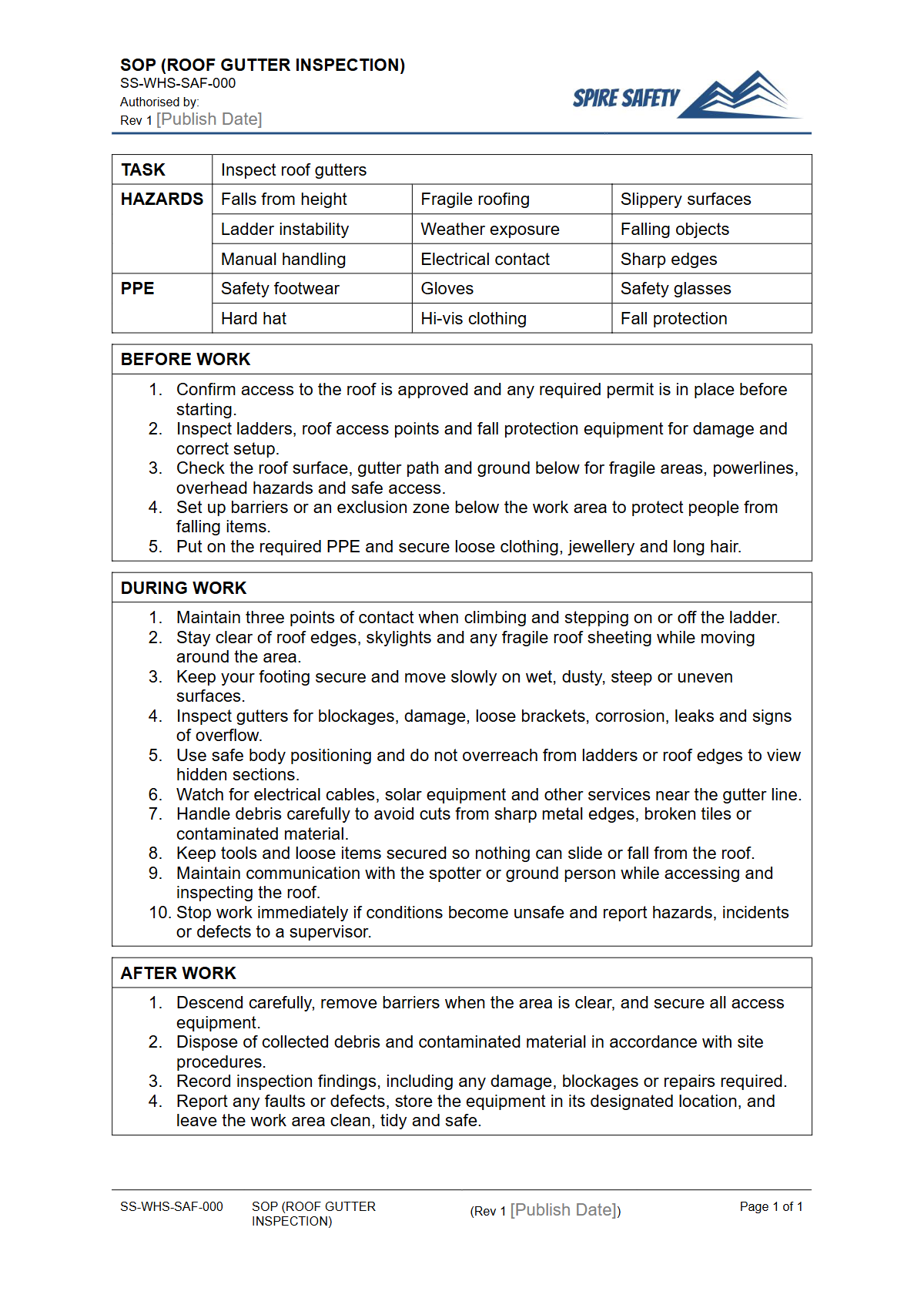
Our free Safe Operating Procedure (SOP) template for roof gutter inspections helps you outline critical safety steps.
Free Safe Operating Procedure (Roof Gutter Inspection) Template
DOCX • 126 KB + PDF
Updated Oct 2026
No signup required
Purpose of the Free Safe Operating Procedure (Roof Gutter Inspection) Template
This Free Safe Operating Procedure (Roof Gutter Inspection) Template provides a structured framework for documenting the safety requirements for inspecting and cleaning roof gutters. Performing maintenance on roof gutters is a high-risk activity, primarily due to the inherent danger of working at height.
This SOP is designed to help you systematically identify hazards and implement effective control measures to ensure the task is performed safely. It prompts you to consider risks such as falls from height, contact with overhead powerlines, manual handling injuries, exposure to pests like spiders or wasps, and potential structural weaknesses of the roof or access equipment.
By using this template, you create a formal, step-by-step guide that standardises the process for all workers. A documented procedure is a cornerstone of a robust safety management system, demonstrating a commitment to fulfilling your WHS obligations.
It serves as an essential tool for worker training, induction, and supervision. For tasks involving specific machinery for access, such as an elevated work platform or even a telehandler, you must ensure separate procedures are in place, similar in principle to our free Telehandler SOP template.
Video walkthrough
How to use the Free Safe Operating Procedure (Roof Gutter Inspection) Template
Simply download the template in your preferred format (DOCX for easy editing or PDF). The document is structured with sections covering key safety elements, including required PPE, pre-operational checks, step-by-step instructions, and emergency procedures.
You must then populate these sections with information specific to your workplace, the type of roof, and the access methods used (e.g., ladders, scaffolding, elevated work platforms).
Important: This document is a template and must be customised. We are not familiar with your specific site, equipment, personnel, or local regulations.
You must consult with your workers and other relevant stakeholders to ensure the final SOP is comprehensive and accurately reflects the risks and controls in your unique operational environment. The goal is to create a practical, user-friendly document that your team will actually use. You can find more examples of task-specific procedures in our free WHS resources library.
When to use this SOP
A Safe Operating Procedure for roof gutter inspection should be developed, implemented, and communicated before any worker is assigned the task. It is a proactive tool that forms a critical part of your planning process. This SOP should be used to:
- Train new employees or contractors on the safe method for inspecting gutters.
- Provide a refresher for existing workers.
- Serve as a reference guide for supervisors to monitor work practices.
- Form part of the documentation reviewed after an incident or near miss.
- Guide a review of safety protocols whenever a new type of access equipment or cleaning method is introduced.
Who should use this SOP
This SOP should be used by multiple stakeholders within an organisation. It is not just a document for the safety manager's files. Key users include:
- Persons Conducting a Business or Undertaking (PCBUs): To meet their primary duty of care to provide and maintain a safe system of work.
- Managers and Supervisors: To train workers, assign tasks, and ensure procedures are being followed correctly on the ground.
- Workers and Contractors: As a clear set of instructions to follow to perform their job safely. Their consultation in its development is vital.
- WHS Committees and Representatives: To assist in the review and improvement of workplace safety procedures.
Documented procedures are fundamental to any safety management system, as they demonstrate proactive risk management. Having robust, customised SOPs for all key tasks is a critical element often examined during a formal WHS compliance audit. For organisations needing assistance to develop a suite of documents tailored to their operations, specialist WHS consulting can provide valuable expertise and support.
The principle of documenting procedures applies across all work environments, not just those involving heights. For example, a busy workshop relies on clear instructions for equipment use, which is why we provide resources like a Free Air Compressor SOP. The context may change, but the need for a documented, safe system of work remains constant.
Common mistakes
Common mistakes to avoid
- Using a generic template without customising it for the specific roof, access method, and site conditions.
- Failing to consult with workers who perform the inspections when drafting the procedure.
- Not providing adequate training on the SOP or verifying that workers understand and follow it.
- Forgetting to include specific emergency and rescue procedures, particularly for fall arrest systems.
Legal references
Legal considerations
The following legal requirements may be relevant to this type of work.
- Work Health and Safety Act (Harmonised) — Provides the primary duties for protecting workers and other people from work health and safety risks.
- Work Health and Safety Regulations (Harmonised) — Sets out requirements supporting the management of workplace hazards and risks.
The following codes may be relevant to this type of work.
- Managing WHS Risks Code of Practice — Provides practical guidance on identifying hazards, assessing risks and applying effective controls.
- Work Health and Safety Consultation, Cooperation and Coordination Code of Practice — Provides practical guidance on consulting workers and coordinating with other duty holders.
- Managing the Work Environment and Facilities Code of Practice — Provides practical guidance on safe work environments, workplace facilities and related controls.
Did you know
A Common Misconception
While 'SOP' and 'SWMS' (Safe Work Method Statement) are related, a SWMS is specifically mandated by law for 'high risk construction work', which includes work with a risk of falling more than two metres.
Fall Statistics
According to Safe Work Australia, falls from height are a leading cause of workplace fatalities and serious injuries. A significant portion of these fatal falls occur from a height of four metres or less.
FAQ
Frequently asked questions
01What should be included in a Safe Operating Procedure for roof gutter inspection?
02Is an SOP legally required for gutter cleaning in Australia?
03Who is responsible for creating the SOP for roof gutter inspection?
04How often should a roof gutter inspection SOP be reviewed?
Share this resource
Free Safe Operating Procedure (Roof Gutter Inspection) Template
Browse Categories
How To Use It
- 1Download and open in Word or PDF.
- 2Replace the placeholders with your business details.
- 3Get it reviewed by a WHS specialist before rollout.
Need it customised?
Our WHS consultants can adapt this template to your site, run a gap analysis, or audit what you already have in place.
Book a Free Consultation WHS consulting servicesor call 1300 156 382
Related templates
- Free Safe Operating Procedure (Roof Ladder) Template
- Free Safe Operating Procedure (Roof Plant Cleaning) Template
- Free Safe Operating Procedure (Roof Plant Inspection) Template
- Free Safe Operating Procedure (Roof Seamer) Template
- Free Safe Operating Procedure (Roofing Torch) Template
- Free Safe Operating Procedure (Room Privacy Screen) Template