
Free Safe Operating Procedure (Room Privacy Screen) Template
Download our free Safe Operating Procedure (Room Privacy Screen) Template to manage WHS risks in healthcare and clinical settings.
Free Safe Operating Procedure (Room Privacy Screen) Template
DOCX • 126 KB + PDF
Updated Oct 2026
No signup required
Purpose of the Free Safe Operating Procedure (Room Privacy Screen) Template
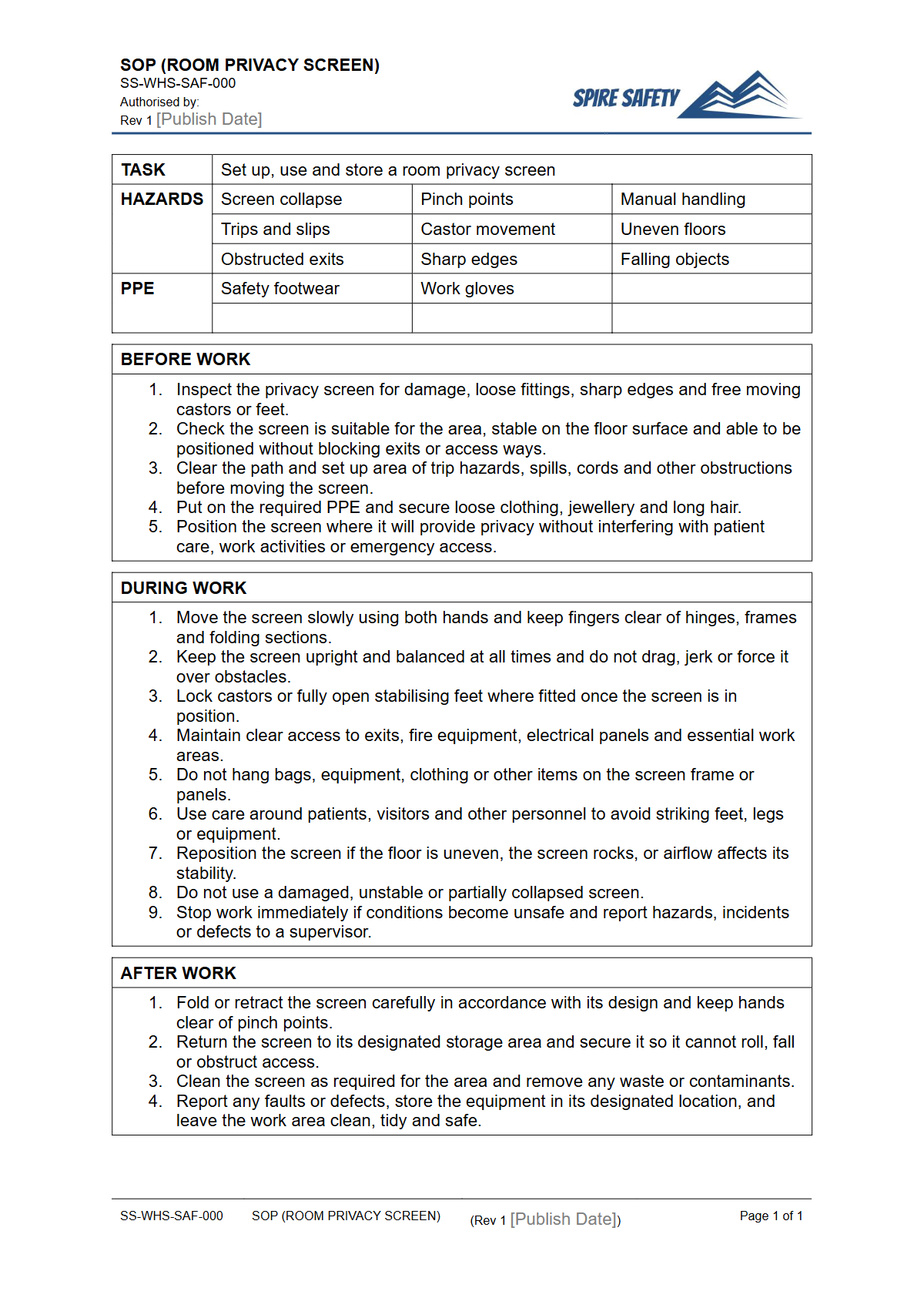
This Free Safe Operating Procedure (Room Privacy Screen) Template provides a structured framework for documenting the safe use, handling, and cleaning of portable room dividers. These screens are common in healthcare, aged care, and clinical environments, and while seemingly simple, they present several workplace hazards.
A documented SOP helps your organisation manage risks including manual handling injuries from lifting and moving, trip hazards from unstable placement, and pinch points in folding mechanisms. It also establishes clear protocols for cleaning and disinfection, which is critical for infection control.
By implementing a clear SOP, you standardise safe work practices, support worker training, and demonstrate a commitment to health and safety. Documenting procedures for all types of equipment is a cornerstone of a robust safety framework. For instance, even simple equipment in other settings requires similar documentation, as shown in our Free Safe Operating Procedure for a Deep Fryer.
Video walkthrough
How to use the Free Safe Operating Procedure (Room Privacy Screen) Template
This template is provided in both DOCX and PDF formats to serve as a comprehensive starting point. It is not a complete, ready-to-use document.
You must customise it to reflect the specific context of your workplace, including the types of privacy screens in use, the physical environment, and your organisation's existing policies. A key part of this is incorporating the manufacturer’s instructions for your specific model of screen.
To adapt the template effectively:
- Conduct a risk assessment for the task of using privacy screens in your environment.
- Insert specific details about the make and model of your screens.
- Clearly define the Personal Protective Equipment (PPE) required, such as gloves for cleaning.
- Add site-specific emergency contacts and procedures.
- Incorporate your company branding and document control information.
Remember, an SOP is a living document. It forms a critical component of your overall WHS management systems and should be reviewed regularly and updated whenever processes or equipment change.
We have included comments and prompts within the DOCX file to guide your customisation process.
When to use it
A Safe Operating Procedure for room privacy screens should be used as a primary reference tool in several situations. It is essential during the induction and training of new employees who will be required to handle the screens, including clinical staff, support workers, and cleaning personnel.
It should also be a focus of regular refresher training to prevent complacency and reinforce safe work habits. The SOP should be readily accessible in the work area for quick reference before tasks such as setting up, relocating, cleaning, or storing the screens.
Furthermore, it serves as a critical checklist during routine workplace inspections and safety observations.
Effectiveness of the SOP can be verified through periodic safety checks. Engaging external experts for WHS compliance auditing can provide an objective assessment of how well your documented procedures are being implemented in practice.
Who should use it
This SOP is intended for all persons conducting a business or undertaking (PCBUs) where room privacy screens are used. This includes hospitals, medical clinics, dental practices, aged care facilities, and physiotherapy centres.
Direct users of the document include a range of personnel. Workers, such as nurses, healthcare assistants, and cleaners, will use it to understand and follow the correct procedures.
Supervisors and managers are responsible for ensuring staff are trained on the SOP and adhere to its guidelines. WHS managers and coordinators will use the template to develop and integrate it into the broader safety management system.
Developing and implementing effective SOPs across a diverse workplace can be complex. If your facility uses a wide range of equipment, from clinical tools to maintenance machinery, you may need to create many different procedures.
For example, a hospital's maintenance department might require a Free Air Compressor SOP for its workshop equipment. For expert guidance on tailoring these documents, consider engaging professional WHS consulting services.
Spire Safety offers a wide range of templates to help you build out your safety documentation. You can browse our entire free WHS resources library to find other useful templates, checklists, and guides.
Common mistakes
Common mistakes to avoid
- Failing to inspect the screen's castors, hinges, and fabric for damage before use.
- Positioning the screen on an uneven surface or where its legs create a trip hazard in a walkway.
- Using incorrect or overly harsh chemicals for cleaning that can damage the screen material or frame.
- Neglecting to train new or temporary staff on the correct procedure for moving and setting up screens.
Legal references
Legal considerations
The following legal requirements may be relevant to this type of work.
- Work Health and Safety Act (Harmonised) — Provides the primary duties for protecting workers and other people from work health and safety risks.
- Work Health and Safety Regulations (Harmonised) — Sets out requirements supporting the management of workplace hazards and risks.
The following codes may be relevant to this type of work.
- Managing WHS Risks Code of Practice — Provides practical guidance on identifying hazards, assessing risks and applying effective controls.
- Work Health and Safety Consultation, Cooperation and Coordination Code of Practice — Provides practical guidance on consulting workers and coordinating with other duty holders.
- Managing the Work Environment and Facilities Code of Practice — Provides practical guidance on safe work environments, workplace facilities and related controls.
Did you know
Manual Handling in Healthcare
The healthcare and social assistance industry has one of the highest rates of serious workers' compensation claims in Australia, with hazardous manual tasks being a leading cause of injury.
Pinch Points
Pinch point injuries often occur when folding or adjusting equipment with hinged or moving parts. Even on lightweight equipment like privacy screens, these can cause painful crush injuries or lacerations.
FAQ
Frequently asked questions
01What are the main hazards of using a room privacy screen?
02How often should an SOP for a privacy screen be reviewed?
03Is specific training required to use a room privacy screen safely?
04Why can't I just use the manufacturer's instructions instead of an SOP?
Share this resource
Free Safe Operating Procedure (Room Privacy Screen) Template
Browse Categories
How To Use It
- 1Download and open in Word or PDF.
- 2Replace the placeholders with your business details.
- 3Get it reviewed by a WHS specialist before rollout.
Need it customised?
Our WHS consultants can adapt this template to your site, run a gap analysis, or audit what you already have in place.
Book a Free Consultation WHS consulting servicesor call 1300 156 382
Related templates
- Free Safe Operating Procedure (Room Service Trolley) Template
- Free Safe Operating Procedure (Room Turnaround Cleaning) Template
- Free Safe Operating Procedure (Root Ball Handling) Template
- Free Safe Operating Procedure (Rope Grab) Template
- Free Safe Operating Procedure (Rose Pruning) Template
- Free Safe Operating Procedure (Rotary Hammer) Template