
Free Safe Operating Procedure (Room Turnaround Cleaning) Template
Define safe work methods for your hospitality or accommodation staff with our detailed room turnaround cleaning SOP. Download the free DOCX or PDF today.
Free Safe Operating Procedure (Room Turnaround Cleaning) Template
DOCX • 126 KB + PDF
Updated Oct 2026
No signup required
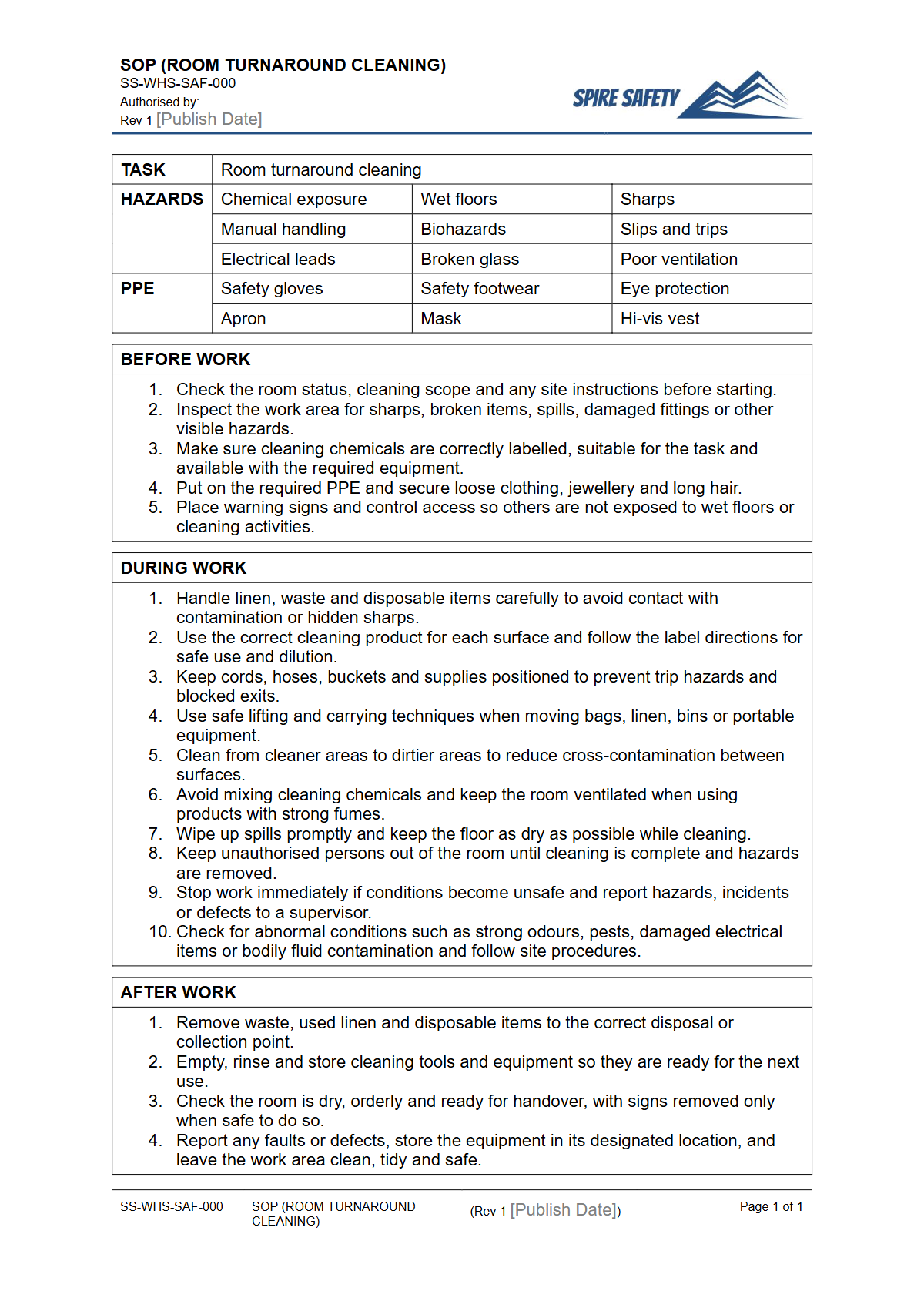
Purpose of the Free Safe Operating Procedure (Room Turnaround Cleaning) Template
This Free Safe Operating Procedure (Room Turnaround Cleaning) Template provides a comprehensive framework for businesses in the accommodation, hospitality, and healthcare sectors. It helps document the step-by-step process for cleaning and preparing rooms between occupants, ensuring tasks are performed safely, efficiently, and to a consistent standard.
The primary goal is to control health and safety risks associated with cleaning tasks, such as manual handling, exposure to hazardous chemicals, slips and trips, and biological hazards.
A well-defined Safe Operating Procedure (SOP) is a critical component of effective WHS management systems. It serves as a formal instruction guide for workers, outlining the safest and most effective way to perform a routine task. By standardising procedures, you can reduce the likelihood of incidents, improve service quality, and demonstrate a clear commitment to workplace safety.
Video walkthrough
How to use the Free Safe Operating Procedure (Room Turnaround Cleaning) Template
This document is a structured starting point, designed for easy adaptation. To implement it effectively, follow these steps:
- Download the template in your preferred format (DOCX for editing or PDF for reference).
- Conduct a risk assessment of your specific room cleaning tasks to identify all relevant hazards.
- Consult with your housekeeping and cleaning staff—the people who perform the tasks every day. Their input is invaluable for creating a practical and effective procedure.
- Customise the content to match your site's specific equipment (e.g., vacuum cleaner models, cart types), approved chemical products (including names and safety data sheet references), and layout.
- Add detailed, sequential steps for your complete room turnaround process, from entering the room to the final quality check.
- Ensure that requirements for Personal Protective Equipment (PPE) like gloves and eye protection are clearly stated.
- Once finalised, use the SOP as a training tool for new and existing employees. Keep records of this training.
- Display the SOP in an accessible location for easy reference by staff.
IMPORTANT: This document is a template only. We have created it as a guide, and you must customise it to reflect the specific equipment, chemicals, tasks, and hazards present in your unique work environment.
Its effectiveness depends on its accurate application to your workplace.
When to use this Safe Operating Procedure
An SOP for room turnaround cleaning should be a core document used in daily operations within any facility that provides accommodation. It is particularly crucial during staff induction and regular refresher training sessions to reinforce safe work practices.
The procedure should be referenced when introducing new cleaning products or equipment to ensure protocols are updated accordingly. It also serves as a key piece of evidence during WHS compliance auditing, demonstrating that you have a formalised process for managing routine but hazardous tasks.
Who should use this Safe Operating Procedure
This SOP is intended for all personnel involved in the cleaning and maintenance of rooms. This includes:
- Housekeeping and cleaning staff
- Team leaders and supervisors
- Hotel, motel, and facility managers
- WHS officers and representatives
Management is responsible for developing, implementing, and reviewing the SOP in consultation with workers. Employees are responsible for following the established procedure to ensure their own safety and the safety of others.
If you are uncertain how to properly tailor this SOP to your operational risks, engaging external WHS consulting services can provide expert guidance.
Key Hazards in Room Turnaround Cleaning
A comprehensive SOP must address the specific hazards of the job. For room cleaning, these commonly include:
- Manual Tasks: Lifting heavy mattresses, pushing and pulling heavily laden carts, carrying vacuums, and bending to clean low surfaces can cause musculoskeletal injuries.
- Chemical Exposure: Inhalation of vapours or skin contact with cleaning agents can cause respiratory issues, burns, or dermatitis. Procedures must include details on safe handling, dilution, and storage.
- Slips, Trips & Falls: Wet floors during mopping, trailing electrical cords from vacuums, and general clutter are common trip hazards.
- Biological Hazards: Handling soiled linen and cleaning bathrooms exposes workers to bacteria, viruses, and other pathogens.
- Ergonomic Strain: Highly repetitive motions, such as scrubbing surfaces or vacuuming large areas, can lead to strain injuries over time.
Developing specific procedures for different functions is essential. For example, if your facility includes a commercial kitchen, you will need separate documents like a free Safe Operating Procedure for deep fryer operation. For other operational tasks, you can browse our complete free WHS resources library for more templates.
Common mistakes
Common mistakes to avoid
- Using a generic template without customising it for specific cleaning agents and equipment.
- Failing to train staff on the finalised SOP and document their understanding.
- Not including specific procedures for handling biological hazards like blood or bodily fluids.
- Forgetting to review and update the SOP after an incident or near miss occurs.
Legal references
Legal considerations
The following legal requirements may be relevant to this type of work.
- Work Health and Safety Act (Harmonised) — Provides the primary duties for protecting workers and other people from work health and safety risks.
- Work Health and Safety Regulations (Harmonised) — Sets out requirements supporting the management of workplace hazards and risks.
The following codes may be relevant to this type of work.
- Managing WHS Risks Code of Practice — Provides practical guidance on identifying hazards, assessing risks and applying effective controls.
- Work Health and Safety Consultation, Cooperation and Coordination Code of Practice — Provides practical guidance on consulting workers and coordinating with other duty holders.
- Managing the Work Environment and Facilities Code of Practice — Provides practical guidance on safe work environments, workplace facilities and related controls.
Did you know
Musculoskeletal Risk
According to Safe Work Australia, cleaners and laundry workers have one of the highest rates of serious musculoskeletal disorder claims, often due to hazardous manual tasks like lifting mattresses and pushing heavy carts.
Chemical Safety
Mixing certain common cleaning chemicals, like bleach and ammonia, can create toxic chloramine gas. This highlights the vital importance of proper chemical handling training and clear procedural instructions in an SOP.
FAQ
Frequently asked questions
01What should be included in a room turnaround cleaning SOP?
02How often should a cleaning SOP be reviewed?
03Is a Safe Operating Procedure a legal requirement for cleaning staff?
04Can I use this template for both hotel and hospital room cleaning?
Share this resource
Free Safe Operating Procedure (Room Turnaround Cleaning) Template
Browse Categories
How To Use It
- 1Download and open in Word or PDF.
- 2Replace the placeholders with your business details.
- 3Get it reviewed by a WHS specialist before rollout.
Need it customised?
Our WHS consultants can adapt this template to your site, run a gap analysis, or audit what you already have in place.
Book a Free Consultation WHS consulting servicesor call 1300 156 382
Related templates
- Free Safe Operating Procedure (Root Ball Handling) Template
- Free Safe Operating Procedure (Rope Grab) Template
- Free Safe Operating Procedure (Rose Pruning) Template
- Free Safe Operating Procedure (Rotary Hammer) Template
- Free Safe Operating Procedure (Rotary Ironer) Template
- Free Safe Operating Procedure (Rotating Laser) Template