
Free Safe Operating Procedure (Rotary Ironer) Template
Effectively manage the risks of commercial laundry equipment with our free template. Download your customisable Safe Operating Procedure for a rotary ironer today.
Free Safe Operating Procedure (Rotary Ironer) Template
DOCX • 126 KB + PDF
Updated Oct 2026
No signup required
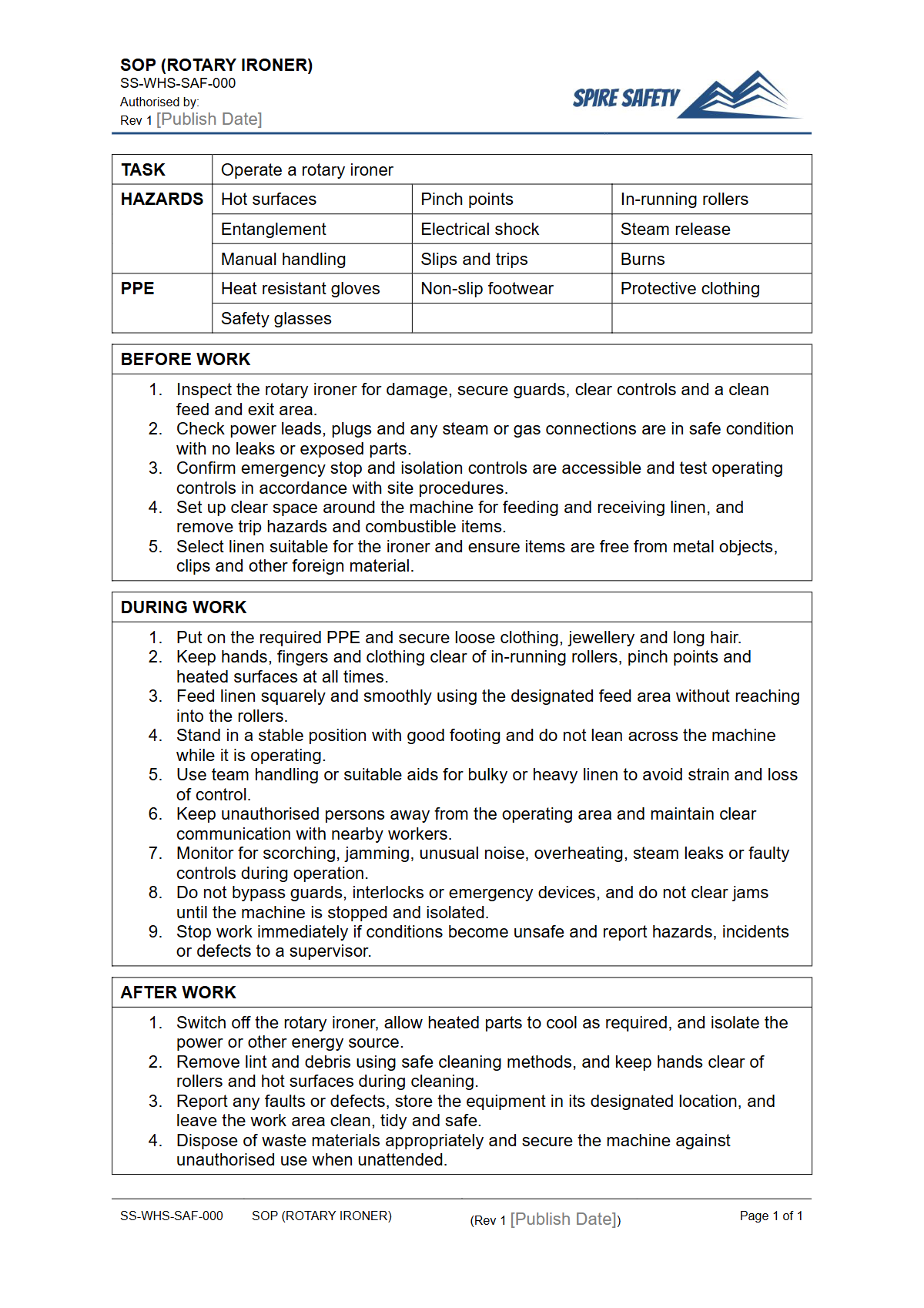
Purpose of the Free Safe Operating Procedure (Rotary Ironer) Template
Operating commercial laundry equipment like a rotary ironer introduces significant workplace hazards. This Free Safe Operating Procedure (Rotary Ironer) Template provides a structured starting point for documenting the safe use of this machinery.
A well-drafted Safe Operating Procedure (SOP) is a fundamental tool for any Person Conducting a Business or Undertaking (PCBU) to meet their primary duty of care. It provides clear, step-by-step instructions that standardise tasks, reduce operational errors, and minimise the risk of injury.
The primary purpose of an SOP is to control identified hazards. For a rotary ironer, these include severe burns from heated chests and rollers, entanglement or crushing injuries at nip points, and ergonomic strains from repetitive feeding motions.
By formally documenting pre-start checks, correct operating techniques, and emergency shutdown protocols, you create a reliable reference for training and daily use. Integrating this document into your broader WHS management systems helps build a proactive safety culture and demonstrates a commitment to worker wellbeing.
Video walkthrough
How to use the Free Safe Operating Procedure (Rotary Ironer) Template
Our template is available for immediate download as a DOCX file, allowing for easy customisation, or as a PDF for quick reference. To use it effectively, you must adapt it to the specific context of your workplace and the exact model of your rotary ironer.
Generic procedures are not sufficient for ensuring safety.
Important: This document is a template and must be customised to your specific workplace. You need to consult the manufacturer's operating manual and conduct a site-specific risk assessment to fill in details about your exact rotary ironer model, unique safety features, site procedures, and designated personnel.
This ensures the final SOP is practical and effective for your team.
The template is organised into logical sections to guide you:
- Hazard Identification: Lists common risks associated with rotary ironers.
- Personal Protective Equipment (PPE): A section to specify the required PPE, such as heat-resistant gloves or specific footwear.
- Pre-Operational Checks: A checklist of safety and operational verifications to perform before starting the machine, such as checking emergency stops and guards.
- Operating Procedure: A step-by-step guide to safely feeding linen and operating the controls. When detailing the material handling steps, you may find the principles in our FREE Conveyer System SOP useful for outlining safe feeding and movement.
- Shut-Down and Cleaning Procedure: Instructions for powering down, isolating, and cleaning the machine safely.
- Emergency Procedures: Critical steps to take in case of an incident, including use of the emergency stop and first aid response for burns or entanglement.
When to use a Safe Operating Procedure
A Safe Operating Procedure for a rotary ironer is not a document that should be filed away and forgotten. It is an active tool used in daily operations.
It should be the primary document for training new operators and for conducting regular refresher training for experienced staff. Operators should be encouraged to review the SOP if they are unsure about any step in the process.
Furthermore, the SOP is a critical reference during safety reviews and after any incident or near miss. Regular reviews are also a key part of preparation for any WHS compliance auditing activities.
Who should use this Safe Operating Procedure
This SOP is intended for several groups within an organisation. The primary users are the equipment operators themselves, who rely on it for clear, safe instructions.
Supervisors and line managers must also be thoroughly familiar with the SOP to enforce its use, conduct competency assessments, and lead by example. WHS managers and safety committees will use the SOP as a key document in the site's overall safety framework, alongside other equipment-specific documents like our free SOP for deep fryers, to ensure a consistent approach to managing plant and equipment risks.
Ultimately, a collaborative approach involving consultation with operators who use the machinery every day is the best way to develop a procedure that is both safe and practical. If you require more procedural documents, you can find a wide range of templates covering various plant and equipment in our free WHS resources library, including our popular free Air Compressor SOP.
Common mistakes
Common mistakes to avoid
- Forgetting to include model-specific details from the manufacturer's manual.
- Failing to clearly outline the emergency stop and isolation procedures.
- Not specifying the exact Personal Protective Equipment (PPE) required.
- Using the template for training without assessing operator competency afterwards.
Legal references
Legal considerations
The following legal requirements may be relevant to this type of work.
- Work Health and Safety Act (Harmonised) — Provides the primary duties for protecting workers and other people from work health and safety risks.
- Work Health and Safety Regulations (Harmonised) — Sets out requirements supporting the management of workplace hazards and risks.
The following codes may be relevant to this type of work.
- Managing WHS Risks Code of Practice — Provides practical guidance on identifying hazards, assessing risks and applying effective controls.
- Work Health and Safety Consultation, Cooperation and Coordination Code of Practice — Provides practical guidance on consulting workers and coordinating with other duty holders.
- Managing the Work Environment and Facilities Code of Practice — Provides practical guidance on safe work environments, workplace facilities and related controls.
Did you know
Nip Point Dangers
The rollers on a rotary ironer create a "nip point" where objects can be drawn in and crushed. These incidents can happen in a fraction of a second, making guards and emergency stops critical safety features.
FAQ
Frequently asked questions
01What are the main hazards of a rotary ironer?
02Who needs to be trained on this SOP?
03How often should a rotary ironer SOP be reviewed?
04Can this template be used for any brand of rotary ironer?
Share this resource
Free Safe Operating Procedure (Rotary Ironer) Template
Browse Categories
How To Use It
- 1Download and open in Word or PDF.
- 2Replace the placeholders with your business details.
- 3Get it reviewed by a WHS specialist before rollout.
Need it customised?
Our WHS consultants can adapt this template to your site, run a gap analysis, or audit what you already have in place.
Book a Free Consultation WHS consulting servicesor call 1300 156 382
Related templates
- Free Safe Operating Procedure (Rotating Laser) Template
- Free Safe Operating Procedure (Rotisserie Loading) Template
- Free Safe Operating Procedure (Rotisserie Oven) Template
- Free Safe Operating Procedure (Rotor Safety) Template
- Free Safe Operating Procedure (Roughness Tester) Template
- Free Safe Operating Procedure (Route Sheet Handover) Template