
Free Safe Operating Procedure (Rotor Safety) Template
Manage the risks of rotating machinery with our free Safe Operating Procedure (Rotor Safety) Template. Download the customisable DOCX and PDF today.
Free Safe Operating Procedure (Rotor Safety) Template
DOCX • 126 KB + PDF
Updated Oct 2026
No signup required
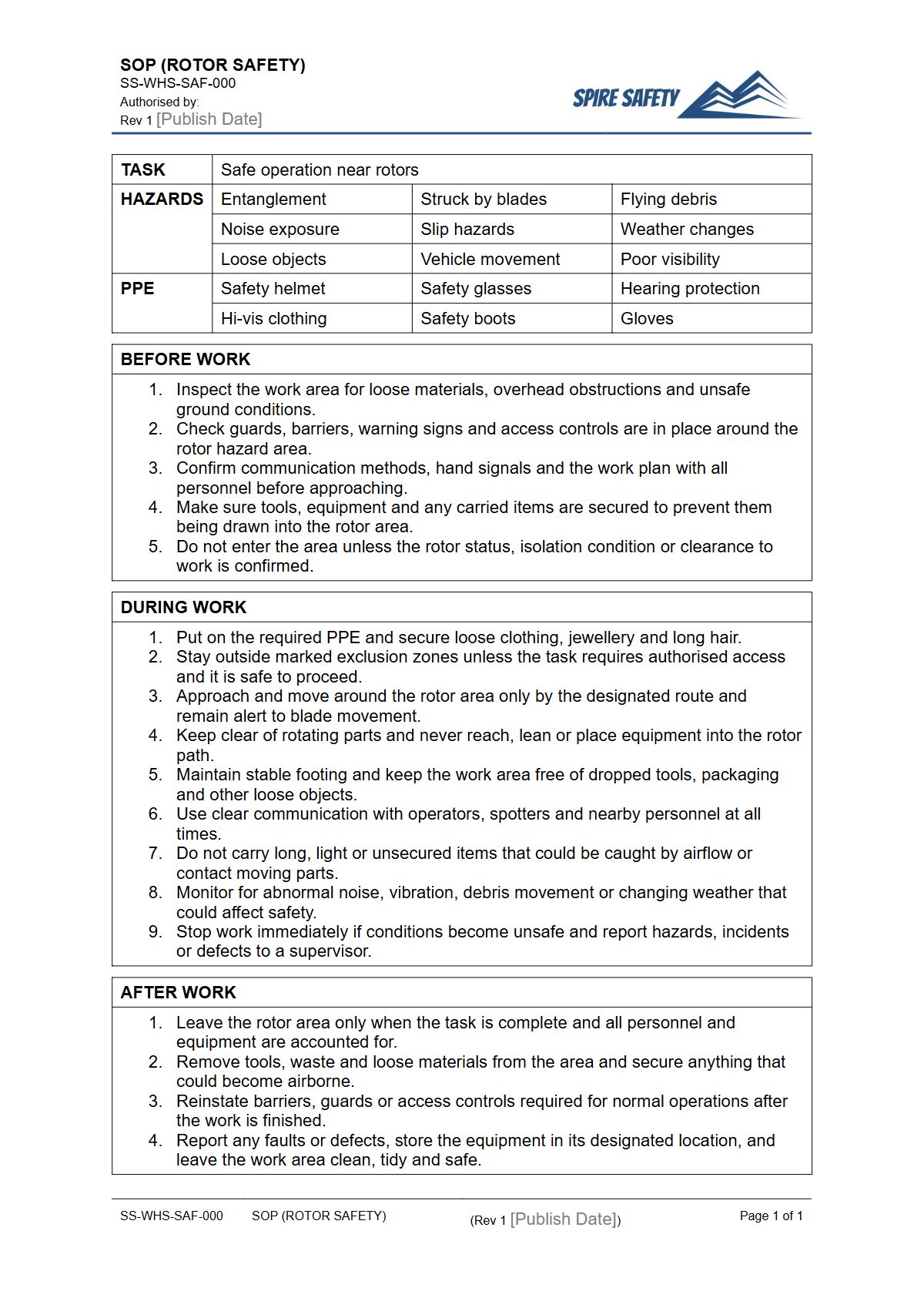
Purpose of the Free Safe Operating Procedure (Rotor Safety) Template
Rotating components on machinery present severe workplace hazards, including entanglement, crushing, and cutting. A Safe Operating Procedure (SOP) is a critical administrative control that provides clear, step-by-step instructions for performing a task safely.
This Free Safe Operating Procedure (Rotor Safety) Template offers a structured starting point for documenting the process of operating, cleaning, and maintaining any equipment with significant rotating parts.
The purpose of this document is to help your organisation standardise safety protocols, minimise human error, and demonstrate a commitment to risk management. It serves as an essential tool for worker training, induction, and on-the-job reference.
By formalising procedures, you can effectively manage the risks associated with agricultural, industrial, or manufacturing machinery. For equipment with specific functions, such as those used in farming, you may need a more detailed document like our FREE Grain Drill SOP Template.
Video walkthrough
How to use the Free Safe Operating Procedure (Rotor Safety) Template
This resource is available for immediate download as a customisable DOCX file and a ready-to-use PDF. To effectively implement it in your workplace, you must adapt the content to your specific circumstances.
Generic procedures are insufficient for managing site-specific risks.
Follow these steps:
- Step 1: Consultation. Consult with the operators, maintenance personnel, and supervisors who work directly with the machinery. Their hands-on knowledge is invaluable for identifying all potential hazards and practical control measures.
- Step 2: Customisation. Populate the template with details specific to your equipment, including its make, model, and location. Detail the required pre-operational checks, personal protective equipment (PPE), and emergency shutdown procedures unique to your context.
- Step 3: Review and Approval. Have a competent person, such as a WHS manager or an experienced supervisor, review and approve the finalised SOP. This ensures it is accurate, comprehensive, and aligned with your organisation's broader WHS management systems.
- Step 4: Training and Implementation. Train all relevant workers on the contents of the final SOP. Make the document easily accessible at or near the equipment for quick reference.
Please note: This document is a template only. We provide it as a starting point.
You must customise it to reflect the specific machinery, hazards, and control measures present in your workplace to ensure it is effective.
When to use a Safe Operating Procedure
A well-developed SOP for rotor safety should be a core part of your daily operations and safety management lifecycle. It should be used during:
- Worker Training and Induction: To ensure new and existing employees understand the correct and safe way to operate the equipment before they begin work.
- Pre-Operational Checks: As a checklist to guide workers through daily or weekly inspections of guards, emergency stops, and other critical safety features.
- Maintenance and Cleaning: To outline the mandatory lockout/tagout procedures required before any maintenance, cleaning, or clearing of blockages to prevent accidental start-up. This is critical for machinery like that covered in our FREE Spreader SOP Template.
- Incident Investigations: As a benchmark to determine if procedural deviations contributed to an incident or near miss.
- Safety Audits: During internal or external reviews of your safety processes. Regular reviews and formal WHS compliance auditing help verify that documented procedures are being followed in practice.
Who should use this template
This Safe Operating Procedure template is designed for use by various roles within an organisation, all of whom share responsibility for workplace safety:
- Persons Conducting a Business or Undertaking (PCBUs): To help meet their primary duty of care to provide and maintain safe systems of work.
- Managers and Supervisors: To use as a tool for training workers, supervising tasks, and enforcing safety standards on the floor.
- Workers and Operators: As a clear and accessible guide for performing their work safely and consistently.
- WHS Advisors and Professionals: As a foundational template for developing comprehensive safety documentation. WHS professionals often need to adapt such templates for a wide range of specific equipment, from general machinery to highly specialised plant like that detailed in our Free Thresher SOP Template.
By implementing robust SOPs, your organisation creates a safer environment and fosters a proactive safety culture. For more templates covering a wide range of equipment and tasks, explore our complete free WHS resources library.
Common mistakes
Common mistakes to avoid
- Failing to adequately customise the template with machine-specific details.
- Not isolating and de-energising equipment (lockout/tagout) before maintenance or cleaning.
- Becoming complacent and bypassing safety guards or interlocks for convenience.
- Neglecting to provide sufficient training on the SOP for all relevant workers.
Legal references
Legal considerations
The following legal requirements may be relevant to this type of work.
- Work Health and Safety Act (Harmonised) — Provides the primary duties for protecting workers and other people from work health and safety risks.
- Work Health and Safety Regulations (Harmonised) — Sets out requirements supporting the management of workplace hazards and risks.
The following codes may be relevant to this type of work.
- Managing WHS Risks Code of Practice — Provides practical guidance on identifying hazards, assessing risks and applying effective controls.
- Work Health and Safety Consultation, Cooperation and Coordination Code of Practice — Provides practical guidance on consulting workers and coordinating with other duty holders.
- Managing the Work Environment and Facilities Code of Practice — Provides practical guidance on safe work environments, workplace facilities and related controls.
Did you know
The Danger Zone
Most entanglement incidents with rotating machinery occur during maintenance, cleaning, or clearing blockages, often because the equipment was not properly isolated from its power source.
Guarding is Key
According to Safe Work Australia, inadequate machine guarding is one of the most common factors contributing to workplace injuries involving plant and machinery.
FAQ
Frequently asked questions
01What are the most significant hazards associated with rotating machinery parts?
02How often should a Safe Operating Procedure for rotors be reviewed?
03Can a generic SOP be used for all rotating equipment?
04What is the difference between a Safe Operating Procedure (SOP) and a Safe Work Method Statement (SWMS)?
Share this resource
Free Safe Operating Procedure (Rotor Safety) Template
Browse Categories
How To Use It
- 1Download and open in Word or PDF.
- 2Replace the placeholders with your business details.
- 3Get it reviewed by a WHS specialist before rollout.
Need it customised?
Our WHS consultants can adapt this template to your site, run a gap analysis, or audit what you already have in place.
Book a Free Consultation WHS consulting servicesor call 1300 156 382
Related templates
- Free Safe Operating Procedure (Roughness Tester) Template
- Free Safe Operating Procedure (Route Sheet Handover) Template
- Free Safe Operating Procedure (Rugby Post Inspection) Template
- Free Safe Operating Procedure (Runway Sweeper) Template
- Free Safe Operating Procedure (Safety Valve Test) Template
- Free Safe Operating Procedure (Salad Spinner) Template