
Free Safe Operating Procedure (Rugby Post Inspection) Template
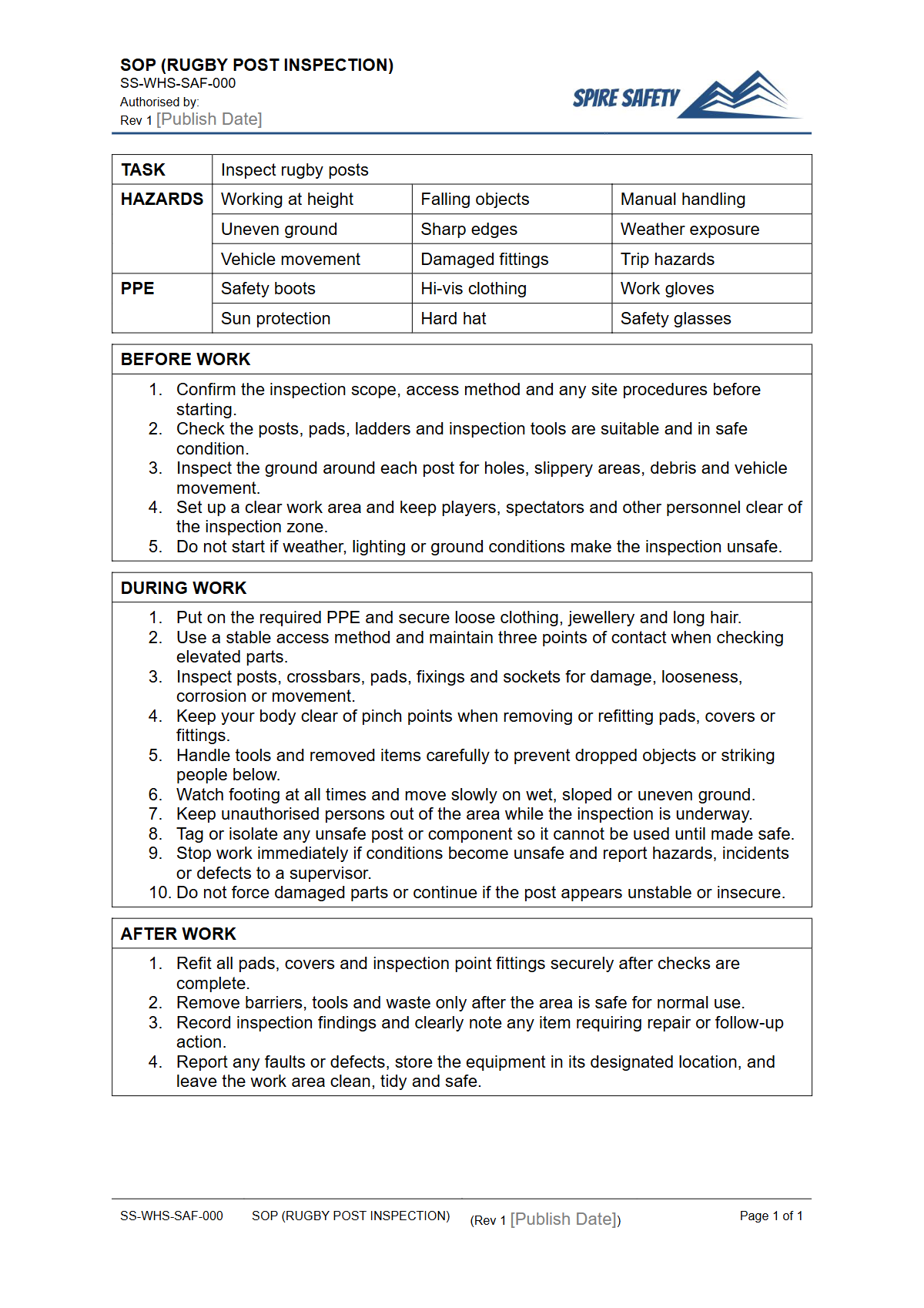
Download our free Safe Operating Procedure for rugby post inspections. This template helps schools and clubs formalise checks and manage risks effectively.
Free Safe Operating Procedure (Rugby Post Inspection) Template
DOCX • 126 KB + PDF
Updated Oct 2026
No signup required
Purpose of the Free Safe Operating Procedure (Rugby Post Inspection) Template
This Safe Operating Procedure (SOP) template provides a structured framework for conducting and documenting safety inspections of rugby union and rugby league goal posts. For any organisation managing sports grounds, from local councils and schools to amateur and professional clubs, ensuring the structural integrity of fixed equipment is a critical part of their duty of care.
This free resource helps you formalise a key safety process. Using this template assists in managing the risks associated with goal posts, which can include structural failure, collapse due to corrosion or damage, and impact injuries.
A documented inspection process is a cornerstone of responsible facility management, demonstrating a proactive approach to safety for players, officials, and the public.
Video walkthrough
How to use the Free Safe Operating Procedure (Rugby Post Inspection) Template
This Safe Operating Procedure for rugby post inspections is provided as a customisable DOCX file and a ready-to-use PDF. Simply download the template and integrate it into your safety management system.
The document outlines key steps for a pre-operational inspection, the inspection process itself, and post-inspection actions. It serves as a clear guide for the person conducting the task. Developing robust safety documentation is a key function of a complete WHS management system.
Important: This is a template, not a finished document. We have designed it as a starting point, aligned with Australian WHS principles.
You must review and customise the content to address the specific conditions of your site, the type of goal posts installed, the equipment used for inspection, and your organisation's internal procedures. Generic documents are not sufficient for demonstrating due diligence.
When to Conduct Inspections
Regular and consistent inspection is essential for identifying potential hazards before they cause an incident. A formal, documented inspection of rugby posts should be carried out at several key times:
- Pre-Season: A thorough inspection before the start of the playing season to ensure posts are fit for use after a period of inactivity.
- Post-Major Weather Events: After high winds, severe storms, or flooding, to check for any damage, movement, or instability.
- Regular Intervals: At scheduled frequencies during the season (e.g., monthly) to monitor for developing issues like rust, loose fittings, or damage from play.
- Post-Report: Immediately following any report of damage or concern from players, officials, or the public.
These formal checks should be supplemented by informal visual inspections by grounds staff as part of their daily or weekly routines. To ensure these procedures are being followed correctly, organisations can benefit from periodic WHS compliance auditing to verify their safety systems are working as intended.
Who Should Perform the Inspection
Inspections must be carried out by a competent person. This is someone who has the knowledge, training, and experience to identify hazards related to the structure and condition of goal posts. This may include:
- Experienced groundskeepers
- Facilities or maintenance managers
- Structural engineers (for more complex assessments)
- External contractors with relevant expertise
Volunteers may be able to conduct basic visual checks if they are provided with clear instructions and a checklist, but formal documented inspections should be reserved for those with the appropriate competence. For guidance on defining competency requirements, our WHS consulting services can provide tailored advice.
Key Inspection Points
A thorough inspection should cover all aspects of the goal post structure. This SOP template guides the user to check:
- Foundations and Footings: Look for any signs of ground erosion, concrete cracking, or movement at the base. The post should be completely stable with no wobble or lean.
- Structural Integrity: Visually inspect the entire length of each post and the crossbar for cracks, dents, bending, or severe corrosion.
- Joints and Fixings: Check that all bolts, welds, and joints are secure and free from significant rust or degradation.
- Protective Padding: Ensure post padding is present, correctly fitted, and in good condition, with no rips or deterioration that would reduce its protective function.
- Surrounding Area: Inspect the immediate vicinity for any hazards, such as uneven ground or debris.
Embedding such detailed checks into your safety processes can help align your organisation with global best practices. This commitment is often formalised through frameworks supported by ISO 45001 consulting.
What to Do If a Hazard Is Identified
If an inspection reveals a significant hazard, immediate action is required. The person performing the inspection should:
- Immediately restrict access to the area to prevent use of the posts. This may involve using temporary fencing and warning signs.
- Report the hazard to the designated manager or person in control of the workplace.
- Document the findings clearly on the inspection record, including photos if possible.
- Ensure the posts are not returned to service until they have been repaired by a qualified person and re-inspected.
This document is one of many helpful templates available in our free WHS resources library, designed to support Australian businesses.
Common mistakes
Common mistakes to avoid
- Focusing only on the visible parts of the post and neglecting the integrity of the footings and ground-level connections.
- Failing to create and maintain a written record of each inspection, which is crucial for demonstrating compliance and due diligence.
- Allowing untrained staff or volunteers to conduct inspections without a clear procedure or checklist to follow.
- Not immediately isolating and reporting damaged or unsafe posts, leaving them accessible to players and the public.
Legal references
Legal considerations
The following legal requirements may be relevant to this type of work.
- Work Health and Safety Act (Harmonised) — Provides the primary duties for protecting workers and other people from work health and safety risks.
- Work Health and Safety Regulations (Harmonised) — Sets out requirements supporting the management of workplace hazards and risks.
The following codes may be relevant to this type of work.
- Managing WHS Risks Code of Practice — Provides practical guidance on identifying hazards, assessing risks and applying effective controls.
- Work Health and Safety Consultation, Cooperation and Coordination Code of Practice — Provides practical guidance on consulting workers and coordinating with other duty holders.
- Managing the Work Environment and Facilities Code of Practice — Provides practical guidance on safe work environments, workplace facilities and related controls.
Did you know
Structural Stress
Rugby goal posts, especially on public grounds, can be subjected to significant stresses beyond gameplay, including high winds, attempted vandalism, and environmental corrosion, making regular structural checks vital.
Padding is Key
The Australian Rugby Union's Safety Code of Practice requires that all posts within the playing area be padded to a height of at least 2 metres, a critical measure for preventing impact injuries.
FAQ
Frequently asked questions
01How often should rugby posts be formally inspected?
02What are the main hazards associated with rugby goal posts?
03Who is legally responsible for the safety of rugby posts?
04Do I really need a written Safe Operating Procedure for this task?
Share this resource
Free Safe Operating Procedure (Rugby Post Inspection) Template
Browse Categories
How To Use It
- 1Download and open in Word or PDF.
- 2Replace the placeholders with your business details.
- 3Get it reviewed by a WHS specialist before rollout.
Need it customised?
Our WHS consultants can adapt this template to your site, run a gap analysis, or audit what you already have in place.
Book a Free Consultation WHS consulting servicesor call 1300 156 382
Related templates
- Free Safe Operating Procedure (Runway Sweeper) Template
- Free Safe Operating Procedure (Safety Valve Test) Template
- Free Safe Operating Procedure (Salad Spinner) Template
- Free Safe Operating Procedure (Salamander Grill) Template
- Free Safe Operating Procedure (Salon Chemical Storage) Template
- Free Safe Operating Procedure (Salon Towel Handling) Template