
Free Safe Operating Procedure (Salon Towel Handling) Template
Manage salon hygiene and safety with our free Safe Operating Procedure (Salon Towel Handling) template. Download the customisable DOCX and PDF to start today.
Free Safe Operating Procedure (Salon Towel Handling) Template
DOCX • 126 KB + PDF
Updated Oct 2026
No signup required
Purpose of the Free Safe Operating Procedure (Salon Towel Handling) Template
Handling towels in a salon environment involves more than just washing and drying. It's a critical process for infection control, client safety, and staff wellbeing.
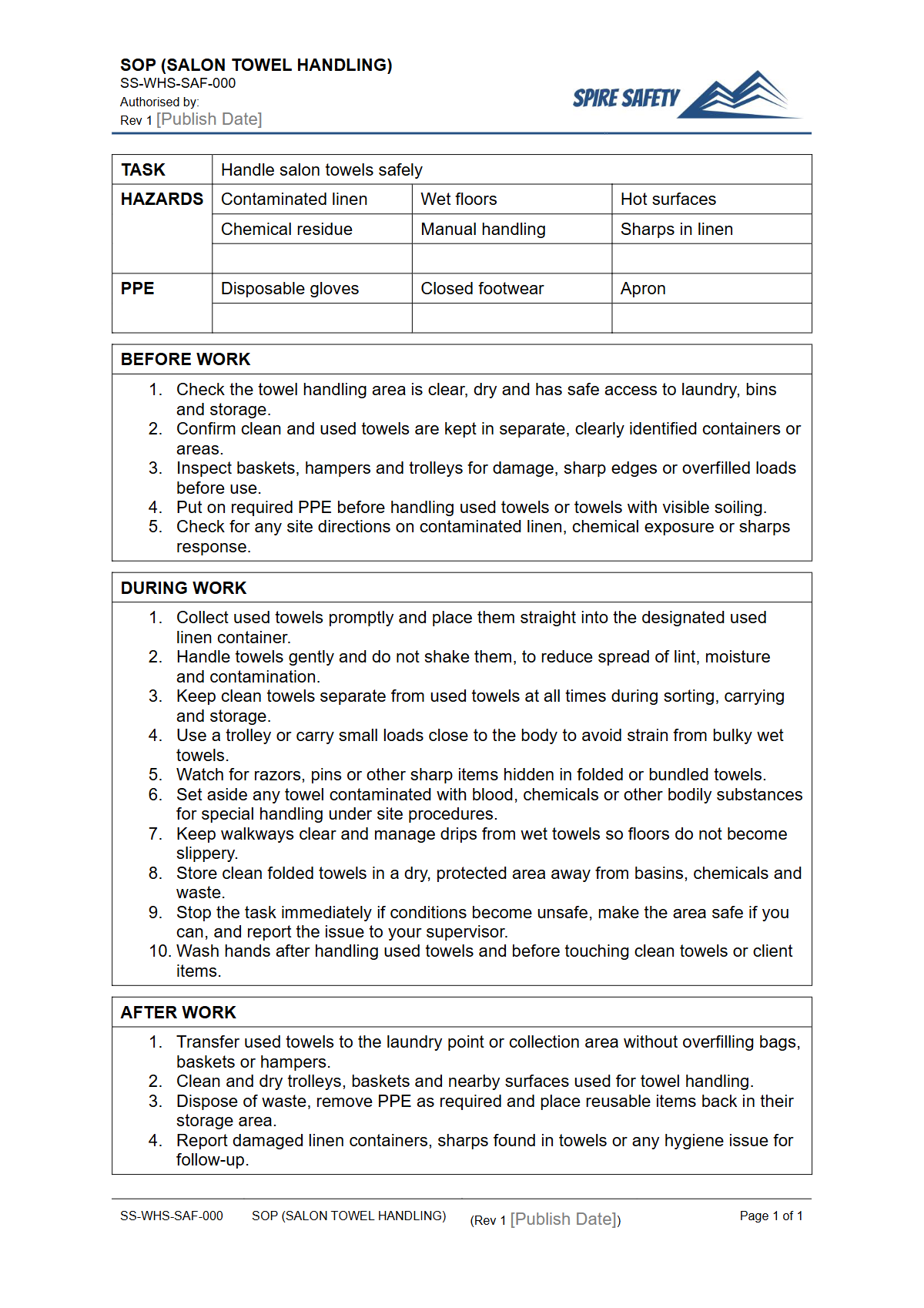
This Free Safe Operating Procedure (Salon Towel Handling) Template provides a structured framework to document your salon's specific process for collecting, laundering, and storing towels. Using a formal SOP helps standardise practices among all staff, reducing the risk of cross-contamination, exposure to cleaning chemicals, and manual handling injuries from heavy laundry bags.
It demonstrates a commitment to professional standards and workplace health and safety.
A documented procedure ensures every team member understands their responsibilities, from apprentices to senior stylists. This structured approach is common in other service industries where safety is paramount, such as hospitality, where a deep fryer standard operation SOP is essential for preventing burns.
While the hazards differ, the principle of a clear, repeatable process remains the same. By implementing this SOP, you create a clear and auditable record of your salon's hygiene protocols.
While handling salon towels might seem simple, it involves specific risks, much like operating common workshop equipment requires a dedicated Air Compressor Safe Operating Procedure to manage pressure and electrical hazards. In a salon, the primary hazards are biological (from used towels) and chemical (from detergents).
This SOP helps you manage those specific risks effectively.
A single SOP is a powerful tool, but its effectiveness is magnified when it forms part of a broader safety strategy. Integrating individual procedures like this one into comprehensive WHS management systems ensures a holistic approach to safety across all your salon's operations, from chemical handling to client interactions.
Video walkthrough
How to use the Free Safe Operating Procedure (Salon Towel Handling) Template
This Safe Operating Procedure template, available in both DOCX and PDF formats, is designed for immediate use after customisation. Start by downloading the file and opening it.
Read through the pre-filled sections, which cover key stages like preparation, personal protective equipment (PPE), the step-by-step process for handling soiled and clean towels, and emergency procedures.
It is crucial that you adapt this document to your specific workplace. We've included common steps, but you must review and edit the content to reflect your salon's unique equipment (brand and model of washing machine/dryer), layout, and the specific cleaning chemicals you use.
Be sure to reference the Safety Data Sheets (SDS) for your laundry products and incorporate relevant handling and first aid advice. Add your salon's name, assign review dates, and finalise the document for implementation.
Once customised, the SOP should be used as a primary training tool for staff. Ensure every team member reads, understands, and signs off on the procedure.
If you need assistance in tailoring this template to your salon's specific needs or developing other safety documents, our WHS consulting services can provide expert guidance and support.
When to use it
This Safe Operating Procedure should be the foundation of your salon's towel hygiene protocol. It is not a document to be filed away and forgotten.
Use it actively during the induction and training of all new employees, including stylists, apprentices, and cleaning staff, to ensure they learn the correct procedure from day one. It should also be a key document for annual refresher training to prevent procedural drift and reinforce good habits.
The SOP should be readily accessible in the laundry area as a quick reference guide for all workers. Furthermore, this document should be reviewed and updated following any incident, near miss, or change in your processes.
This includes introducing new laundry equipment, changing your brand of detergent or sanitiser, or altering the salon layout. Regular review ensures the procedure remains relevant and effective.
Maintaining and reviewing your safety documents is a key part of compliance. Periodically conducting a WHS compliance audit can help verify that procedures like this SOP are being followed correctly and are effectively controlling risks.
Who should use it
This resource is designed for a range of personnel within a salon, spa, or barber shop environment. Salon owners and managers should use this template to establish, document, and enforce a standardised and safe process for towel handling.
It provides a clear framework for meeting their duty of care to provide a safe working environment for staff and a safe service for clients.
All employees who handle towels at any stage of the process must be trained in and follow the procedure. This includes senior stylists, junior hairdressers, apprentices, salon assistants, and any dedicated cleaning staff.
The SOP ensures that everyone, regardless of their role or experience level, follows the same safe and hygienic steps.
WHS representatives or officers within the business can use this document as a tool for risk assessment, training, and incident investigation. It serves as a benchmark for expected behaviour and safe practice. You can find more templates to build out your safety system in our free WHS resources library.
Common mistakes
Common mistakes to avoid
- Using a generic template without customising it for the salon's specific washing machines, dryers, and chemicals.
- Failing to train all staff, including new hires and casuals, on the documented procedure.
- Storing clean and dirty towels in the same area, creating a high risk of cross-contamination.
- Overloading washing machines or laundry bags, leading to ineffective cleaning and manual handling injuries.
Legal references
Legal considerations
The following legal requirements may be relevant to this type of work.
- Work Health and Safety Act (Harmonised) — Provides the primary duties for protecting workers and other people from work health and safety risks.
- Work Health and Safety Regulations (Harmonised) — Sets out requirements supporting the management of workplace hazards and risks.
The following codes may be relevant to this type of work.
- Managing WHS Risks Code of Practice — Provides practical guidance on identifying hazards, assessing risks and applying effective controls.
- Work Health and Safety Consultation, Cooperation and Coordination Code of Practice — Provides practical guidance on consulting workers and coordinating with other duty holders.
- Managing the Work Environment and Facilities Code of Practice — Provides practical guidance on safe work environments, workplace facilities and related controls.
Did you know
Cross-Contamination Risk
Damp, used towels create a perfect breeding ground for bacteria and fungi. A formal handling process is a key infection control measure in personal service settings, as required by many local council and state health regulations.
Chemical Safety
Even common laundry detergents are classed as hazardous chemicals. An SOP ensures staff use the correct amounts and personal protective equipment (PPE), like gloves, to prevent skin irritation and chemical exposure.
FAQ
Frequently asked questions
01Why do I need a specific SOP for handling salon towels?
02What are the main hazards of handling salon towels?
03Can I use this template for a beauty salon or spa?
04How often should we review our Salon Towel Handling SOP?
Share this resource
Free Safe Operating Procedure (Salon Towel Handling) Template
Browse Categories
How To Use It
- 1Download and open in Word or PDF.
- 2Replace the placeholders with your business details.
- 3Get it reviewed by a WHS specialist before rollout.
Need it customised?
Our WHS consultants can adapt this template to your site, run a gap analysis, or audit what you already have in place.
Book a Free Consultation WHS consulting servicesor call 1300 156 382
Related templates
- Free Safe Operating Procedure (Sample Freezer) Template
- Free Safe Operating Procedure (Sampling Plant) Template
- Free Safe Operating Procedure (Sand Screw) Template
- Free Safe Operating Procedure (Sandpit Raking) Template
- Free Safe Operating Procedure (Sauna Cleaning) Template
- Free Safe Operating Procedure (Sausage Filler) Template