
Free Safe Operating Procedure (Sample Freezer) Template
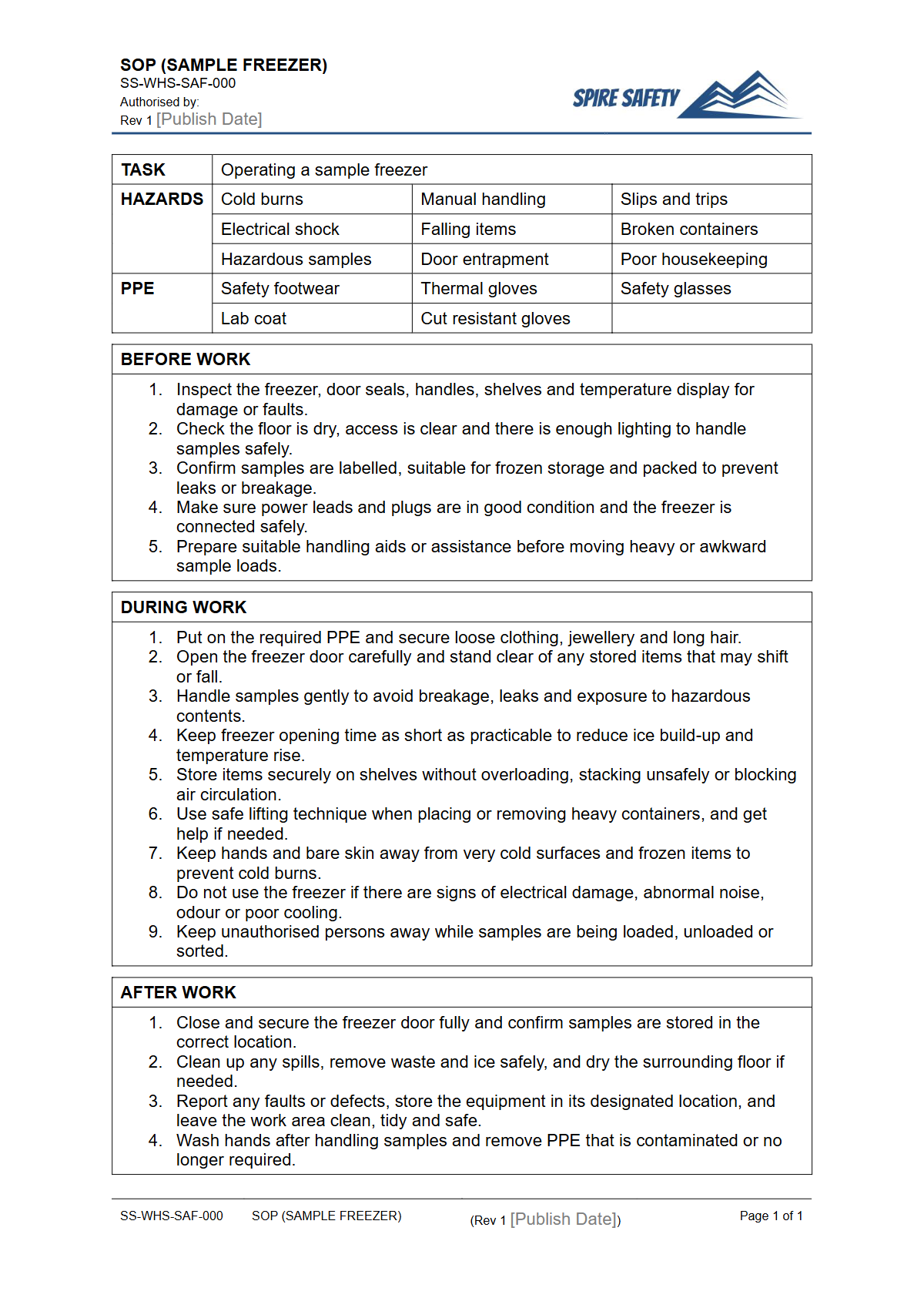
Download our free Safe Operating Procedure for sample freezers to formalise your safety processes. This template helps you outline key hazards and controls.
Free Safe Operating Procedure (Sample Freezer) Template
DOCX • 126 KB + PDF
Updated Oct 2026
No signup required
Purpose of the Free Safe Operating Procedure (Sample Freezer) Template
Operating specialised equipment like laboratory or medical sample freezers introduces significant workplace hazards. This Free Safe Operating Procedure (Sample Freezer) Template provides a structured framework for documenting the required steps to operate this equipment safely.
It prompts you to identify risks such as cryogenic burns from ultra-low temperatures, manual handling injuries from moving heavy sample racks, electrical faults, and potential asphyxiation from coolant gases like liquid nitrogen in poorly ventilated areas. A well-defined SOP is a critical tool for risk management, worker training, and demonstrating compliance with WHS duties.
Using this template helps standardise your processes, ensuring every worker follows a consistent, safety-focused method. Documenting procedures is a cornerstone of an effective WHS management system, providing clear instructions that minimise the risk of incidents and injuries.
Video walkthrough
How to use the Free Safe Operating Procedure (Sample Freezer) Template
This resource is available as a DOCX file, which is fully editable in Microsoft Word or other compatible programs, and a PDF for easy viewing and printing. To use it, download the DOCX version and methodically work through each section, replacing the placeholder text with information specific to your equipment and workplace.
Key areas for customisation include the specific make and model of the freezer, required Personal Protective Equipment (PPE), pre-operational safety checks, step-by-step operating instructions, and emergency shutdown procedures.
Important: This document is a template, not a finished procedure. It is aligned with Australian WHS practice, but we cannot guarantee its suitability for your specific situation.
You must customise it to accurately reflect your unique operational context, hazards, and control measures. While this SOP covers freezers, your facility may use other plant that also requires documented procedures; for this, our Free Air Compressor SOP (Safe Operating Procedure) Template can serve as another useful starting point.
When to Use This Safe Operating Procedure
A Safe Operating Procedure for a sample freezer should be an active, accessible document used in various daily and periodic activities. It is essential during the induction of new employees who will be required to work with or near the equipment.
It serves as a primary resource for task-specific training and can be used to conduct refresher courses to ensure ongoing competency. The SOP also provides a baseline for developing risk assessments and investigating any incidents or near misses, helping to identify procedural gaps or areas for improvement.
Furthermore, these documented procedures are a key piece of evidence during safety reviews. A routine WHS compliance audit will often verify that high-risk tasks are supported by formal, written instructions that are understood and followed by workers.
Who Should Use This Document
This Safe Operating Procedure is intended for use by several groups within an organisation. The Person Conducting a Business or Undertaking (PCBU) is ultimately responsible for ensuring safe systems of work are in place, making this template a tool to help fulfil that duty.
Laboratory managers, team leaders, and supervisors should use the finalised document to train their teams and oversee safe work practices. Health and Safety Representatives (HSRs) and WHS committee members can use it as a reference when reviewing workplace safety and consulting on risk controls.
Finally, and most importantly, workers who directly operate, clean, or maintain the sample freezers must use the SOP as their guide for performing their tasks safely. In larger facilities with automated sample processing lines, a freezer SOP may be one part of a larger workflow that also involves other machinery; in such cases, a document like our FREE Conveyer System SOP (Safe Operating Procedure) Template may also be necessary.
By implementing a clear, customised SOP for your sample freezers, you establish a clear standard for safety and operational excellence. For more templates and safety guides, you can explore our complete free WHS resources library.
Common mistakes
Common mistakes to avoid
- Using a generic template without customising it for the specific freezer model and workplace layout.
- Failing to provide or mandate the correct Personal Protective Equipment (PPE), such as cryogenic gloves and face shields.
- Neglecting to include detailed procedures for emergencies like power failures, which could compromise valuable samples.
- Storing the SOP in an office instead of making it easily accessible to workers at the point of use.
Legal references
Legal considerations
The following legal requirements may be relevant to this type of work.
- Work Health and Safety Act (Harmonised) — Provides the primary duties for protecting workers and other people from work health and safety risks.
- Work Health and Safety Regulations (Harmonised) — Sets out requirements supporting the management of workplace hazards and risks.
The following codes may be relevant to this type of work.
- Managing WHS Risks Code of Practice — Provides practical guidance on identifying hazards, assessing risks and applying effective controls.
- Work Health and Safety Consultation, Cooperation and Coordination Code of Practice — Provides practical guidance on consulting workers and coordinating with other duty holders.
- Managing the Work Environment and Facilities Code of Practice — Provides practical guidance on safe work environments, workplace facilities and related controls.
Did you know
Cryogenic Risks
Ultra-low temperature (ULT) freezers, which can reach -80°C or lower, can cause severe frostbite or cryogenic burns to unprotected skin almost instantly.
Asphyxiation Hazard
Freezers using liquid nitrogen as a coolant can displace oxygen in poorly ventilated rooms. A small leak can quickly create a serious asphyxiation risk for anyone in the area.
FAQ
Frequently asked questions
01What are the main hazards of a sample freezer?
02Is a Safe Operating Procedure a legal requirement in Australia?
03How often should an SOP for a sample freezer be reviewed?
04Who is responsible for training workers on this SOP?
Share this resource
Free Safe Operating Procedure (Sample Freezer) Template
Browse Categories
How To Use It
- 1Download and open in Word or PDF.
- 2Replace the placeholders with your business details.
- 3Get it reviewed by a WHS specialist before rollout.
Need it customised?
Our WHS consultants can adapt this template to your site, run a gap analysis, or audit what you already have in place.
Book a Free Consultation WHS consulting servicesor call 1300 156 382
Related templates
- Free Safe Operating Procedure (Sampling Plant) Template
- Free Safe Operating Procedure (Sand Screw) Template
- Free Safe Operating Procedure (Sandpit Raking) Template
- Free Safe Operating Procedure (Sauna Cleaning) Template
- Free Safe Operating Procedure (Sausage Filler) Template
- Free Safe Operating Procedure (Saw Horse) Template