
Free Safe Operating Procedure (Saw Horse) Template
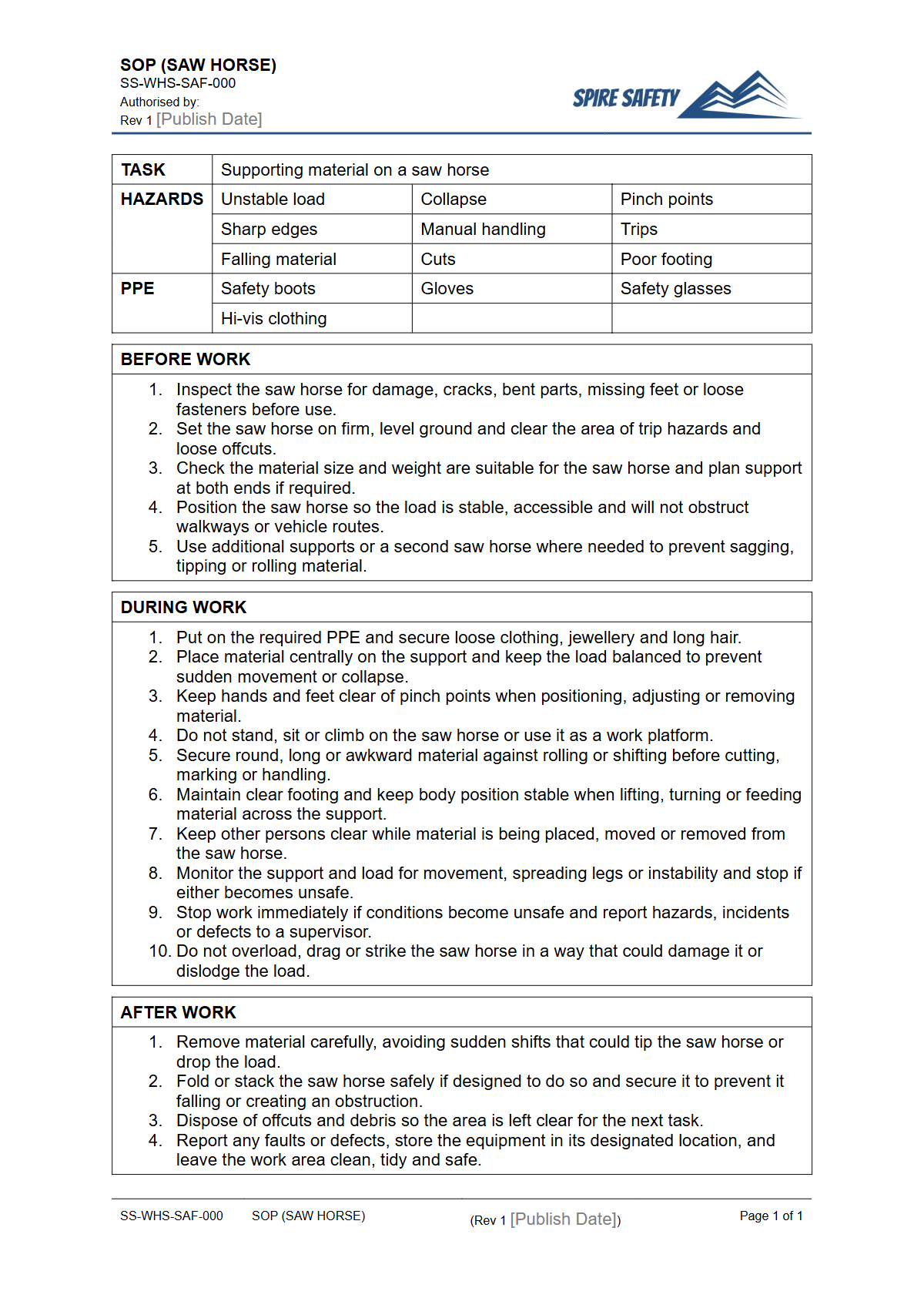
Download our free Safe Operating Procedure (Saw Horse) template. This customisable document provides a structured framework for safe workshop practices.
Free Safe Operating Procedure (Saw Horse) Template
DOCX • 126 KB + PDF
Updated Oct 2026
No signup required
Purpose of the Free Safe Operating Procedure (Saw Horse) Template
The primary purpose of this Free Safe Operating Procedure (Saw Horse) Template is to help your organisation establish and communicate a clear, standardised method for using saw horses safely. A saw horse might seem like a simple piece of equipment, but improper use can lead to serious injuries from falls, collapses, or manual handling strains.
This template provides a structured foundation for documenting the correct procedures, helping to ensure workers use saw horses safely and consistently.
A well-drafted SOP helps to prevent incidents by outlining pre-use checks, correct setup on various surfaces, load limitations, and safe work practices. It also serves as a valuable training tool for new employees and a reference for toolbox talks. Integrating specific SOPs like this one is a fundamental part of developing robust and effective WHS management systems.
Video walkthrough
How to use the Free Safe Operating Procedure (Saw Horse) Template
To use this Free Safe Operating Procedure (Saw Horse) Template, simply download the DOCX or PDF file and open it in your preferred editor. The template is designed to be a structured starting point, not a finished document.
You will need to add details such as your company name, specific locations where the equipment is used, and the roles responsible for implementation and supervision.
It is essential that you customise this template to reflect the specific context of your workplace. Critically, you must assess the specific types and models of saw horses you use, noting their individual load capacities and features. You should also detail the personal protective equipment (PPE) required and the steps for safely handling materials being supported, especially when performing tasks like cutting.
For related power tool procedures, you might find our FREE Circular Saw SOP Template a useful companion document.
Customisation is Key for Effectiveness
A generic procedure is not sufficient for managing your safety duties. Your customisation should involve a risk assessment of the tasks performed using saw horses at your site.
Consider factors like the work environment (e.g., uneven ground outdoors vs. a flat workshop floor), the materials being worked on, and other equipment being used concurrently.
This process of review and adaptation ensures the final document is relevant and effective for your workers. Regular reviews of your documented procedures can be integrated into your WHS compliance auditing schedule to ensure they remain current.
When to Use a Saw Horse SOP
A Safe Operating Procedure for saw horses should be consulted and applied in several key situations. It is essential for onboarding and training new team members, ensuring they learn the correct, safe method from day one.
The SOP should also be used as a refresher during toolbox talks or safety meetings, particularly before commencing projects that will heavily rely on this equipment. Furthermore, it serves as a benchmark for supervisors conducting safety observations and is an essential document to review after any near miss or incident involving a saw horse.
Integrating with Other Safety Documents
This SOP should not exist in isolation. It should be referenced in broader safety documents like Job Safety Analyses (JSAs) or Safe Work Method Statements (SWMS) for high-risk construction work where saw horses play a role.
It complements procedures for other common equipment; for example, many workshops that use saw horses will also have procedures for compressed air equipment, much like our Free Air Compressor SOP Template outlines.
Who Should Use This Template?
This template is designed for anyone responsible for health and safety in a workplace where saw horses are used. This includes WHS Managers, Safety Officers, and Site Supervisors in industries like construction, carpentry, manufacturing, and maintenance.
Team leaders and tradespeople can also use it to standardise practices within their crew. It provides the formal structure needed to move beyond verbal instructions and create a documented, auditable safety process.
If you require further guidance on implementing procedures like this, specialist WHS consulting can provide tailored support for your organisation.
By documenting and standardising your procedures, you create a safer and more predictable work environment. This template is just one of many resources designed to help.
Explore our complete free WHS resources library for more templates and guides to support your safety management efforts.
Common mistakes
Common mistakes to avoid
- Using damaged, wobbly, or faulty saw horses.
- Placing saw horses on uneven, unstable, or slippery ground.
- Exceeding the manufacturer's specified load capacity.
- Using a single saw horse for tasks that require a pair for stability.
Legal references
Legal considerations
The following legal requirements may be relevant to this type of work.
- Work Health and Safety Act (Harmonised) — Provides the primary duties for protecting workers and other people from work health and safety risks.
- Work Health and Safety Regulations (Harmonised) — Sets out requirements supporting the management of workplace hazards and risks.
The following codes may be relevant to this type of work.
- Managing WHS Risks Code of Practice — Provides practical guidance on identifying hazards, assessing risks and applying effective controls.
- Work Health and Safety Consultation, Cooperation and Coordination Code of Practice — Provides practical guidance on consulting workers and coordinating with other duty holders.
- Managing the Work Environment and Facilities Code of Practice — Provides practical guidance on safe work environments, workplace facilities and related controls.
Did you know
An Overlooked Hazard
Saw horses are frequently involved in trip and fall incidents, not just from collapsing, but from being left as obstacles in walkways and designated access routes.
Load Capacity Varies
Not all saw horses are equal. Professional-grade saw horses can support over 1,000 kg per pair, while lighter-duty models may only support a fraction of that. Always check the manufacturer's specifications.
FAQ
Frequently asked questions
01Why do I need an SOP for something as simple as a saw horse?
02What should be included in a customised saw horse SOP?
03Is this saw horse SOP template ready to use immediately?
04How often should a Safe Operating Procedure for a saw horse be reviewed?
Share this resource
Free Safe Operating Procedure (Saw Horse) Template
Browse Categories
How To Use It
- 1Download and open in Word or PDF.
- 2Replace the placeholders with your business details.
- 3Get it reviewed by a WHS specialist before rollout.
Need it customised?
Our WHS consultants can adapt this template to your site, run a gap analysis, or audit what you already have in place.
Book a Free Consultation WHS consulting servicesor call 1300 156 382
Related templates
- Free Safe Operating Procedure (Sawmill Carriage) Template
- Free Safe Operating Procedure (Scaffold Hoist) Template
- Free Safe Operating Procedure (Scoreboard Cleaning) Template
- Free Safe Operating Procedure (Screen Printing) Template
- Free Safe Operating Procedure (Screening Plant Operation) Template
- Free Safe Operating Procedure (Screw Gun) Template