
Free Safe Operating Procedure (Sawmill Carriage) Template
Download our free Safe Operating Procedure (Sawmill Carriage) Template to manage high-risk sawmill operations. Get your customisable DOCX and PDF now.
Free Safe Operating Procedure (Sawmill Carriage) Template
DOCX • 126 KB + PDF
Updated Oct 2026
No signup required
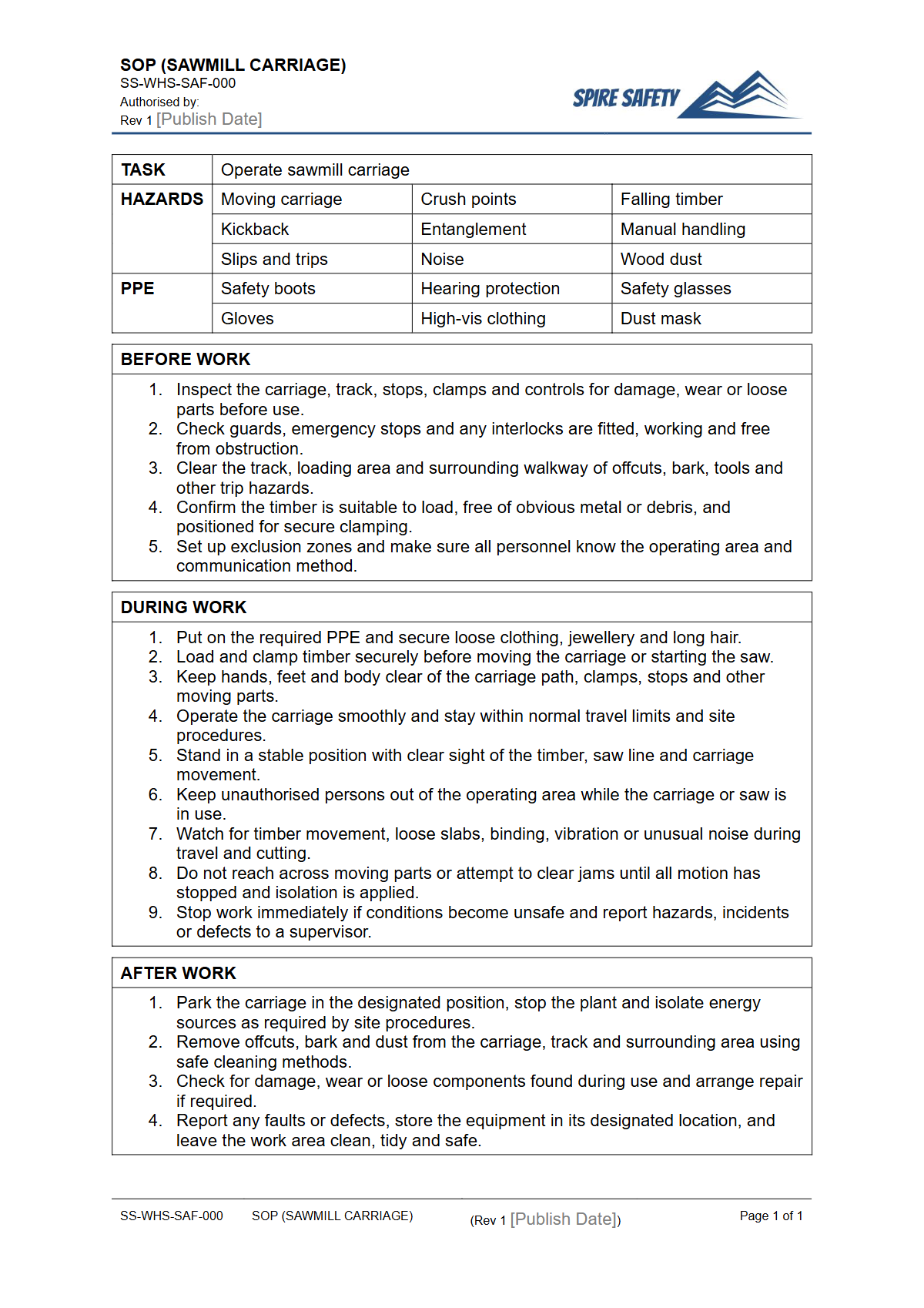
Purpose of the Free Safe Operating Procedure (Sawmill Carriage) Template
Operating a sawmill carriage involves significant risks, including contact with moving parts, ejected debris, and crushing hazards from logs. This free Safe Operating Procedure (Sawmill Carriage) Template provides a structured framework to help your organisation document the required steps for operating this equipment safely.
A well-developed SOP is a critical tool for standardising work practices, training operators, and demonstrating a commitment to risk management. By clearly outlining pre-start checks, operational sequences, and emergency procedures, you can significantly reduce the likelihood of incidents and injuries in your timber processing facility.
This template is designed as a foundational document, guiding you through the essential components of a robust procedure. It helps formalise the safe work methods specific to your machinery and environment, forming a key part of your overall safety management.
It also serves as an excellent resource during worker inductions and refresher training sessions, ensuring everyone understands their responsibilities. For facilities with multiple heavy machines, a consistent approach to SOPs is vital, similar to the process for creating a Safe Operating Procedure for a conveyer system.
Video walkthrough
How to use the Free Safe Operating Procedure (Sawmill Carriage) Template
This template is provided in both DOCX and PDF formats for your convenience. To effectively implement it, you must conduct a thorough risk assessment of your specific sawmill carriage and work area.
The document includes placeholder text that needs to be replaced with your site-specific information, such as the make and model of the carriage, required Personal Protective Equipment (PPE), and emergency contact details. It is not a finished document and requires careful customisation.
Important: We have created this template as a starting point. To ensure it is effective, you must adapt it to reflect the unique hazards and control measures of your workplace.
Your finalised SOP should be reviewed by a competent person and approved by management before being implemented. A properly customised SOP is a cornerstone of developing a comprehensive WHS management system that genuinely protects your workers.
When to Use This Safe Operating Procedure
A Safe Operating Procedure for a sawmill carriage should be used consistently as part of your daily operations. It is not a document to be filed away and forgotten.
It should be readily accessible to all operators near the equipment. Key times to use the SOP include:
- Before every shift: Operators should reference the pre-start inspection checklist within the SOP to ensure the carriage and its safety features are functioning correctly.
- During training and onboarding: The SOP is an essential training tool for new operators, providing clear, step-by-step instructions.
- For competency verification: It can be used by supervisors to assess whether an operator is performing the task according to the established safe procedure.
- After an incident or near miss: The SOP should be reviewed and updated as part of any incident investigation to prevent recurrence.
Regular reviews are also crucial. Periodic WHS compliance audits can help identify gaps in your procedures and ensure they remain current with operational practices and legislative requirements.
Who Should Use It
This SOP is intended for several key roles within a sawmill or timber processing operation. Primarily, it is for the machinery operators who are directly responsible for running the sawmill carriage.
It provides them with the authoritative guide on how to perform their duties safely.
Beyond the operator, other personnel who should use this document include:
- Supervisors and Managers: To enforce safe work practices, conduct safety observations, and carry out incident investigations.
- Work Health and Safety (WHS) Personnel: To integrate the procedure into the broader safety management system and use it as a basis for risk assessments.
- Maintenance Staff: To understand the operational hazards and necessary isolation procedures (lockout/tagout) before commencing any repair or maintenance work. Sawmill work often involves various types of saws, and having a specific SOP for a portable circular saw can complement procedures for fixed plant.
- Training Coordinators: To develop training programs and competency assessments based on a standardised, approved procedure. Many timber yards also use mobile plant for loading, making a specific SOP for telehandler use another valuable resource to have on hand.
You can find many other useful templates and checklists in our complete free WHS resources library to support your safety management efforts.
Common mistakes
Common mistakes to avoid
- Failing to conduct a site-specific risk assessment before finalising the SOP.
- Using a generic template without adding machine-specific details for the particular sawmill carriage model.
- Neglecting to train workers on the finalised procedure and verify their understanding and competency.
- Not including clear, step-by-step lockout/tagout (LOTO) instructions for maintenance and cleaning.
Legal references
Legal considerations
The following legal requirements may be relevant to this type of work.
- Work Health and Safety Act (Harmonised) — Provides the primary duties for protecting workers and other people from work health and safety risks.
- Work Health and Safety Regulations (Harmonised) — Sets out requirements supporting the management of workplace hazards and risks.
The following codes may be relevant to this type of work.
- Managing WHS Risks Code of Practice — Provides practical guidance on identifying hazards, assessing risks and applying effective controls.
- Work Health and Safety Consultation, Cooperation and Coordination Code of Practice — Provides practical guidance on consulting workers and coordinating with other duty holders.
- Managing the Work Environment and Facilities Code of Practice — Provides practical guidance on safe work environments, workplace facilities and related controls.
Did you know
Leading Cause of Injury
The most serious injuries in sawmill operations are often caused by contact with moving machinery parts, particularly saw blades, log carriages, and conveyor systems.
Energy Isolation is Critical
A moving sawmill carriage possesses significant kinetic energy even after power is cut. A robust lockout/tagout (LOTO) procedure is non-negotiable for any maintenance, cleaning, or jam-clearing task to prevent unexpected movement.
FAQ
Frequently asked questions
01What should be included in a sawmill carriage SOP?
02Is this sawmill carriage SOP template ready to use immediately?
03How often should a Safe Operating Procedure be reviewed?
04Who is responsible for implementing the SOP for a sawmill carriage?
Share this resource
Free Safe Operating Procedure (Sawmill Carriage) Template
Browse Categories
How To Use It
- 1Download and open in Word or PDF.
- 2Replace the placeholders with your business details.
- 3Get it reviewed by a WHS specialist before rollout.
Need it customised?
Our WHS consultants can adapt this template to your site, run a gap analysis, or audit what you already have in place.
Book a Free Consultation WHS consulting servicesor call 1300 156 382
Related templates
- Free Safe Operating Procedure (Scaffold Hoist) Template
- Free Safe Operating Procedure (Scoreboard Cleaning) Template
- Free Safe Operating Procedure (Screen Printing) Template
- Free Safe Operating Procedure (Screening Plant Operation) Template
- Free Safe Operating Procedure (Screw Gun) Template
- Free Safe Operating Procedure (Scroll Saw) Template