
Free Safe Operating Procedure (Screening Plant Operation) Template
Download our free Safe Operating Procedure (Screening Plant Operation) template.
Free Safe Operating Procedure (Screening Plant Operation) Template
DOCX • 155 KB + PDF
Updated Oct 2026
No signup required
Purpose of the Free Safe Operating Procedure (Screening Plant Operation) Template
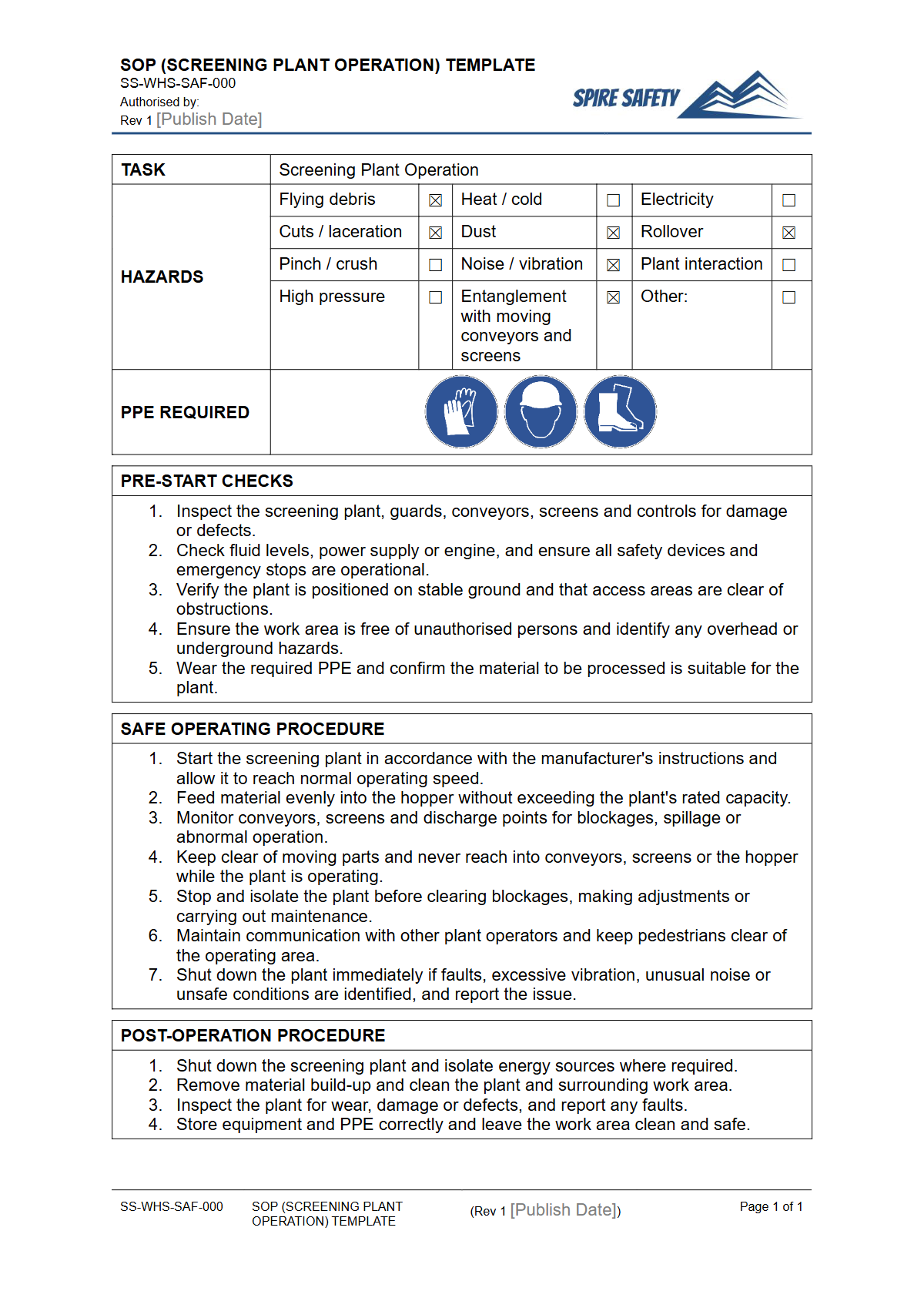
Operating a screening plant involves significant health and safety risks, including entanglement in moving parts, noise exposure, airborne dust, and vehicle interactions. This Free Safe Operating Procedure (Screening Plant Operation) Template provides a structured starting point for your business to document a safe system of work.
It is designed to help you control these hazards and meet your duties under Australian WHS legislation. The template guides you in detailing step-by-step instructions for pre-operational checks, safe operation, shutdown, and maintenance tasks associated with screening plants.
Using a documented SOP is a fundamental part of managing workplace risks. It standardises procedures, provides a critical tool for worker training and induction, and serves as a reference point for supervisors and managers.
This document helps ensure that everyone involved understands the required safety measures, personal protective equipment (PPE), and emergency protocols. It forms an essential part of your broader safety framework, which often includes procedures for associated machinery, such as those covered in our free Front End Loader SOP template.
Video walkthrough
How to use the Free Safe Operating Procedure (Screening Plant Operation) Template
This document is a template, not a finished procedure. To make it effective, you must adapt it to the specific circumstances of your workplace.
Download the DOCX file and begin by customising the content to reflect the make, model, and configuration of your screening plant. It is critical to conduct a site-specific risk assessment and incorporate your findings into the SOP.
The customisation process should be a collaborative effort. Consult directly with the workers who operate the equipment, as well as their supervisors and any health and safety representatives.
They have firsthand knowledge of the tasks and associated hazards. We strongly advise that you make this SOP a living document within your overall safety framework; it is not a 'set and forget' form.
The final, approved procedure should be integrated into your comprehensive WHS management systems to ensure it is properly implemented, reviewed, and updated as required.
When to use it
A Safe Operating Procedure for a screening plant should be used consistently as a primary reference tool. It is essential during the induction and training of new operators to ensure they learn the correct, safe method from the beginning.
It should also be used for refresher training for existing staff, especially if there has been an incident or a near miss. Supervisors should refer to the SOP during routine inspections and performance observations to verify that safe work practices are being followed.
The SOP is also a key document to review before undertaking non-routine tasks, such as clearing a blockage, performing maintenance, or adjusting the plant. Furthermore, it should be referenced when conducting formal risk assessments or investigating an incident.
It provides the established benchmark against which actual work practices can be compared. Many sites require operators of heavy equipment to review relevant SOPs, like a FREE Dozer SOP Template, before commencing each shift.
Who should use it
This SOP is intended for several key groups within an organisation. The primary users are the plant operators themselves, who must follow the procedure for every task.
They need to be thoroughly trained on its contents and have easy access to it in their work area. Supervisors and line managers are responsible for ensuring operators are trained and competent, and for enforcing the procedures outlined in the SOP.
They use it as a tool for monitoring compliance and coaching their teams on safe behaviour.
Workplace Health and Safety (WHS) personnel and managers will use this SOP as a component of the overall safety system. They are often responsible for developing, reviewing, and updating the document in consultation with workers.
Management can use the existence and quality of SOPs as a key performance indicator, which may be verified during a WHS compliance audit. The principles of safe operation for heavy earthmoving equipment are similar across different machines, making it useful to have consistent formats for documents like this and a FREE Scraper SOP Template. You can find more examples in our free WHS resources library for other plant and equipment.
Common mistakes
Common mistakes to avoid
- Failing to implement and enforce strict lock-out tag-out (LOTO) procedures before any cleaning or maintenance.
- Using the generic template without customising it for the specific plant model, site conditions, and materials being processed.
- Neglecting to include specific, safe procedures for clearing common blockages in chutes, screens, and conveyors.
- Providing inadequate training or assuming operators have read and understood the SOP without verifying competency.
Legal references
Legal considerations
The following legal requirements may be relevant to this type of work.
- Work Health and Safety Act (Harmonised) — Provides the primary duties for protecting workers and other people from work health and safety risks.
- Work Health and Safety Regulations (Harmonised) — Sets out requirements supporting the management of workplace hazards and risks.
The following codes may be relevant to this type of work.
- Managing WHS Risks Code of Practice — Provides practical guidance on identifying hazards, assessing risks and applying effective controls.
- Work Health and Safety Consultation, Cooperation and Coordination Code of Practice — Provides practical guidance on consulting workers and coordinating with other duty holders.
- Managing the Work Environment and Facilities Code of Practice — Provides practical guidance on safe work environments, workplace facilities and related controls.
Did you know
Entanglement Risk
Many serious and fatal incidents involving screening plants occur during maintenance or when clearing blockages, where workers become entangled after failing to properly isolate and de-energise the machine.
Silica Dust Hazard
Screening rock, sand, or concrete can generate high levels of respirable crystalline silica (RCS), a hazardous dust that can lead to silicosis, a severe and incurable lung disease.
FAQ
Frequently asked questions
01What key hazards should an SOP for a screening plant cover?
02How often should a Safe Operating Procedure be reviewed?
03Is this SOP template suitable for all types of screening plants?
04Who is responsible for developing a Safe Operating Procedure in the workplace?
Share this resource
Free Safe Operating Procedure (Screening Plant Operation) Template
Browse Categories
How To Use It
- 1Download and open in Word or PDF.
- 2Replace the placeholders with your business details.
- 3Get it reviewed by a WHS specialist before rollout.
Need it customised?
Our WHS consultants can adapt this template to your site, run a gap analysis, or audit what you already have in place.
Book a Free Consultation WHS consulting servicesor call 1300 156 382
Related templates
- Free Safe Operating Procedure (Screw Gun) Template
- Free Safe Operating Procedure (Scroll Saw) Template
- Free Safe Operating Procedure (Scrubber Dryer) Template
- Free Safe Operating Procedure (Sealant Application) Template
- Free Safe Operating Procedure (Seaming Machine) Template
- Free Safe Operating Procedure (Section Roller) Template