
Free Safe Operating Procedure (Seaming Machine) Template
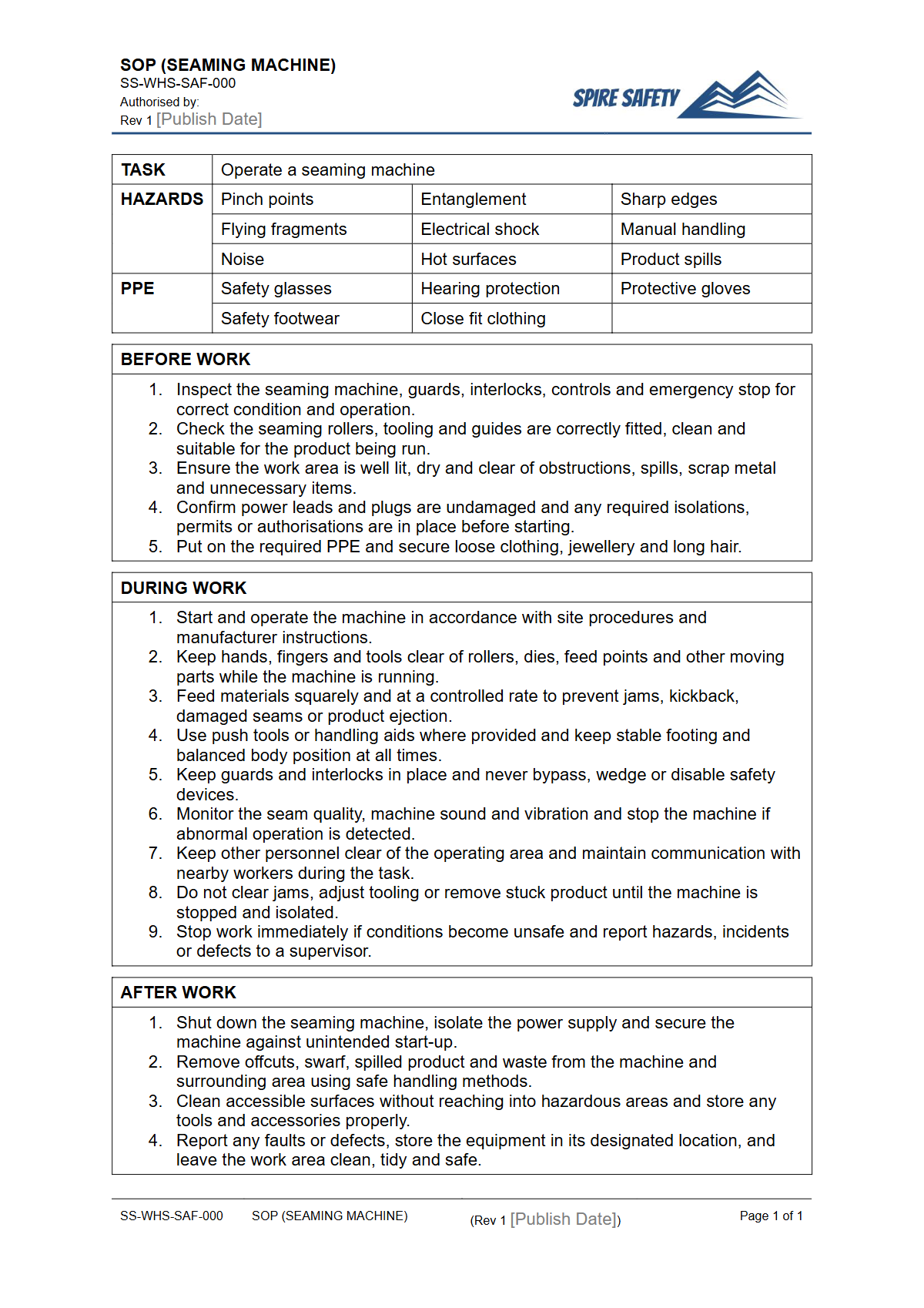
Download our free Safe Operating Procedure (Seaming Machine) Template to formalise safe work practices. Start outlining your seamer procedures today.
Free Safe Operating Procedure (Seaming Machine) Template
DOCX • 126 KB + PDF
Updated Oct 2026
No signup required
Purpose of the Free Safe Operating Procedure (Seaming Machine) Template
This Safe Operating Procedure (SOP) template for seaming machines provides a structured framework for documenting the required steps to perform tasks safely. Using our free Safe Operating Procedure (Seaming Machine) Template helps your organisation manage risks associated with seamer operation, including entanglement, crushing, and noise hazards.
It is designed to be a starting point, helping you clearly define pre-operational checks, operational steps, shutdown procedures, and emergency responses. Formalising these processes is a critical component of any effective safety management system, ensuring consistency and demonstrating due diligence in protecting workers.
By implementing a detailed SOP, you can standardise training, reduce the likelihood of incidents, and improve overall operational efficiency. This document serves as a key tool in your risk management process, assisting Persons Conducting a Business or Undertaking (PCBUs) in meeting their primary duty of care under Australian WHS legislation.
It should be developed in consultation with workers who operate the machinery. For equipment that is often part of a larger automated line, consider integrating this SOP with others, such as for a Conveyer System SOP.
Video walkthrough
How to use the Free Safe Operating Procedure (Seaming Machine) Template
This template is available in both DOCX for easy editing and PDF for straightforward distribution. To use it effectively, you must customise the content to reflect the specific make and model of the seaming machine at your workplace, your site-specific hazards, and your established control measures.
Generic procedures are not sufficient for ensuring safety.
Important: We have provided a comprehensive starting point based on common industry practices, but every workplace is unique. You must consult the manufacturer's manual, conduct a specific risk assessment, and involve competent operators to adapt this document.
This ensures the final SOP is a practical and relevant tool for your team. Reviewing and customising this document is a core part of developing robust WHS management systems that are tailored to your business operations.
The template covers the following key sections:
- Required Personal Protective Equipment (PPE)
- Pre-Operational Safety Checks
- Step-by-Step Operating Sequence
- Post-Operational and Shutdown Procedures
- Maintenance and Cleaning Guidelines
- Emergency Procedures and Contacts
When to use a Seaming Machine SOP
A Safe Operating Procedure for a seaming machine should be used in several key situations. It is essential during the induction and training of new operators to ensure they learn the correct, safe method from the outset.
The SOP should also be readily available at the machine's location as a constant reference for all workers, reinforcing correct practices and serving as a guide for non-routine tasks or troubleshooting.
Furthermore, the SOP is a critical document during incident investigations, helping to determine if procedures were followed. It should also be reviewed and updated regularly, particularly after an incident, when new hazards are identified, or when the machine or process is modified.
Similar principles apply to supporting equipment; for instance, a free Air Compressor SOP is vital if your seamer relies on pneumatic power.
Who should use this SOP
This SOP is intended for use by several groups within an organisation. Primarily, machine operators must be thoroughly trained on and follow the SOP to ensure their own safety and the safety of those around them.
Supervisors and managers are responsible for implementing the SOP, providing adequate training, and ensuring compliance on the floor.
Safety officers, WHS committees, and management personnel will use the SOP as part of the broader safety framework. It serves as evidence of risk controls and is a key document reviewed during safety audits.
Engaging a third party for WHS compliance auditing can provide an objective assessment of how well your SOPs are implemented in practice. This process helps identify gaps between documented procedures and actual work behaviours.
The principles of documenting safe procedures are universal across different types of industrial equipment. Whether your workplace uses seamers or other machinery, the methodical approach remains the same, as seen in templates like our free Injection Molding Machine SOP.
For a wider range of templates covering various plant and equipment, you can browse our complete free WHS resources library for documents aligned with Australian WHS standards.
Common mistakes
Common mistakes to avoid
- Using a generic template without customising it for the specific machine model and workplace.
- Failing to include procedures for non-routine tasks like cleaning, clearing jams, and maintenance.
- Not involving experienced operators in the drafting and review process, leading to impractical steps.
- Neglecting to train workers on the finalised SOP or failing to make it easily accessible at the work area.
Legal references
Legal considerations
The following legal requirements may be relevant to this type of work.
- Work Health and Safety Act (Harmonised) — Provides the primary duties for protecting workers and other people from work health and safety risks.
- Work Health and Safety Regulations (Harmonised) — Sets out requirements supporting the management of workplace hazards and risks.
The following codes may be relevant to this type of work.
- Managing WHS Risks Code of Practice — Provides practical guidance on identifying hazards, assessing risks and applying effective controls.
- Work Health and Safety Consultation, Cooperation and Coordination Code of Practice — Provides practical guidance on consulting workers and coordinating with other duty holders.
- Managing the Work Environment and Facilities Code of Practice — Provides practical guidance on safe work environments, workplace facilities and related controls.
Did you know
Machine Guarding
Inadequate machine guarding is consistently one of the most common safety breaches found by regulators. A well-written SOP reinforces the importance of keeping all guards in place during operation.
The Double Seam
The double seam, formed by can seaming machines, creates an airtight seal by interlocking the can body and lid. Its invention in the late 19th century revolutionised food preservation and distribution.
FAQ
Frequently asked questions
01What are the main hazards associated with seaming machines?
02How often should a Safe Operating Procedure for a seaming machine be reviewed?
03Is specific training required to operate a seaming machine?
04What Personal Protective Equipment (PPE) is typically required for operating a seaming machine?
Share this resource
Free Safe Operating Procedure (Seaming Machine) Template
Browse Categories
How To Use It
- 1Download and open in Word or PDF.
- 2Replace the placeholders with your business details.
- 3Get it reviewed by a WHS specialist before rollout.
Need it customised?
Our WHS consultants can adapt this template to your site, run a gap analysis, or audit what you already have in place.
Book a Free Consultation WHS consulting servicesor call 1300 156 382
Related templates
- Free Safe Operating Procedure (Section Roller) Template
- Free Safe Operating Procedure (Security Door Cleaning) Template
- Free Safe Operating Procedure (Security Gate Operation) Template
- Free Safe Operating Procedure (Security Key Handover) Template
- Free Safe Operating Procedure (Security Log Handover) Template
- Free Safe Operating Procedure (Security Patrol Handover) Template