
Free Safe Operating Procedure (Security Gate Operation) Template
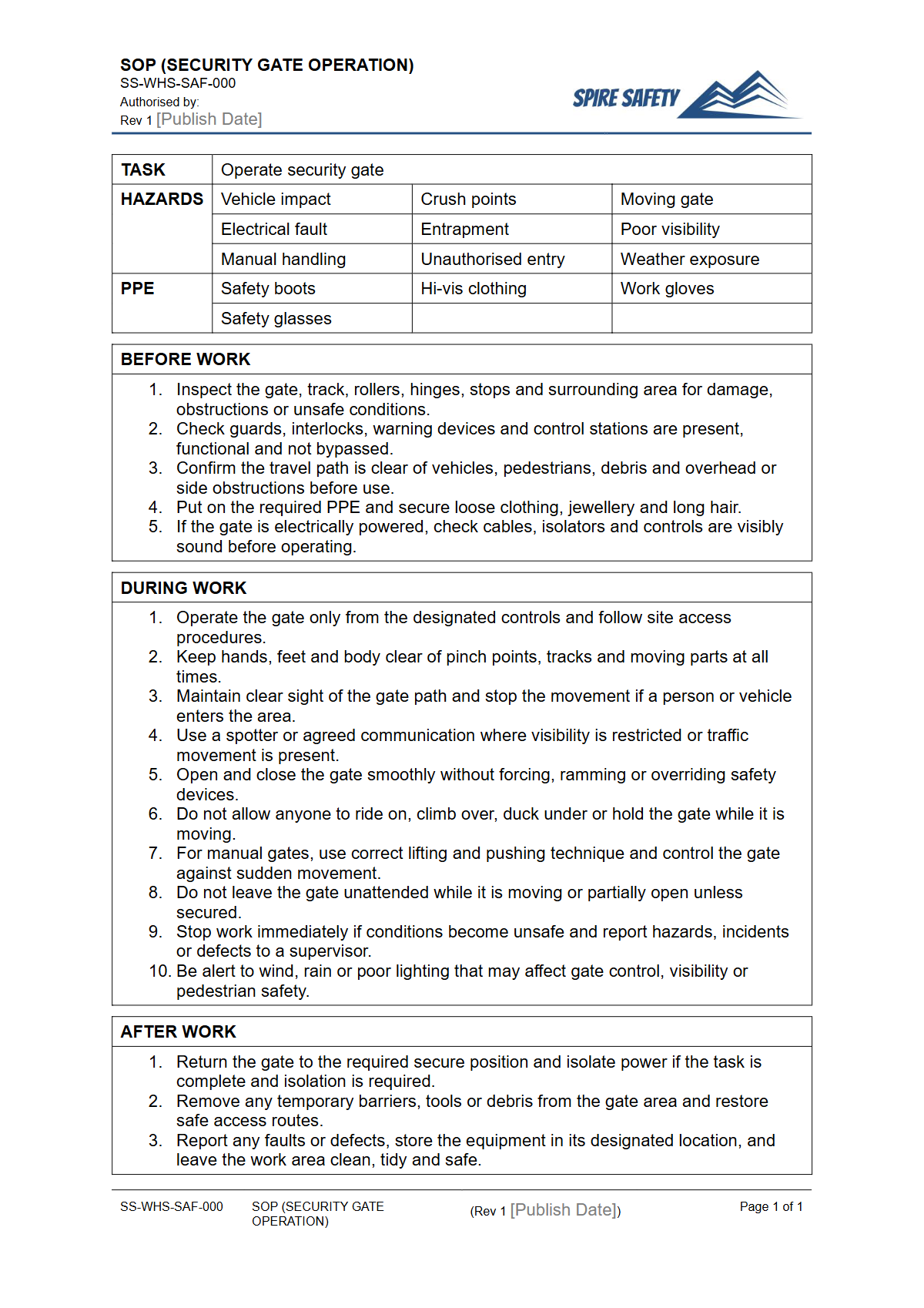
Formalise your procedures for operating automated security gates to manage risks. Download our free Safe Operating Procedure (Security Gate Operation) template.
Free Safe Operating Procedure (Security Gate Operation) Template
DOCX • 126 KB + PDF
Updated Oct 2026
No signup required
Purpose of the Free Safe Operating Procedure (Security Gate Operation) Template
Automated security gates are a common feature in many Australian workplaces, controlling vehicle and pedestrian access. While essential for security, their moving parts present significant risks, including crushing, shearing, and impact hazards.
This Free Safe Operating Procedure (Security Gate Operation) Template provides a structured framework to document the step-by-step process for using your specific gates safely. By clearly defining pre-operational checks, operating steps, and emergency responses, you can standardise safe work practices, reduce the risk of incidents, and provide a clear training tool for all personnel.
A well-developed SOP is a critical control measure for managing hazards associated with powered equipment. It forms a key part of your safety management system, demonstrating a commitment to providing a safe working environment.
Formalising these instructions helps ensure every operator, whether a full-time employee or a temporary contractor, understands the correct and safe way to interact with the gate system, minimising confusion and human error. This is as vital for access control points as it is for complex machinery, making a documented procedure like a safe operating procedure for a conveyer system essential.
Video walkthrough
How to use the Free Safe Operating Procedure (Security Gate Operation) Template
This template is designed to be a comprehensive starting point, aligned with Australian WHS principles. Available in both DOCX and PDF formats, you can easily download and adapt it to your specific operational needs.
The DOCX file is fully editable, allowing you to insert details about your specific gate model, site layout, access control methods (like keypads, remotes, or sensors), and emergency contact information. A robust SOP is a cornerstone of a safe workplace, much like a specific telehandler SOP is for operating high-risk mobile plant.
To get started, download the template and work through each section. Consult with the gate manufacturer’s manual, your site supervisors, and the workers who operate the gates daily to gather all necessary information.
Pay close attention to defining the persons responsible for each task, from routine operation to maintenance and emergency overrides.
Please note: We've provided this template as a starting point. You must customise it with your specific site details, gate model, emergency procedures, and personnel roles to ensure it is effective for your workplace.
When to use this Safe Operating Procedure
An SOP for security gate operation should be a living document integrated into your daily activities. It is not a file to be written once and forgotten.
It should be used during new worker inductions to familiarise them with site-specific access protocols and safety features. It serves as the primary reference document for both standard operation and for troubleshooting minor issues, such as a sensor malfunction or a power outage.
Furthermore, the SOP should be reviewed during regular refresher training sessions to reinforce safe behaviour and address any complacency.
Following any incident, near-miss, or change to the gate system (such as an upgrade or repair), the SOP must be reviewed and updated to reflect new information or controls. This process of continual improvement is fundamental to maintaining its relevance and effectiveness.
The insights gained can feed into your overall risk management framework and be verified through regular WHS compliance auditing activities.
Who should use it
The responsibility for implementing this Safe Operating Procedure rests with the Person Conducting a Business or Undertaking (PCBU). However, its practical use involves several roles within the organisation.
- Managers and Supervisors: Use the SOP to train workers, enforce safe work practices, and conduct risk assessments. They are responsible for ensuring the procedure is understood, followed, and reviewed regularly.
- Operators and Workers: Any employee or contractor authorised to operate the security gate must be trained on the SOP and use it as their guide for safe operation. This includes security personnel, delivery drivers with authorised access, and general staff.
- Maintenance Personnel: Use the SOP to understand operational hazards before commencing maintenance or repair work, particularly during lockout-tagout procedures.
Ultimately, this document is a tool for everyone on site, promoting a shared understanding of risk. It is one critical document among many that constitute comprehensive WHS management systems, ensuring that safety is a collaborative effort. Similar to how an SOP for an air compressor is vital for workshop safety, this procedure is key for site access safety. Explore our entire free WHS resources library for more templates to support your organisation.
Common mistakes
Common mistakes to avoid
- Using a generic template without customising it for the specific gate model and site conditions.
- Failing to include clear instructions for emergency manual override procedures during a power failure.
- Neglecting to schedule and document regular maintenance for safety features like sensors and auto-reverse mechanisms.
- Providing insufficient training to all users, including casual staff, delivery drivers, and contractors.
Legal references
Legal considerations
The following legal requirements may be relevant to this type of work.
- Work Health and Safety Act (Harmonised) — Provides the primary duties for protecting workers and other people from work health and safety risks.
- Work Health and Safety Regulations (Harmonised) — Sets out requirements supporting the management of workplace hazards and risks.
The following codes may be relevant to this type of work.
- Managing WHS Risks Code of Practice — Provides practical guidance on identifying hazards, assessing risks and applying effective controls.
- Work Health and Safety Consultation, Cooperation and Coordination Code of Practice — Provides practical guidance on consulting workers and coordinating with other duty holders.
- Managing the Work Environment and Facilities Code of Practice — Provides practical guidance on safe work environments, workplace facilities and related controls.
Did you know
Force and Risk
A typical sliding or swing gate can exert hundreds of kilograms of force, which is more than enough to cause serious injury or fatality. This is why safety features like photo-electric beams, pressure-sensitive edges, and force limitation devices are critical components.
FAQ
Frequently asked questions
01What should be included in a Safe Operating Procedure for a security gate?
02How often should security gate SOPs be reviewed?
03Are security guards and other staff required to be trained on the gate SOP?
04What are the main hazards of operating an automatic security gate?
Share this resource
Free Safe Operating Procedure (Security Gate Operation) Template
Browse Categories
How To Use It
- 1Download and open in Word or PDF.
- 2Replace the placeholders with your business details.
- 3Get it reviewed by a WHS specialist before rollout.
Need it customised?
Our WHS consultants can adapt this template to your site, run a gap analysis, or audit what you already have in place.
Book a Free Consultation WHS consulting servicesor call 1300 156 382
Related templates
- Free Safe Operating Procedure (Security Key Handover) Template
- Free Safe Operating Procedure (Security Log Handover) Template
- Free Safe Operating Procedure (Security Patrol Handover) Template
- Free Safe Operating Procedure (Security Patrol) Template
- Free Safe Operating Procedure (Security Radio Check) Template
- Free Safe Operating Procedure (Security Shift Handover) Template