
Free Safe Operating Procedure (Security Radio Check) Template
Ensure clear and safe communication protocols with our free Safe Operating Procedure for security radio checks. Download the customisable template today.
Free Safe Operating Procedure (Security Radio Check) Template
DOCX • 126 KB + PDF
Updated Oct 2026
No signup required
Purpose of the Free Safe Operating Procedure (Security Radio Check) Template
Clear, reliable communication is the backbone of any effective security operation. This Free Safe Operating Procedure (Security Radio Check) Template provides a structured framework for ensuring all two-way radio equipment is functional and that personnel are proficient in its use.
Establishing a consistent check-in process helps verify signal strength, confirm battery life, and ensure all team members are accounted for before, during, and after a shift. Formalising this process is crucial for maintaining operational readiness, coordinating responses, and ensuring worker safety, particularly during emergencies or in isolated work environments.
Implementing a standardised SOP for radio checks minimises confusion and ensures every team member follows the same protocol. This consistency is vital for building a reliable communication network that can be depended upon when it matters most.
Using this template helps embed a critical safety habit into your team's daily routine, forming a key part of a proactive safety culture. It serves as an essential tool within a broader WHS management system, demonstrating a commitment to providing a safe system of work.
Video walkthrough
How to use the Free Safe Operating Procedure (Security Radio Check) Template
This template is provided in both DOCX and PDF formats for your convenience. Download the file and integrate it into your existing safety documentation.
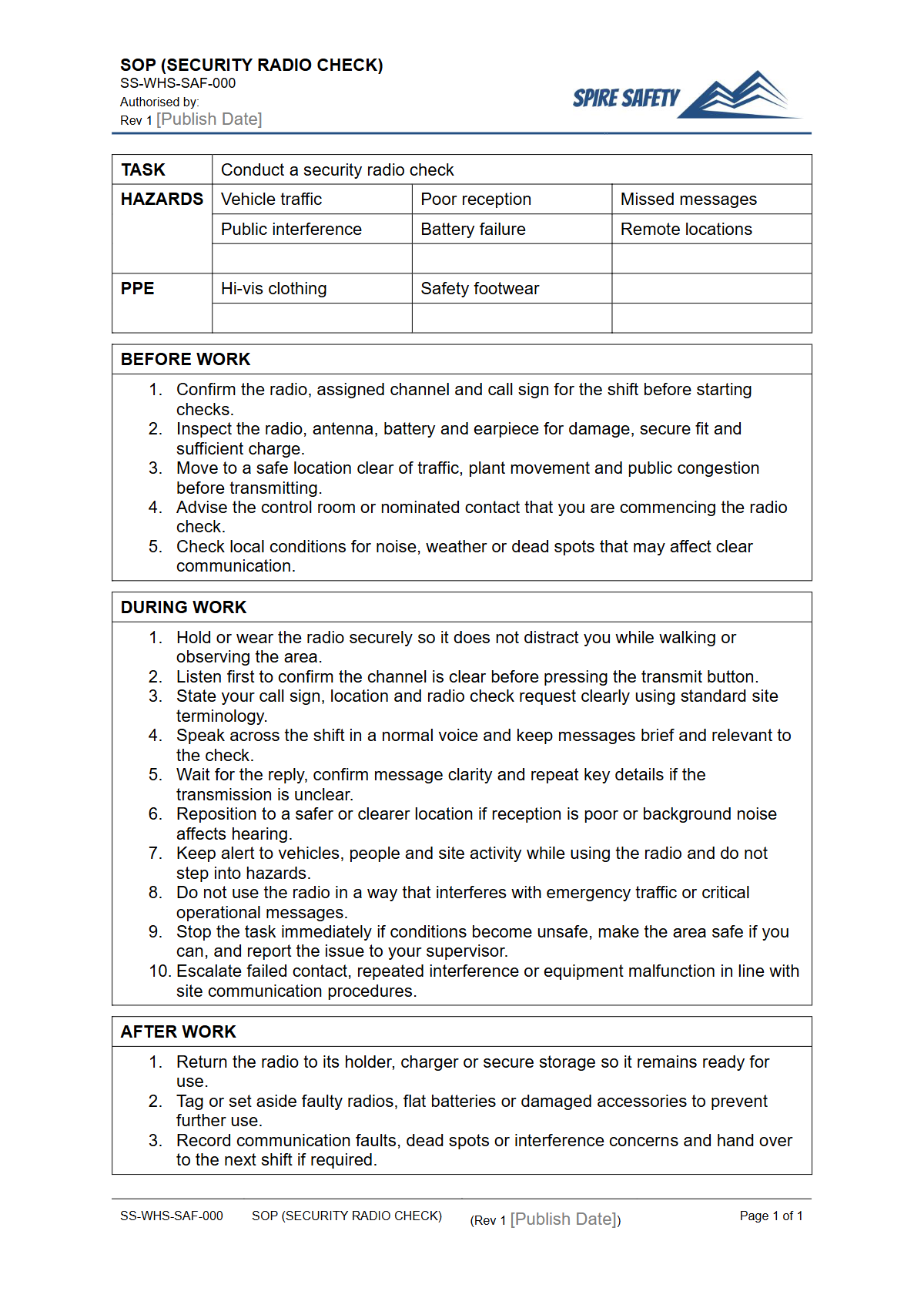
The procedure outlines the essential steps for conducting a radio check, from pre-start equipment inspection to using correct communication language and confirming receipt of the message. It is designed as a foundational document that guides users through a logical and safe sequence of actions.
Important: This is a template only. You must customise this Safe Operating Procedure to align with the unique aspects of your organisation.
This includes specifying your company's designated radio channels, call signs, emergency codes, site-specific dead zones, and battery management protocols. We cannot guarantee this document's suitability for your specific needs without thorough customisation to reflect your equipment and operational context. In a busy warehouse, for example, clear radio communication is just as vital as the correct operation of equipment detailed in a conveyer system safe operating procedure.
What’s included in the template?
The SOP template is structured to cover all critical aspects of performing a security radio check. Key sections include:
- Associated Risks: Identifies potential hazards like communication failure, battery failure, or incorrect use.
- Pre-operational Checks: Details inspections for the physical condition of the radio, battery level, and antenna security.
- Operational Steps: Provides a step-by-step guide to initiating and responding to a radio check using clear, professional language.
- Post-operational Checks: Outlines procedures for cleaning, charging, and securely storing the equipment.
- Emergency Procedures: Specifies actions to take in case of radio failure or an emergency broadcast.
Properly adapting these sections is essential for creating a truly effective document for your workplace. If you require expert assistance in tailoring this SOP or developing other safety documents, our WHS consulting services can provide tailored support.
When to use it
A formal radio check procedure should be conducted at several key intervals to maintain communication integrity. These include:
- At the start of every shift: To ensure all personnel are online and their equipment is working correctly before commencing duties.
- Before undertaking critical or high-risk tasks: To confirm a reliable line of communication is available for lone workers or teams in remote areas.
- After changing a battery or radio unit: To verify the new equipment is functioning as expected.
- Periodically during long shifts: As a welfare check and to re-confirm signal strength.
- When entering a known or suspected signal 'dead spot': To test the limits of communication and inform the control room.
Similar to how an air compressor SOP details pre-start checks for equipment, this procedure outlines essential pre-shift communication checks to prevent failure during use.
Who should use it
This Safe Operating Procedure is intended for any worker or supervisor who relies on two-way radio communication as part of their job. This commonly includes:
- Security Officers and Guards
- Event Staff and Crowd Controllers
- Control Room Operators and Dispatchers
- Construction Site Supervisors and Foremen
- Maintenance and Facilities Management Teams
- Lone or Isolated Workers
Effective implementation requires that all relevant personnel are trained on the procedure. This ensures everyone understands their role in maintaining the communication network, from the person initiating the check to the one receiving it.
Regular reviews and updates, sometimes guided by a WHS compliance audit, ensure the procedure remains effective and relevant to your evolving operational needs. While this SOP focuses on communication, procedures for operating heavy machinery require their own detailed documents, such as our free Telehandler SOP template. You can find more templates like this in our complete free WHS resources library.
Common mistakes
Common mistakes to avoid
- Using informal language or slang instead of standard radio-telephony procedure.
- Failing to wait for confirmation that a message was received and understood.
- Skipping pre-shift checks and assuming the radio is working correctly from the previous shift.
- Not having a clear, documented process for reporting equipment faults or low batteries.
Legal references
Legal considerations
The following legal requirements may be relevant to this type of work.
- Work Health and Safety Act (Harmonised) — Provides the primary duties for protecting workers and other people from work health and safety risks.
- Work Health and Safety Regulations (Harmonised) — Sets out requirements supporting the management of workplace hazards and risks.
The following codes may be relevant to this type of work.
- Managing WHS Risks Code of Practice — Provides practical guidance on identifying hazards, assessing risks and applying effective controls.
- Work Health and Safety Consultation, Cooperation and Coordination Code of Practice — Provides practical guidance on consulting workers and coordinating with other duty holders.
- Managing the Work Environment and Facilities Code of Practice — Provides practical guidance on safe work environments, workplace facilities and related controls.
Did you know
Phonetic Alphabet Origins
The NATO phonetic alphabet (Alpha, Bravo, Charlie) was developed in the 1950s to ensure clarity in radio communications between speakers of different languages and accents.
Radio Dead Spots
Radio "dead spots" are common in large buildings with concrete and steel structures, making regular signal testing and mapping a critical safety task for site-based security teams.
FAQ
Frequently asked questions
01Why is a formal radio check procedure necessary for security teams?
02What should be included in a standard radio check message?
03How often should security radios be tested?
04What is the difference between a radio check and a radio service?
Share this resource
Free Safe Operating Procedure (Security Radio Check) Template
Browse Categories
How To Use It
- 1Download and open in Word or PDF.
- 2Replace the placeholders with your business details.
- 3Get it reviewed by a WHS specialist before rollout.
Need it customised?
Our WHS consultants can adapt this template to your site, run a gap analysis, or audit what you already have in place.
Book a Free Consultation WHS consulting servicesor call 1300 156 382
Related templates
- Free Safe Operating Procedure (Security Shift Handover) Template
- Free Safe Operating Procedure (Security Tag Removal) Template
- Free Safe Operating Procedure (Seed Cleaning) Template
- Free Safe Operating Procedure (Seed Hand Treatment) Template
- Free Safe Operating Procedure (Seedling Handling) Template
- Free Safe Operating Procedure (Seedling Transplanting) Template