
Free Safe Operating Procedure (Security Tag Removal) Template
Formalise your retail safety processes with our customisable template. Download your free Safe Operating Procedure for security tag removal to get started.
Free Safe Operating Procedure (Security Tag Removal) Template
DOCX • 126 KB + PDF
Updated Oct 2026
No signup required
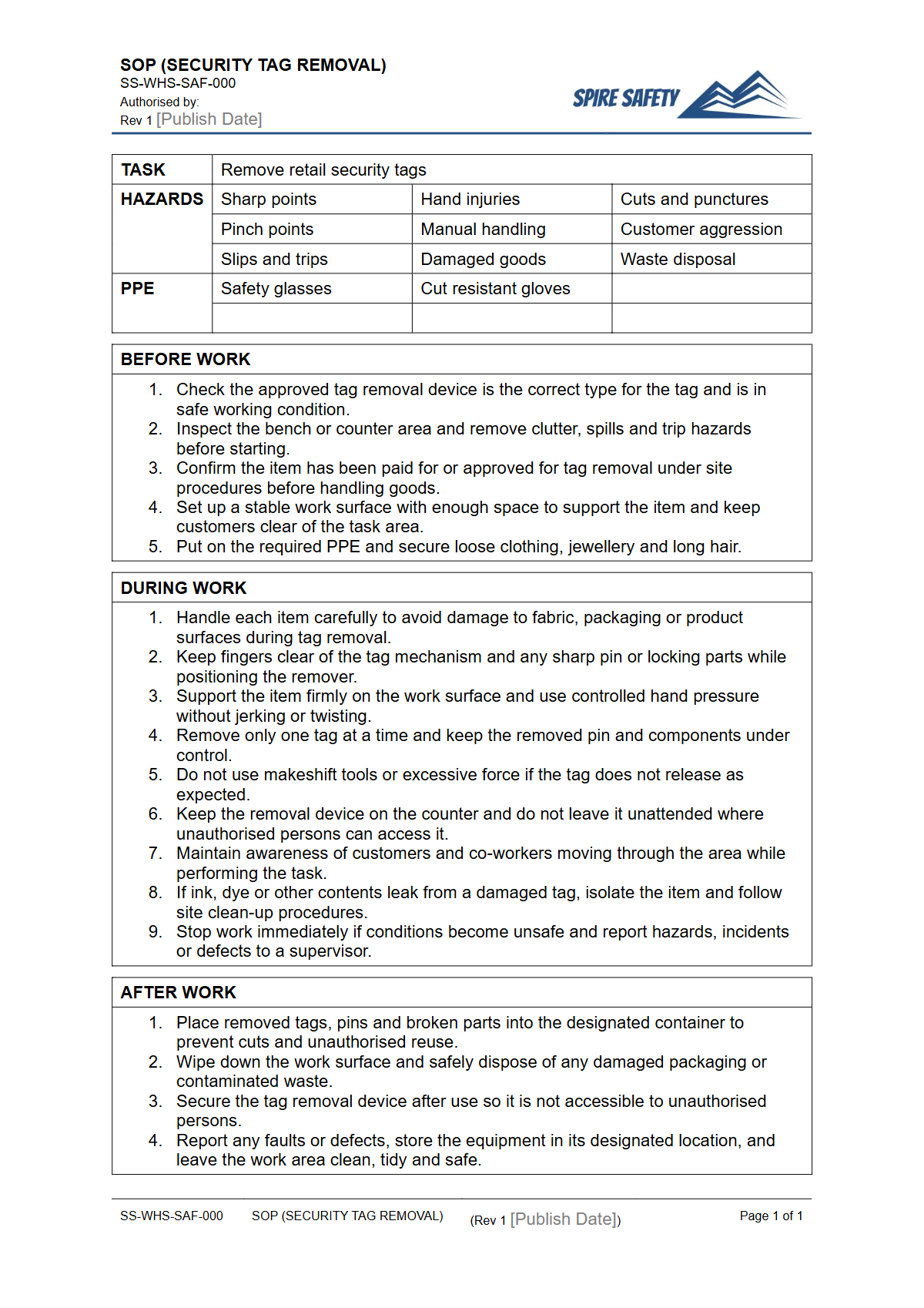
Purpose of the Free Safe Operating Procedure (Security Tag Removal) Template
This Free Safe Operating Procedure (Security Tag Removal) Template provides a structured framework for documenting a safe system of work for removing security tags in retail and warehouse environments. While seemingly a simple task, the repetitive nature of tag removal poses significant ergonomic risks.
This SOP helps your organisation meet its duty of care by formally addressing these hazards, reducing the likelihood of musculoskeletal injuries and ensuring consistent, safe practices across all staff members.
Implementing documented procedures is a cornerstone of effective WHS management systems. This template assists in controlling common risks associated with tag removal, including:
- Repetitive Strain Injury (RSI) from frequent, rapid hand and wrist movements.
- Awkward postures, such as twisting or reaching at checkout counters.
- Puncture wounds or lacerations from broken tags or malfunctioning detachers.
- Forceful exertion when dealing with stubborn or faulty tags.
By defining the correct method, required equipment, and risk controls, this Safe Operating Procedure helps standardise behaviour and create a safer environment for every worker.
Video walkthrough
How to use the Free Safe Operating Procedure (Security Tag Removal) Template
To effectively use the Free Safe Operating Procedure (Security Tag Removal) Template, you must adapt it to the unique context of your workplace. The downloaded document serves as a comprehensive starting point aligned with Australian WHS principles.
Begin by downloading the DOCX file and adding your company name, logo, and other relevant details. Then, conduct a specific risk assessment for the task as it is performed in your store or facility.
Consult directly with workers who perform the task daily. Their feedback is invaluable for identifying practical challenges and effective controls.
Update the SOP to reflect the specific types of security tags and detachers you use, noting any manufacturer-specific instructions or warnings. If you need assistance tailoring this document or conducting a risk assessment, our WHS consulting services can provide expert guidance.
Customisation is Essential
Please note: this template is a starting point. We strongly advise that you customise it to reflect the specific equipment, processes, and risks present in your workplace.
A generic SOP that doesn't match your operational reality will not be effective in controlling hazards.
Documenting procedures should be a comprehensive effort across your operations. For example, a large department store with a food court would not only need this SOP but might also require a free Safe Operating Procedure for deep fryers to manage entirely different kitchen-based risks.
When to use it
A Safe Operating Procedure is a dynamic tool that should be integrated into your daily operations. It is most effective when used during staff induction and for ongoing training, ensuring every team member understands the established safe work method from their first day.
It's particularly useful when training casual or seasonal staff who may have limited experience. In a larger retail or logistics setting, this procedure would be used alongside other key documents, like a FREE Conveyer System SOP, as part of a complete induction package.
The SOP should also be used as a reference guide, kept easily accessible at the point of sale or in a staff room. It is a critical document during incident investigations, helping to determine if procedures were followed.
Importantly, SOPs are not 'set and forget' documents. They must be reviewed regularly—at least annually, or whenever there's a change in process, equipment (e.g., a new type of tag is introduced), or after an incident or near miss.
This review process can be formalised as part of your routine WHS compliance auditing activities.
Who should use it
This Safe Operating Procedure is primarily intended for frontline workers who perform the task of removing security tags, as well as their direct supervisors and retail managers. It provides clear, step-by-step instructions to guide their actions and reinforce safe work habits.
Store managers and team leaders should use the document to train staff, monitor performance, and enforce safety standards at the point of sale.
Beyond the shop floor, this template is a valuable resource for Work Health and Safety (WHS) managers, HR personnel, and business owners. It provides the necessary structure to formalise risk management processes and demonstrate compliance with safety obligations.
Developing and implementing SOPs is a key activity for anyone responsible for the safety of a workplace. This SOP is one of many documents available in our comprehensive free WHS resources library, designed to help you build a safer workplace.
Common mistakes
Common mistakes to avoid
- Using the downloaded template without customising it for your specific tags, detachers, and store layout.
- Failing to consult with and train frontline workers on the finalised procedure.
- Not providing the correct type of detacher for the tag, leading to forceful exertion and breakages.
- Forgetting to review and update the SOP after a near miss or when new equipment is introduced.
Legal references
Legal considerations
The following legal requirements may be relevant to this type of work.
- Work Health and Safety Act (Harmonised) — Provides the primary duties for protecting workers and other people from work health and safety risks.
- Work Health and Safety Regulations (Harmonised) — Sets out requirements supporting the management of workplace hazards and risks.
The following codes may be relevant to this type of work.
- Managing WHS Risks Code of Practice — Provides practical guidance on identifying hazards, assessing risks and applying effective controls.
- Work Health and Safety Consultation, Cooperation and Coordination Code of Practice — Provides practical guidance on consulting workers and coordinating with other duty holders.
- Managing the Work Environment and Facilities Code of Practice — Provides practical guidance on safe work environments, workplace facilities and related controls.
Did you know
Retail Injury Stats
According to Safe Work Australia, the retail trade industry has one of the highest rates of serious claims for musculoskeletal disorders, often stemming from the repetitive manual tasks common in the sector.
FAQ
Frequently asked questions
01What are the main health and safety hazards of removing security tags?
02How often should a Safe Operating Procedure for security tag removal be reviewed?
03Is this SOP template suitable for all types of security tags and detachers?
04Can this document be used for staff training and induction?
Share this resource
Free Safe Operating Procedure (Security Tag Removal) Template
Browse Categories
How To Use It
- 1Download and open in Word or PDF.
- 2Replace the placeholders with your business details.
- 3Get it reviewed by a WHS specialist before rollout.
Need it customised?
Our WHS consultants can adapt this template to your site, run a gap analysis, or audit what you already have in place.
Book a Free Consultation WHS consulting servicesor call 1300 156 382
Related templates
- Free Safe Operating Procedure (Seed Cleaning) Template
- Free Safe Operating Procedure (Seed Hand Treatment) Template
- Free Safe Operating Procedure (Seedling Handling) Template
- Free Safe Operating Procedure (Seedling Transplanting) Template
- Free Safe Operating Procedure (Self Retracting Lifeline) Template
- Free Safe Operating Procedure (Septic Tank Inspection) Template