
Free Safe Operating Procedure (Seedling Transplanting) Template
Our Safe Operating Procedure for seedling transplanting provides a structured framework for controlling hazards. Download this free template to get started.
Free Safe Operating Procedure (Seedling Transplanting) Template
DOCX • 126 KB + PDF
Updated Oct 2026
No signup required
Purpose of the Free Safe Operating Procedure (Seedling Transplanting) Template
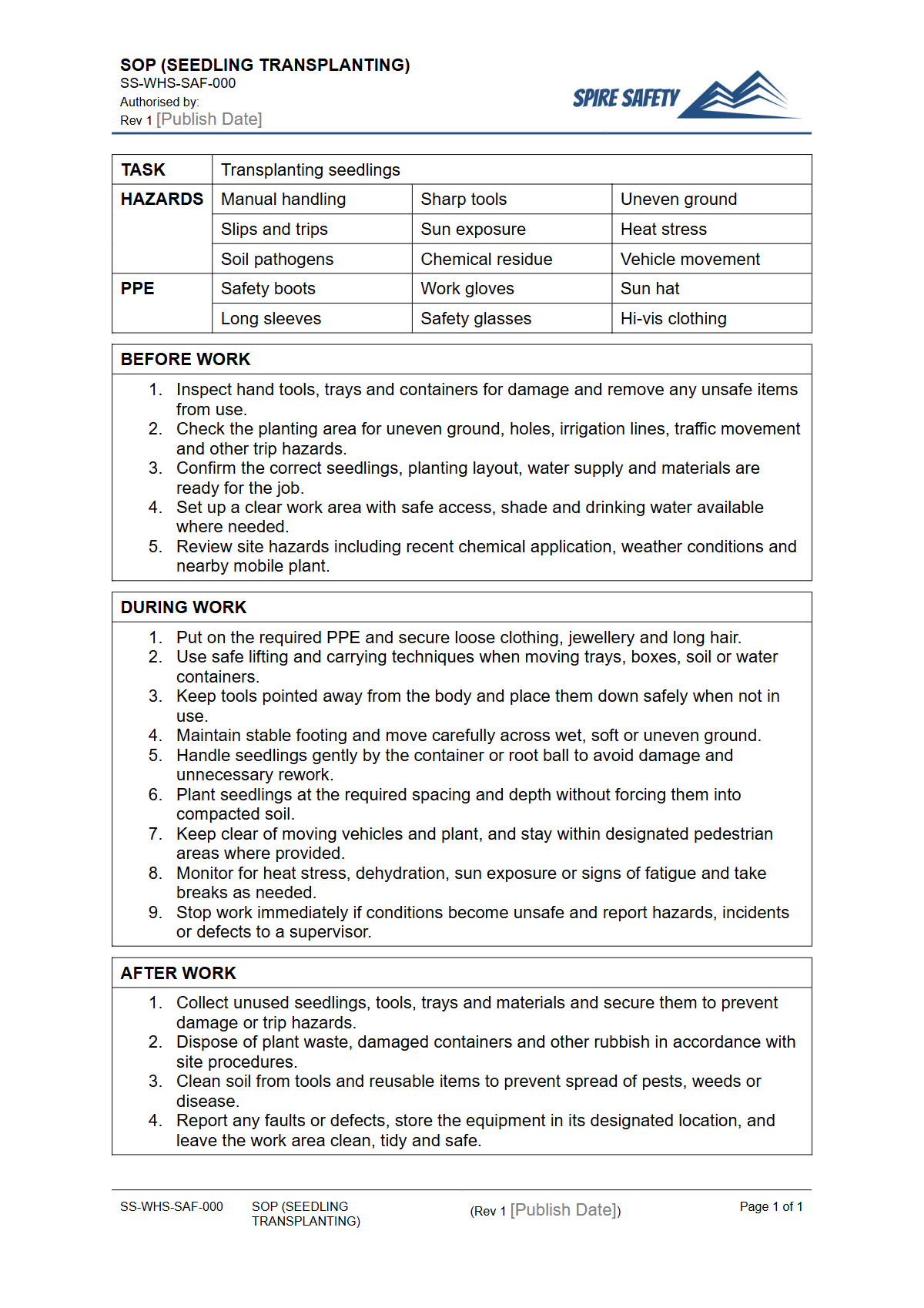
This Free Safe Operating Procedure (Seedling Transplanting) Template provides a structured, step-by-step guide to help you identify and manage the risks associated with transplanting seedlings in horticultural and agricultural settings. The primary goal is to ensure tasks are performed safely and consistently, minimising the risk of injury to workers.
A well-developed Safe Operating Procedure (SOP) is a critical tool for training, demonstrating compliance, and fostering a positive safety culture. It formalises your commitment to worker safety for tasks that involve repetitive movements, manual handling, and potential exposure to biological or chemical agents.
Using a standardised procedure helps your organisation meet its duties under Australian WHS laws by providing a practical method for risk control. A documented SOP is a core component of broader WHS management systems, serving as evidence that you have considered the hazards and implemented controls.
It outlines the safest known method for performing the job, covering preparation, operation, and clean-up to ensure all aspects of the task are addressed.
Video walkthrough
How to use the Free Safe Operating Procedure (Seedling Transplanting) Template
This document is designed as a starting point. To make it effective, you must adapt it to your specific operational context.
Download the DOCX file and systematically work through each section, consulting with the workers who actually perform the transplanting tasks. Their input is invaluable for identifying practical hazards and effective controls.
Please note: This is a template, not a finished document. You must customise it to reflect the specific equipment, environment, and processes used in your workplace. We cannot be responsible for your WHS outcomes.
Your customisation should include adding details about the specific types of seedlings, tools used (e.g., trowels, dibbers), soil mixes, fertilisers, and any machinery involved. The process for managing a manual planting task is fundamentally similar to operating machinery, requiring clear, sequential steps for safety, as demonstrated in our free Planter SOP template. Once customised, the SOP should be approved by management, used to train all relevant personnel, and made readily available at the worksite.
Key Customisation Steps:
- Risk Assessment: Conduct a thorough risk assessment for the task at your site. Identify hazards like ergonomic strain from bending and stooping, manual handling of trays, dust inhalation, and exposure to potting mix additives.
- Control Measures: Document specific controls for each identified hazard. This may include job rotation, mandatory use of personal protective equipment (PPE) like gloves and masks, and specifying safe lifting techniques.
- Emergency Procedures: Detail the site-specific emergency response for incidents like sprains, cuts, or adverse reactions to materials. Include locations of first aid kits and contact numbers for first aid officers.
When to use this Safe Operating Procedure
A Safe Operating Procedure for seedling transplanting should be an active document used consistently throughout your operations. It is not a 'file and forget' tool.
It should be used during the induction and training of new employees to ensure they learn the correct, safe method from day one. It also serves as an excellent resource for regular refresher training sessions with experienced staff to prevent complacency and bad habits from developing.
Furthermore, this SOP should be reviewed before the commencement of large-scale transplanting projects and used as a reference during daily pre-start meetings. If an incident or near-miss occurs during the task, the SOP must be referenced during the investigation and updated to prevent a recurrence. This continuous improvement loop is vital for maintaining a safe workplace and is applicable to related tasks, such as those covered in our FREE Spreader SOP Template.
Who should use this Safe Operating Procedure
The responsibility for using and maintaining this SOP is shared across multiple levels of an organisation. This ensures that safety is integrated into the workflow rather than being a separate, disconnected function.
- Managers and Supervisors: They are responsible for overseeing the customisation, implementation, and review of the SOP. They must ensure workers are trained in the procedure and have the resources (like correct PPE) to follow it.
- Workers: Employees and contractors who perform the seedling transplanting tasks are the primary users. They must follow the procedure as trained and are encouraged to provide feedback for its improvement.
- WHS Officers and Representatives: These individuals will use the SOP as part of safety audits, inspections, and risk management activities to verify that safe work practices are being followed. They can also assist in its development and review, ensuring it aligns with other safety documents like the FREE Grain Drill SOP Template.
For organisations needing assistance in developing a comprehensive suite of safety documentation and integrating it effectively into daily operations, expert advice can be invaluable. Professional WHS consulting can help bridge the gap between having templates and having a truly effective safety management system.
If you need help, feel free to browse our entire free WHS resources library for more templates and guides.
Common mistakes
Common mistakes to avoid
- Failing to customise the template with site-specific details, tools, and chemicals.
- Overlooking ergonomic hazards like awkward postures and repetitive strain.
- Forgetting to include emergency procedures for cuts, sprains, or chemical exposure.
- Not consulting with workers who perform the task when drafting or reviewing the SOP.
Legal references
Legal considerations
The following legal requirements may be relevant to this type of work.
- Work Health and Safety Act (Harmonised) — Provides the primary duties for protecting workers and other people from work health and safety risks.
- Work Health and Safety Regulations (Harmonised) — Sets out requirements supporting the management of workplace hazards and risks.
The following codes may be relevant to this type of work.
- Managing WHS Risks Code of Practice — Provides practical guidance on identifying hazards, assessing risks and applying effective controls.
- Work Health and Safety Consultation, Cooperation and Coordination Code of Practice — Provides practical guidance on consulting workers and coordinating with other duty holders.
- Managing the Work Environment and Facilities Code of Practice — Provides practical guidance on safe work environments, workplace facilities and related controls.
Did you know
Ergonomic Risk
Musculoskeletal disorders resulting from hazardous manual tasks are the most common type of workplace injury in Australian agriculture and horticulture, often stemming from repetitive actions like transplanting.
Potting Mix Dangers
Commercial potting mixes can contain Legionella longbeachae bacteria, which can cause a serious lung infection if dust is inhaled. Wetting down the mix before use is a key control measure.
FAQ
Frequently asked questions
01What are the main hazards to include in a seedling transplanting SOP?
02Why is an SOP needed for a 'simple' task like transplanting seedlings?
03Can I use this template for automated or mechanical transplanting?
04How often should our seedling transplanting SOP be reviewed?
Share this resource
Free Safe Operating Procedure (Seedling Transplanting) Template
Browse Categories
How To Use It
- 1Download and open in Word or PDF.
- 2Replace the placeholders with your business details.
- 3Get it reviewed by a WHS specialist before rollout.
Need it customised?
Our WHS consultants can adapt this template to your site, run a gap analysis, or audit what you already have in place.
Book a Free Consultation WHS consulting servicesor call 1300 156 382
Related templates
- Free Safe Operating Procedure (Self Retracting Lifeline) Template
- Free Safe Operating Procedure (Septic Tank Inspection) Template
- Free Safe Operating Procedure (Service Bay Cleaning) Template
- Free Safe Operating Procedure (Service Corridor Clean) Template
- Free Safe Operating Procedure (Service Door Cleaning) Template
- Free Safe Operating Procedure (Service Lift Cleaning) Template